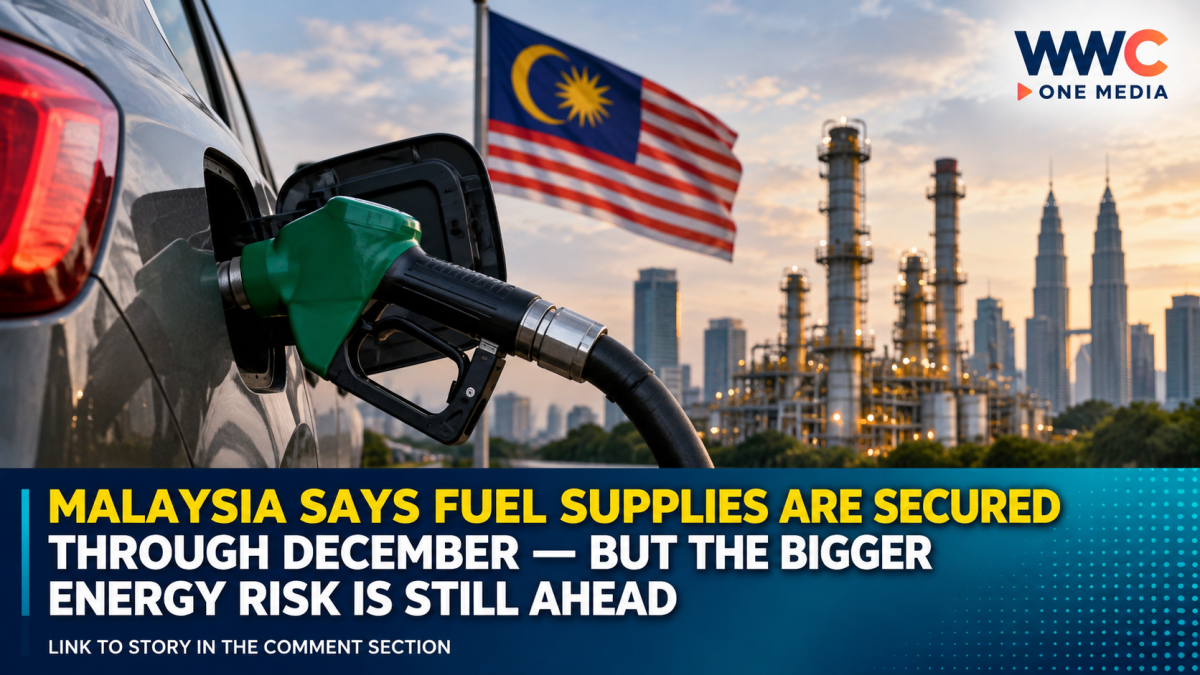
KUALA LUMPUR, Sept. 18, 2026 — Malaysia says it is taking additional steps to ensure the country has enough fuel through the end of the year, as geopolitical tensions and disruptions to global energy routes continue to put pressure on petroleum markets.
Economy Minister Akmal Nasrullah Mohd Nasir said the government is strengthening its fuel-security strategy by diversifying import sources, maximising domestic production and securing longer-term supply arrangements.
The announcement comes as global energy markets remain unsettled by the continuing conflict in the Middle East and uncertainty surrounding major oil-trading routes.
According to Reuters, the ministry said Malaysia intends to obtain crude oil and petroleum products from a wider range of regions, including the Americas, while also exploring alternative sources in Africa. The strategy is designed to reduce the country’s dependence on any single supplier or shipping route.
“This measure aims to reduce dependence on any single country or supply route,” Akmal said during a briefing on the global energy crisis.
Malaysia broadens its fuel-sourcing strategy
The latest announcement builds on measures introduced earlier this year as the global energy crisis began putting pressure on supply chains.
Malaysia had previously said it was looking beyond the Middle East for crude and petroleum products. In July, the government said supplies had been secured for the second half of 2026 and that sourcing had been expanded to regions including South America, West Africa and Central Asia.
The government has also been working to increase the contribution of domestic resources. Measures include higher biodiesel blending, which can help extend available diesel supplies without requiring the same level of additional imports.
Malaysia is also a significant LNG exporter, even though it remains a major importer of crude oil, illustrating the different positions the country occupies across the energy supply chain.
Fuel availability is stable — but prices remain the pressure point
The government’s assurance on supply does not mean Malaysian motorists are insulated from international price movements.
On Sept. 17, the latest weekly fuel-price adjustment took effect. Unsubsidised RON97 increased to RM4.85 per litre, while unsubsidised RON95 rose to RM4.37 and unsubsidised diesel to RM5.27 for the Sept. 17–23 period.
However, eligible consumers under Malaysia’s targeted subsidy programmes continue to pay RM1.99 per litre for RON95 and RM2.10 per litre for diesel, according to the Finance Ministry’s latest figures.
The price increases reflect the continuing impact of international crude and refined-product markets rather than an indication that Malaysia is running out of fuel.
That distinction is important: supply security and pump prices are separate issues.
Why the Strait of Hormuz matters
One of the biggest concerns for Asian energy markets remains the security of shipping routes connecting Middle Eastern producers with international buyers.
Earlier Malaysian government assessments identified disruptions around the Strait of Hormuz as a major risk because the waterway is a critical route for global oil and energy shipments.
The Finance Ministry said in its latest weekly pricing update that heightened tensions in West Asia had pushed Brent crude back above US$100 a barrel during the relevant price-calculation period, with prices approaching US$110 at one point.
Malaysia’s response has therefore focused not only on having enough physical fuel, but also on reducing exposure to individual supply routes.
Government had already been preparing for a prolonged crisis
The latest assurance is not a sudden change in policy.
In July, Economy Minister Akmal said Malaysia had already secured sufficient fuel supplies through the end of 2026 and had begun looking at securing supplies for 2027.
Earlier in September, Prime Minister Anwar Ibrahim’s economic adviser Nurhisham Hussein likewise said Malaysia’s fuel supply remained stable and that sufficient supplies were expected through the end of the year.
But Nurhisham warned that the major risk could increasingly be price volatility, rather than immediate shortages.
The Star also reported on Sept. 7 that the government remained confident about securing sufficient fuel supplies through year-end, while warning that geopolitical tensions and disruptions to key shipping routes could continue putting upward pressure on prices.
Energy crisis reaches beyond petrol stations
The effects of the global energy shock are also extending into Malaysia’s electricity sector.
Bernama reported on Sept. 18 that coal prices had reached US$148 per tonne on Sept. 10, while average Brent crude prices in August rose 8.9% from July to US$90.88 per barrel.
Economy Minister Akmal said higher coal prices directly affect electricity-generation costs.
The Star similarly reported that the impact of the Middle East conflict was increasingly being felt beyond petrol, with higher natural-gas and coal prices adding pressure to electricity-generation costs.
This means the fuel-supply question is part of a much broader energy challenge involving transportation, electricity generation, logistics and household costs.
What happens next?
For Malaysian consumers, the government’s latest message is essentially twofold: physical fuel supplies are being secured through December, but the international energy environment remains volatile.
The strategy involves diversifying imports, increasing domestic production options and strengthening longer-term supply contracts.
Malaysia is therefore attempting to reduce the possibility that a disruption along one major route or from one group of suppliers could translate into a domestic shortage.
The more immediate uncertainty may instead be how long elevated international energy prices persist — and how much of that pressure eventually filters through to transport, electricity, logistics and other consumer costs.
For now, officials are signalling that Malaysia has enough fuel to get through the end of 2026.
But with global energy routes still exposed to geopolitical disruption, the bigger question may be what happens after December.