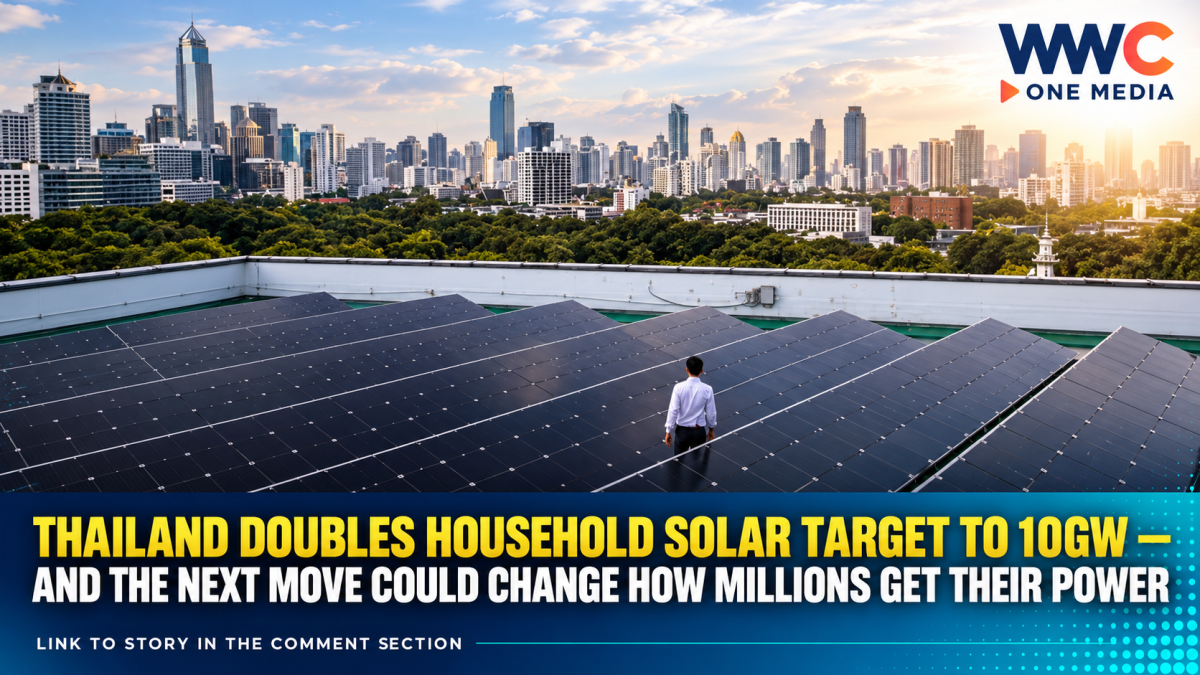
BANGKOK — Thailand is dramatically expanding its household-focused solar ambitions, doubling the planned capacity of its public solar power scheme from 5 gigawatts (GW) to 10 GW as the government accelerates its push toward cleaner and more domestically generated electricity.
Government spokesperson Lalida Periswiwatana said on Friday, Sept. 18, that the expanded program is expected to cover 1 million households. The move comes as Thailand seeks to increase renewable-energy use while reducing its exposure to volatile fossil-fuel and liquefied natural gas prices.
The expansion was approved by Finance Minister Ekniti Nitithanprapas, according to the government, with the scheme designed to encourage households to generate electricity themselves and contribute surplus power to the national grid.
From 5GW to 10GW: What Changed?
Thailand had previously announced plans to help about 1 million households install 5GW of rooftop solar capacity. Energy Minister Akanat Promphan said earlier this month that the initial program was expected to begin around mid-October.
The latest announcement doubles the planned capacity to 10GW and broadens the types of solar installations that can qualify.
In addition to rooftop systems, the expanded framework will allow ground-mounted and floating solar installations, according to the government spokesperson.
For participating households, the basic concept is straightforward: use the electricity generated by their solar systems first, then sell eligible surplus electricity to the grid.
The reported purchase rate is 2.20 baht per kilowatt-hour, with electricity offered for sale capped at 5 kilowatts per household electricity meter under the scheme.
A Solar Push Already Underway
Thailand’s household solar program is not starting from scratch.
The Provincial Electricity Authority (PEA) currently operates a 2026 residential solar-rooftop program covering applications for systems connected to its network. Under the current arrangement, eligible households can sell surplus electricity at 2.20 baht per kWh for 10 years, with the amount offered for sale capped at 5 kW per meter.
The Metropolitan Electricity Authority (MEA), which serves Bangkok, Nonthaburi and Samut Prakan, has likewise published information on the 2026 residential solar program, including the 2.20-baht-per-kWh purchase rate and 10-year purchase period.
Thailand’s government PRD also reported this week that online applications for the household solar program had opened through the MEA and PEA systems, allowing participating homeowners to generate electricity for their own use and sell eligible surplus electricity to the grid.
Why Thailand Is Accelerating Solar
The solar expansion comes against a backdrop of concern over Thailand’s dependence on imported energy.
A Reuters report earlier this month said renewables, including solar, accounted for about 10% of Thailand’s power generation, while natural gas accounted for more than 60% based on government data covering the first six months of 2026. Reuters also reported that more than a quarter of the gas used for power generation is imported.
That exposure makes energy costs vulnerable to international fuel-price movements.
The government has therefore been looking at rooftop solar not only as a climate measure, but also as a way to diversify electricity supply and reduce household exposure to energy-price shocks.
Finance Minister Ekniti previously announced a 50-billion-baht ($1.5 billion) support program for consumers installing rooftop solar, with the initiative expected to begin in mid-October. The government also said it would exempt taxes on certain imported solar-panel components.
The Bigger Picture: Thailand’s 2026 Power Plan
The 10GW solar expansion also fits into Thailand’s broader draft Power Development Plan (PDP) 2026, which maps out the country’s electricity strategy through 2050.
Thailand’s Energy Ministry has proposed increasing the share of clean energy in the country’s electricity system to 50% within the first 10 years of the plan. The longer-term strategy includes solar, wind, energy storage and other technologies, alongside measures aimed at reducing reliance on imported gas.
The draft plan also proposes making households more active participants in the electricity market through expanded rooftop solar and a target of up to 10,000MW of electricity purchases from residential rooftops.
The Nation reported that the broader PDP 2026 blueprint envisages about 50.9GW of additional power capacity during its first phase from 2026 to 2037, including substantial additions of solar generation and battery storage.
Industry publication PV Magazine similarly reported that Thailand’s draft power plan is creating conditions for 10GW of additional rooftop solar, alongside its goal of reaching a 50% clean-energy share within the first decade.
What the 10GW Target Could Mean for Households
If implemented as announced, the expanded program could significantly increase the role of households in Thailand’s electricity system.
Instead of simply buying electricity from the grid, participating households could generate part of their own supply, use that electricity directly and sell eligible excess generation back to the grid.
But the headline 10GW figure should not be confused with 10GW of immediately installed residential rooftop systems.
The government has expanded the overall target, while specific implementation schedules, eligibility requirements and the allocation between different types of solar installations still matter. Existing PEA and MEA programs also have their own technical, application and connection requirements.
For homeowners, the economics will depend on factors including installation costs, electricity consumption, system size, equipment requirements and how much electricity can actually be sold to the grid.
Thailand’s Energy Shift Is Getting Bigger
The latest announcement represents a significant escalation of Thailand’s solar ambitions.
What began as a 5GW household rooftop initiative has now been expanded to 10GW, while the country’s broader PDP 2026 is simultaneously targeting a much larger role for renewable energy, battery storage and distributed electricity generation.
The immediate question is no longer simply whether Thailand will expand household solar.
The bigger question is how quickly the 10GW ambition can be translated into actual installations — and how much of Thailand’s future electricity supply could ultimately come from millions of homes generating their own power.