
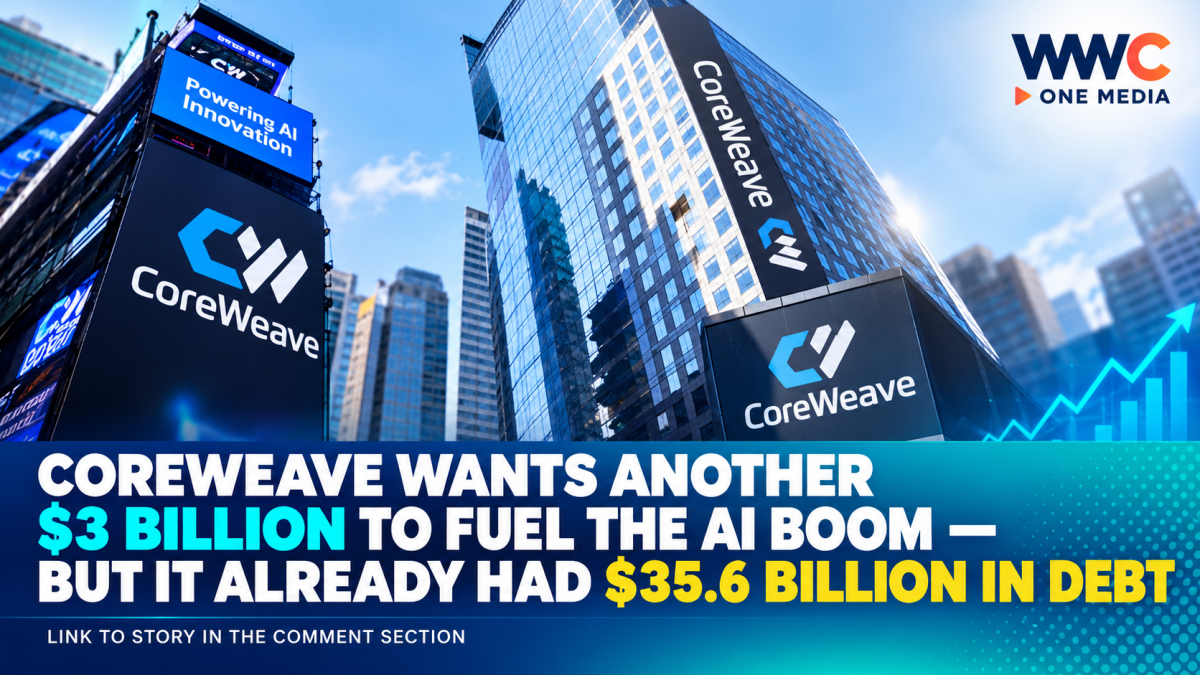
NEW YORK — CoreWeave is heading back to the capital markets for billions more as the Nvidia-backed AI cloud company races to build enough computing infrastructure to satisfy explosive demand — but investors are again confronting the enormous financing bill behind that expansion.
CoreWeave announced on Thursday, September 17, that it plans to sell $3 billion of convertible senior notes due in 2033, with buyers receiving an option for as much as another $500 million.
If that option is fully exercised, the financing could reach $3.5 billion.
The company said part of the proceeds will pay for so-called capped call transactions, which are designed to reduce potential dilution if the notes are eventually converted into CoreWeave shares.
The remaining proceeds are intended for general corporate purposes.
But Wall Street immediately focused on another number.
CoreWeave shares fell more than 3% in early trading after the announcement, according to Reuters, even though the stock remained more than 16% higher for 2026 at the time of the report.
And behind that reaction is a bigger question:
How much more capital will it take to keep building the infrastructure powering the AI boom?
THE $3 BILLION DEAL COULD BECOME $3.5 BILLION
CoreWeave’s new securities will mature on April 1, 2033, unless they are repurchased, redeemed or converted earlier.
Unlike conventional bonds, convertible notes give investors the possibility of eventually exchanging the debt for company shares under specified conditions.
CoreWeave’s investor presentation filed with the U.S. Securities and Exchange Commission showed an expected coupon range of 2.375% to 2.875% and an anticipated conversion premium of 22.5% to 27.5%.
Those were marketing expectations ahead of pricing, rather than finalized terms.
Morgan Stanley, Goldman Sachs, JPMorgan and Wells Fargo were listed as active bookrunners for the transaction.
BUT COREWEAVE ALREADY HAD $35.6 BILLION OF DEBT
The new offering becomes more striking when placed beside CoreWeave’s existing balance sheet.
As of June 30, 2026, the company reported approximately $35.55 billion in total debt.
Its scheduled principal payments included:
- $4.41 billion for the remainder of 2026
- $6.18 billion in 2027
- $4.42 billion in 2028
- $2.42 billion in 2029
- $3.22 billion in 2030
- $14.90 billion thereafter
CoreWeave also had approximately $5.52 billion in cash and cash equivalents at the end of June.
The company’s own quarterly filing warned that its substantial indebtedness requires significant interest and principal payments and could affect its financial flexibility and ability to raise additional capital.
That does not mean the company faces an immediate financing crisis.
But it shows just how capital-intensive CoreWeave’s strategy has become.
INTEREST EXPENSE ALONE HIT $640 MILLION IN ONE QUARTER
CoreWeave’s rapid expansion is generating enormous revenue — and enormous financing costs.
Second-quarter revenue more than doubled from a year earlier to approximately $2.58 billion, compared with $1.21 billion in the same quarter of 2025.
But CoreWeave still recorded a $626 million net loss for the quarter.
Its net interest expense reached approximately $640 million, compared with $267 million a year earlier.
That means financing costs have become a major part of the CoreWeave story even while its top line is expanding at extraordinary speed.
WHY DOES COREWEAVE NEED SO MUCH MONEY?
Because the AI cloud business requires enormous upfront investment.
CoreWeave specializes in high-performance computing infrastructure packed with GPUs used to train and run artificial intelligence models.
Those chips — particularly Nvidia’s advanced processors — are expensive.
Then come the data centers, servers, networking equipment, power infrastructure, cooling systems, leases and financing needed to operate them at massive scale.
And CoreWeave believes demand is still running ahead of supply.
After its second-quarter results, the company raised its expected 2026 capital expenditures to between $35 billion and $39 billion, from an earlier projection of $31 billion to $35 billion.
For perspective, the top of that revised spending range is larger than CoreWeave’s entire reported debt load at the end of June.
COREWEAVE’S BACKLOG HAS ALSO EXPLODED TO $104.2 BILLION
There is another side to the debt story.
CoreWeave isn’t borrowing billions without contracted demand behind much of its expansion.
The company reported a $104.2 billion revenue backlog at the end of the second quarter, up from $99.4 billion in the prior quarter.
Reuters reported that CoreWeave had secured another $25 billion in commitments during the quarter, reflecting intense demand for AI computing capacity.
Its customer roster includes some of the biggest names in artificial intelligence and technology.
CoreWeave has struck major agreements involving companies including Meta, Anthropic and OpenAI, while Nvidia’s hardware remains central to its infrastructure.
In April, Meta expanded its relationship with CoreWeave through a new agreement valued at as much as $21 billion, extending through December 2032. That was in addition to an earlier $14.2 billion agreement.
The implication is straightforward:
CoreWeave has huge contracted demand.
But fulfilling those contracts requires huge amounts of capital first.
THIS ISN’T COREWEAVE’S FIRST MULTIBILLION-DOLLAR CONVERTIBLE DEAL THIS YEAR
Thursday’s proposed sale is also not an isolated financing.
In April, CoreWeave priced an upsized $3.5 billion convertible note offering, with an additional $500 million purchase option.
CoreWeave’s June-quarter filing subsequently recorded $4 billion of 1.75% convertible senior notes due 2032.
It also raised billions through traditional senior notes and delayed-draw term loan facilities.
CoreWeave told investors after its second quarter that it had raised more than $10 billion through unsecured debt and convertible bonds as it strengthened its financing position.
Now, barely five months after the April convertible deal, it is pursuing another potential $3.5 billion.
THERE’S ALSO A 35-MILLION-SHARE PROGRAM
The convertible financing was not the only capital-markets move disclosed on September 17.
CoreWeave also entered into an equity distribution agreement that permits sales of up to 35 million Class A shares through a group of financial institutions.
The SEC filing lists Deutsche Bank, Goldman Sachs, JPMorgan, Jefferies, Morgan Stanley, MUFG, Citigroup and others among the managers involved.
That share program is separate from the convertible-note transaction.
Together, however, the announcements underline CoreWeave’s determination to maintain access to multiple sources of capital as its infrastructure spending accelerates.
They also explain why dilution and financing have become closely watched issues for shareholders.
CONVERTIBLE DEBT IS BECOMING AN AI-BOOM FAVORITE
CoreWeave is part of a wider trend.
Reuters reported earlier this year that U.S. convertible bond issuance has surged as AI-linked companies search for cheaper ways to finance enormous investment programs.
Convertible bonds can carry lower interest rates than ordinary corporate debt because investors receive the added possibility of converting their holdings into stock if the share price rises sufficiently.
That can make them attractive to fast-growing companies.
But there is a trade-off.
If conversion eventually occurs, existing shareholders can face dilution — although structures such as CoreWeave’s proposed capped calls are intended to reduce some of that effect.
WALL STREET IS STARTING TO ASK HARDER QUESTIONS ABOUT THE AI BUILDOUT
The financing arrives as investors increasingly debate whether today’s enormous AI infrastructure spending will ultimately produce returns large enough to justify it.
The Bank for International Settlements has recently warned about vulnerabilities associated with growing AI-related investment and debt, while Reuters Breakingviews has compared the aggressive expansion of newer AI cloud providers with aspects of the telecommunications infrastructure boom around the turn of the century.
That comparison does not mean the same outcome will occur.
AI demand is real, CoreWeave has substantial contracted backlog, and major technology companies are committing tens of billions of dollars to computing infrastructure.
But rapid technological change creates another risk: today’s extremely expensive GPUs and data-center infrastructure must generate sufficient returns before newer generations of hardware alter the economics.
COREWEAVE’S BET IS SIMPLE — BUT ENORMOUS
CoreWeave is essentially making one of the clearest bets in the AI economy:
That demand for advanced computing will remain so large that borrowing and investing tens of billions of dollars today will pay off through years of future cloud revenue.
So far, the demand numbers support that strategy.
Revenue is surging.
The backlog has topped $100 billion.
Major AI companies continue signing massive computing agreements.
But so are CoreWeave’s debt, interest costs and capital requirements.
The latest $3 billion convertible offering therefore isn’t merely another Wall Street financing transaction.
It is another multibillion-dollar wager that the AI computing shortage will last long enough — and remain profitable enough — to justify the debt required to solve it.



Leave a Reply