
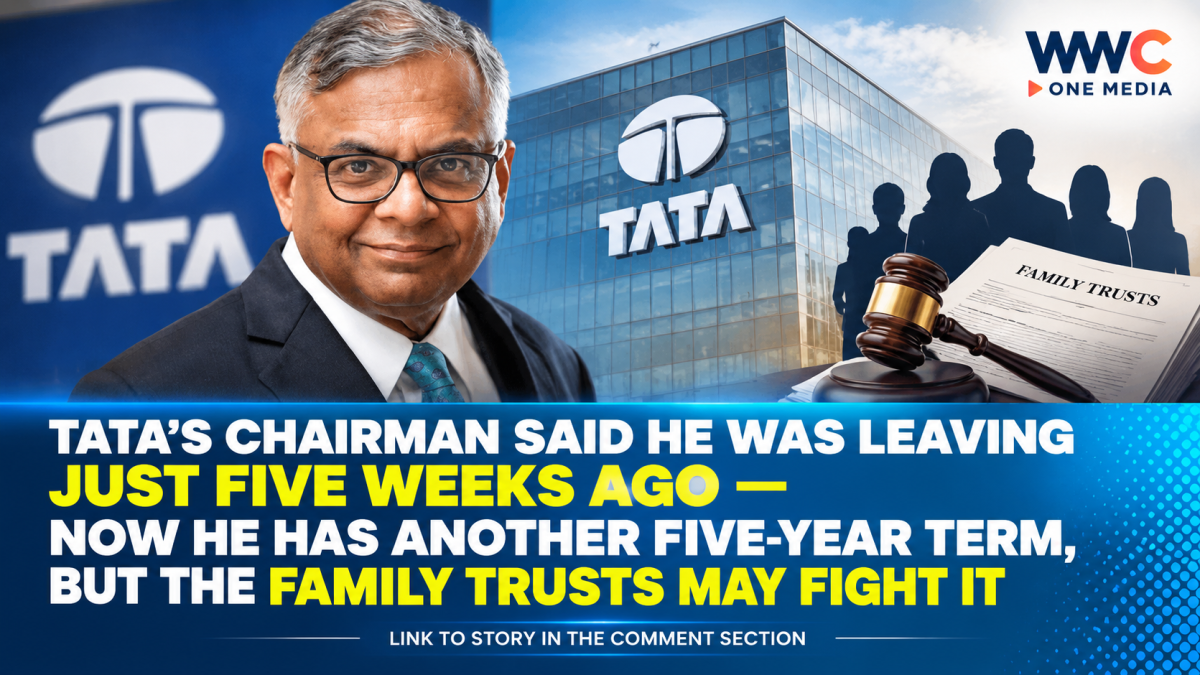
MUMBAI — September 17, 2026 — Just over a month after saying he would walk away from the top job at India’s sprawling Tata empire, N. Chandrasekaran has reversed course and agreed to stay for another five-year term — a dramatic leadership U-turn arriving just as Tata Sons faces one of the biggest governance and regulatory battles in its history.
The Tata Sons board approved a fresh five-year term for the 63-year-old executive chairman on Thursday, reversing Chandrasekaran’s August decision not to seek reappointment when his current term expires in February 2027.
But the decision does not necessarily end the leadership uncertainty.
Reuters reported that Noel Tata, chairman of Tata Trusts, opposed Chandrasekaran’s reappointment and is likely to challenge it. Tata Trusts and related charitable entities control about 66% of Tata Sons, giving them enormous influence over the privately held parent of companies ranging from Tata Consultancy Services and Tata Motors to Tata Steel and Air India.
That means Thursday’s surprise decision may have kept one chairman in his seat — while opening another chapter in an increasingly public disagreement over who controls Tata Sons and whether the holding company must finally go public.
Chandrasekaran Said He Was Leaving Only Last Month
The reversal is striking because Chandrasekaran’s earlier position appeared clear.
In August, he told the board he would not seek another term after February 20, 2027, following months of uncertainty over whether directors would unanimously support his continuation. The Economic Times reported that one director had withheld support, prompting Chandrasekaran to say the prolonged lack of clarity made it necessary to settle the succession question.
Tata Trusts subsequently began preparing for a successor-selection process.
Then the regulatory landscape changed.
Last week, the Reserve Bank of India rejected Tata Sons’ effort to surrender its registration as a core investment company, strengthening the prospect that the holding company may ultimately have to comply with rules requiring large “upper-layer” non-bank financial companies to list their shares.
Days later, Tata’s board asked Chandrasekaran to stay.
The Economic Times reported that the board’s nomination and remuneration committee believed his institutional knowledge and leadership continuity had become especially important as Tata Sons faces the possibility of an unprecedented stock-market listing.
The Biggest Issue Is No Longer Just Who Runs Tata — It Is Whether Tata Sons Must List
Tata Sons is not an ordinary holding company.
It sits at the top of one of India’s largest corporate networks, controlling stakes in more than 30 group companies, including TCS, Tata Motors, Tata Steel, Tata Power and Air India. Reuters has valued the wider Tata Group at roughly US$400 billion.
Tata Sons itself remains privately held.
That arrangement has come under increasing regulatory pressure since the RBI designated it an upper-layer non-banking financial company in 2022, a category subject to heightened oversight and a requirement to list within the applicable regulatory period.
Tata Sons tried to avoid that outcome.
It repaid external borrowings and sought permission to surrender its registration as a core investment company, arguing that doing so would remove it from the regulatory framework triggering the listing requirement. The RBI rejected that request.
The central bank has also filed a caveat with the Bombay High Court to ensure that it is heard if Tata Sons mounts a legal challenge over the listing issue. Reuters described that filing as a precautionary legal step rather than proof that litigation has already begun.
The implications could be enormous.
A Tata Sons IPO would potentially expose one of India’s most closely held corporate institutions to public-market disclosure rules, outside shareholders and much greater scrutiny.
Noel Tata Is Opposed to the Listing
That prospect has exposed a major divide inside the group.
Reuters reported that Noel Tata read out his opposition to a Tata Sons listing during Thursday’s board meeting. He also opposed Chandrasekaran’s reappointment, according to a person familiar with the proceedings.
The two sides have disagreed over more than the IPO question.
Reuters said tensions between Chandrasekaran and Tata Trusts have included Air India’s mounting losses, the potential Tata Sons listing and the handling of a planned exit by a minority shareholder.
The Economic Times separately reported Thursday that Tata Trusts representatives dispute the validity of Chandrasekaran’s reappointment under Tata Sons’ governance rules. That is the Trusts’ legal position, not a court ruling, and Reuters reported only that Noel Tata was likely to challenge the board decision.
So despite headlines saying Chandrasekaran has secured another five years, the governance dispute may not be over.
Markets Liked the Continuity
Investors, however, reacted positively.
Tata Investment Corp and Tata Motors Passenger Vehicles both finished about 4.5% higher on Thursday, while Tata Motors gained 2.8%. TCS rose as much as 3.4% during trading before closing almost flat.
Aishvarya Dadheech of Fident Asset Management told Reuters that leadership continuity appeared to reassure investors as Tata navigates regulatory, legal and capital-market issues.
The reaction follows another surge earlier this week when the RBI’s rejection of Tata Sons’ deregistration request revived speculation about an eventual IPO.
Tata Chemicals, Tata Motors and Tata Investment are among listed companies with ownership exposure to Tata Sons, meaning investors have been speculating that a public listing of the parent could unlock value in those holdings.
But neither the RBI ruling nor Thursday’s board meeting means a Tata Sons IPO is immediately scheduled.
The regulatory and governance process could still involve further legal proceedings and corporate approvals.
Chandrasekaran Is Staying as Tata Faces Problems Across Several Flagship Businesses
The timing also matters because several of Tata’s largest bets are under pressure.
Air India is losing billions
Air India, which returned to Tata ownership in 2022, recorded more than US$2 billion in losses in the financial year ended March 2026, compared with roughly US$1.13 billion the previous year.
The airline is dealing with the aftermath of the fatal 2025 Boeing 787 crash, safety and regulatory scrutiny, an ageing fleet, expensive aircraft orders and geopolitical disruptions affecting international routes.
Air India also has more than 500 aircraft on order, while Tata has looked at deferring some deliveries as it tries to control costs.
That makes aviation one of the most expensive unresolved projects under Chandrasekaran’s leadership.
Jaguar Land Rover is also under pressure
Jaguar Land Rover, another crucial Tata business, has seen profitability deteriorate sharply.
Its operating margin fell to 0.7% in its last fiscal year, down from near-double-digit levels previously, following a cyberattack, U.S. tariffs, weaker Chinese demand and disruptions linked to Middle East instability.
JLR’s retail sales then dropped 15.3% year on year to about 80,000 vehicles in the first quarter of fiscal 2027.
The company is targeting cost reductions and stronger U.S. growth, but its recovery plan disappointed investors when it was presented in June.
Tata Electronics suffered a major cyber breach
Tata is simultaneously building one of India’s most ambitious electronics and semiconductor businesses.
But Tata Electronics suffered a cybersecurity breach this year in which ransomware operators claimed to have published more than 200,000 files. Reuters found purported documents connected with customers or partners including Apple, Tesla, TSMC and Qualcomm, though Reuters said it could not independently authenticate all of the leaked material.
Tata tightened internal access controls and hired an outside consultant to conduct a forensic investigation. The company said the incident did not disrupt operations.
At the same time, the group’s planned US$10 billion semiconductor fabrication project in Gujarat has faced delays, even as India dramatically expands incentives designed to build a domestic chip industry.
Chandrasekaran Has Already Led Tata for Nearly a Decade
Chandrasekaran is unusual among Tata chairmen because he came from deep inside the group rather than from the Tata family.
He joined Tata Consultancy Services in 1987 and eventually became its CEO in 2009. He was appointed chairman of Tata Sons in January 2017 and formally took charge the following month.
His tenure has been defined by what Tata describes as a “One Tata” strategy, emphasizing simplification, scale and greater cooperation across operating companies. He has also pushed the group into new areas including electronics manufacturing, semiconductors, digital businesses and battery technology.
The most visible moves include Tata’s return to aviation through Air India, its rapidly expanding role in Apple’s Indian supply chain, semiconductor investment and new-energy projects.
Those bets have made the group more ambitious — but also substantially more capital intensive.
That is one reason the debate over a potential Tata Sons listing has become so consequential.
The Shapoorji Pallonji Group Adds Another Layer to the Fight
Tata Trusts is the dominant shareholder, but it is not the only powerful owner.
The Shapoorji Pallonji Group, Tata Sons’ second-largest shareholder, has long been associated with demands for greater liquidity around its stake as it manages its own debt obligations. Reuters has reported that the SP Group favors a listing, while some Tata Trusts representatives oppose one.
That creates three overlapping issues:
who leads Tata Sons,
whether Tata Sons becomes publicly listed,
and how the interests of its controlling charitable trusts and minority shareholders are balanced.
Thursday resolved only the first question — and possibly only temporarily if the reappointment is formally challenged.
The Surprise Reversal May Actually Be About What Comes Next
The significance of Chandrasekaran staying is therefore bigger than simply giving a successful executive another contract.
His current term still runs until February 2027.
The fresh five-year appointment would keep experienced leadership in place through whatever comes next for Tata Sons — including a potential listing, regulatory negotiations, legal disputes and the costly turnarounds at Air India and JLR.
Only five weeks ago, Tata appeared to be preparing for its first chairman succession in almost a decade.
Now the board has reversed course.
But the underlying disagreements that drove Chandrasekaran toward the exit have not disappeared.
Tata Trusts still controls two-thirds of Tata Sons.
Noel Tata still opposes a public listing.
The RBI has rejected Tata Sons’ attempt to escape the regulatory framework behind that listing requirement.
Air India continues losing billions.
JLR is trying to rebuild profitability.
And Tata is simultaneously committing enormous capital to chips, electronics and other new businesses.
So the biggest surprise may not be that N. Chandrasekaran changed his mind.
It is that he agreed to remain chairman precisely when the job may be becoming harder than at any previous point in his tenure.



Leave a Reply