
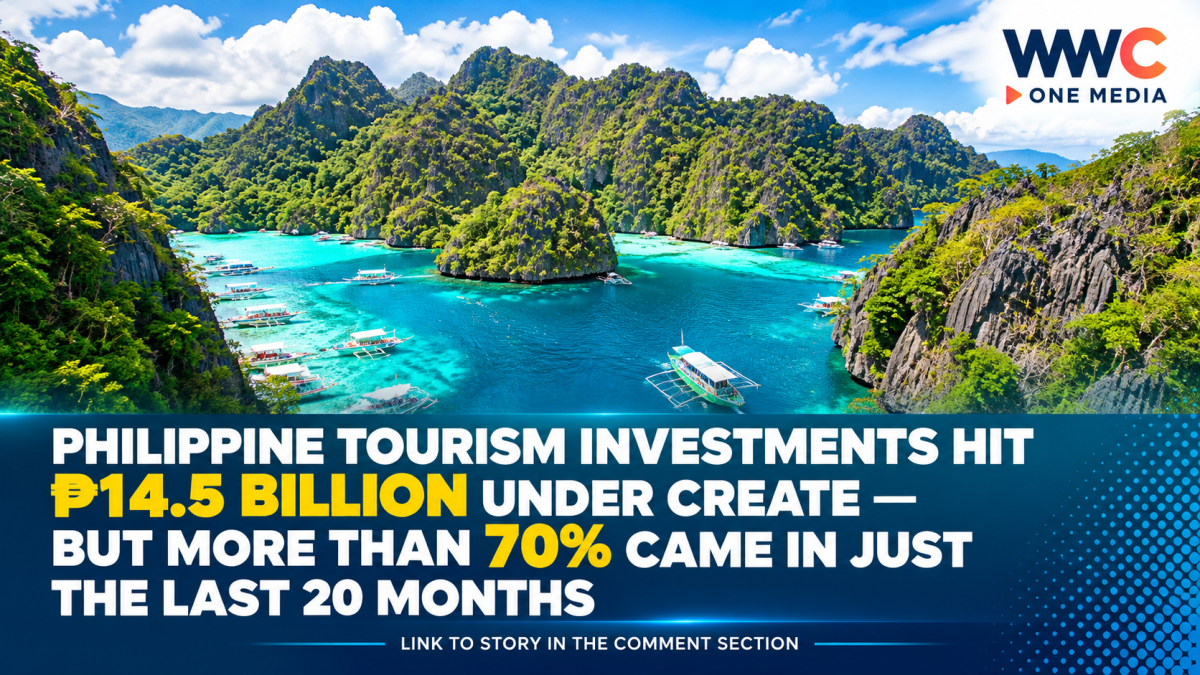
The Philippines has registered ₱14.5 billion worth of tourism investments across 34 projects since 2021, as tax incentives under the CREATE framework increasingly attract developers into hotels, resorts and other tourism-related businesses.
According to Tourism Infrastructure and Enterprise Zone Authority data dated September 15, the projects carry commitments for 2,826 new tourism jobs.
But the headline ₱14.5-billion total does not fully show how dramatically investment has accelerated.
Projects registered during 2025 and January to August 2026 alone accounted for ₱10.37 billion — roughly 71.5% of everything TIEZA has registered under CREATE since 2021.
That means nearly three-quarters of the post-pandemic investment tally arrived in less than two years.
And another ₱2.56 billion worth of proposed tourism investments is already in TIEZA’s application pipeline.
For a tourism industry still rebuilding international arrivals while preparing for tens of thousands of new hotel rooms, that pipeline could matter considerably.
2025 Was Already Strong — Then 2026 Nearly Caught Up in Eight Months
TIEZA registered 16 projects worth ₱5.74 billion in 2025, carrying commitments for about 1,039 jobs.
From January through August 2026, it approved another seven projects worth ₱4.63 billion, representing 522 committed jobs.
That means 2026 investment commitments had already reached about 80.6% of the entire 2025 total by August, despite four months remaining in the year.
Job commitments were running at around half of the 2025 level.
The investment number is therefore growing faster than the project count alone would suggest.
And that could indicate that individual tourism projects are getting larger.
Another ₱2.56 Billion Is Waiting in the Pipeline
TIEZA Assistant Chief Operating Officer Karen Mae Sarinas-Baydo said at the launch of the 2026 Philippine Accommodation Pipeline Report that eight additional applications were under evaluation.
Five projects worth approximately ₱1.07 billion are targeting openings during 2026 and are expected to generate around 256 jobs.
Another three applications represent about ₱1.49 billion in proposed investment and 313 additional jobs.
Those projects should not yet be added to the ₱14.5-billion registered-investment figure because they remain applications rather than completed registrations.
But if all eventually qualify, they would add another substantial layer to the investment pipeline.
The Biggest Misconception: You Don’t Necessarily Need a Tourism Enterprise Zone
This may be one of the most important reasons TIEZA believes investment can expand further.
Many developers apparently still assume they need to locate inside a formally designated Tourism Enterprise Zone, or TEZ, before they can access TIEZA-administered incentives.
That is no longer necessarily the case.
Sarinas-Baydo said TIEZA is trying to spread the message that standalone tourism enterprises can also register for incentives, provided they qualify under the investment framework.
TIEZA itself says eligible activities include accommodation establishments, tourist transport, MICE facilities, amusement and theme parks, adventure and ecotourism facilities, sports and recreation facilities, wellness projects, farm tourism, tourism-training centres, retirement villages and heritage restoration projects.
That dramatically widens the potential investor pool.
A developer does not necessarily have to build an entire destination-scale tourism zone.
A qualifying hotel, resort or other standalone tourism project may be enough.
CREATE Changed the Incentive System — CREATE MORE Expanded It Again
The original Corporate Recovery and Tax Incentives for Enterprises Act, or CREATE, overhauled the Philippines’ corporate tax and investment-incentive system.
It also strengthened TIEZA’s role as an investment promotion agency for qualified tourism businesses.
The later CREATE MORE Act, Republic Act No. 12066, expanded and clarified several of those incentives.
For qualified registered businesses, the framework can include an income-tax holiday followed by either the Special Corporate Income Tax regime or an Enhanced Deductions Regime, depending on eligibility and project structure.
Tourism businesses also receive a sector-specific advantage.
CREATE MORE provides an additional 50% deduction for qualifying tourism reinvestment allowances, while certain trade-fair expenses can receive an additional 50% deduction as well.
The law also extended potential incentive periods and clarified VAT, duty and local-tax treatment for registered enterprises.
Those benefits help explain why developers are paying more attention to registering projects formally rather than simply building without an investment-incentive package.
TIEZA Approved ₱3.74 Billion in Just the First Half of 2026
Separate TIEZA data released in July showed how quickly the momentum developed.
The agency said it approved four tourism investment projects worth ₱3.741 billion during the first half of 2026 alone, carrying an estimated 241 employment opportunities.
That first-half figure already represented the bulk of the ₱4.63 billion TIEZA ultimately recorded through August.
TIEZA said the projects covered multiple types of tourism activity and argued that CREATE MORE had strengthened the investment environment.
The latest September numbers now show that the pace continued into the third quarter.
And Tourism Is Only One Part of a Much Bigger Investment Surge
The tourism total should also be viewed beside broader Philippine investment activity.
The Board of Investments approved ₱461.84 billion worth of projects during the first half of 2026, up 21% from ₱382.24 billion during the comparable 2025 period.
Within that figure, hotel, tourism and accommodation projects accounted for about ₱7.58 billion.
That BOI number is not directly interchangeable with TIEZA’s ₱14.5-billion cumulative figure because the agencies cover different registrations and reporting periods.
But together they indicate that hospitality investment is appearing across multiple government investment channels.
The Hotel Pipeline Is Much Bigger Than ₱14.5 Billion
The most striking comparison comes from the private-sector development pipeline.
A new report from the Philippine Hotel Owners Association and Leechiu Property Consultants estimates that developers intend to invest about ₱387 billion in new hotels through 2032.
The pipeline contains approximately 45,884 rooms across 213 properties nationwide.
Leechiu estimates those projects could directly generate around 64,000 hotel jobs.
That ₱387-billion figure represents proposed hotel development rather than projects already registered with TIEZA under CREATE, so the two numbers should not be combined.
But the contrast is revealing.
TIEZA’s ₱14.5-billion total may be only a fraction of the wider capital developers plan to deploy into Philippine accommodation over the coming years.
Developers Are Building Despite Much Higher Costs
The pipeline is particularly significant because building hotels has become more expensive.
Leechiu said developers are moving forward even though construction costs have risen by roughly 30% over the past two years and higher interest rates have increased financing expenses.
That makes government incentives increasingly relevant.
An additional deduction, tax holiday or exemption may not turn an uneconomic hotel into a profitable one overnight.
But when developers are deciding among competing markets for hundreds of millions or billions of pesos of capital, tax treatment can affect expected returns.
And the Philippines is competing directly with major tourism markets across Southeast Asia.
International Arrivals Are Growing Again — But the Recovery Is Uneven
The investment boom is happening alongside a gradual recovery in foreign visitor numbers.
The Philippines recorded 4.11 million foreign arrivals from January through August 2026, up about 3.7% from the same period of 2025, according to Department of Tourism figures reported by the Philippine News Agency.
The United States became the largest source market with 818,318 arrivals, followed by South Korea with 727,379, Japan with 350,191, China with 310,088, and Australia with 234,156.
The government is targeting somewhere between 6.4 million and 7 million arrivals for the full year.
But not every market is recovering at the same pace, which remains a risk for developers depending heavily on international guests.
Hotel Occupancy Shows Why More Rooms Do Not Automatically Mean More Profits
Colliers reported that international visitor arrivals rose 5.4% year on year during the first half of 2026, reaching approximately 3.16 million.
Yet Metro Manila hotel occupancy slipped to about 63%, partly because of softer meetings and events activity and geopolitical uncertainty.
Average daily room rates still increased by about 2.4% from the preceding half-year.
That combination is important.
Demand is recovering.
New supply is coming.
But occupancy is not moving upward automatically.
Colliers estimates around 2,490 new hotel rooms will be completed in 2026, with foreign hotel brands continuing to expand in Metro Manila and provincial growth centres.
For developers, that means location, branding and market positioning could become just as important as tax incentives.
Foreign Capital Is Still a Weak Point
There is also a less bullish side to the story.
BusinessMirror, citing Bangko Sentral ng Pilipinas data, reported that net foreign direct investment into accommodation and food services fell to about $2.07 million during the first four months of 2026, down almost 58% from the same period a year earlier.
That measure is different from TIEZA’s registered investment commitments.
Investment approvals show money companies have committed to projects.
FDI statistics measure actual cross-border financial flows.
The two can therefore move in different directions.
Still, the weak foreign-capital data show that government incentives alone do not guarantee overseas investment.
Developers also evaluate financing costs, infrastructure, flight connectivity, demand and ease of doing business.
Tourism Investment Is Becoming a Competition Between Destinations
This helps explain why the government is placing increasing emphasis on infrastructure and investment facilitation.
TIEZA is working on a Philippine Tourism Investment Roadmap and a Tourism Investment Portfolio intended to identify priority development areas and make investible projects easier for companies to find.
Its current infrastructure programme includes tourism enterprise zones and projects connected to destinations such as San Vicente, Mt. Samat, Paoay and Iloilo, alongside wastewater, coastal-management and other tourism-support infrastructure.
The logic is straightforward.
A tax incentive is less valuable if a destination lacks airport capacity, reliable utilities, roads, sewerage or sufficient visitor demand.
To convert billions of pesos in commitments into functioning hotels and attractions, those pieces need to arrive together.
The ₱14.5 Billion Number Is Significant — But the ₱10.37 Billion Inside It Matters More
The easiest headline is that tourism investments registered through TIEZA have reached ₱14.5 billion since 2021.
The more revealing number is ₱10.37 billion.
That is how much was registered during 2025 and the first eight months of 2026 alone.
In other words, investment under the programme is not simply accumulating slowly over five years.
It has accelerated sharply.
Another ₱2.56 billion is awaiting approval.
And beyond TIEZA’s own portfolio, developers are planning tens of thousands of additional hotel rooms representing hundreds of billions of pesos in potential investment.
The challenge now is converting announcements and registrations into completed projects, operating businesses and sustainable jobs.
Because the Philippines does not merely need more investment commitments.
It needs the hotels, resorts and attractions behind those numbers to actually open — and enough tourists to keep them full.



Leave a Reply