
MANILA — September 17, 2026 — Filipinos who once needed to deal directly with a traditional brokerage to participate in major corporate share offerings are increasingly doing it from the same app they use to pay bills and send money.
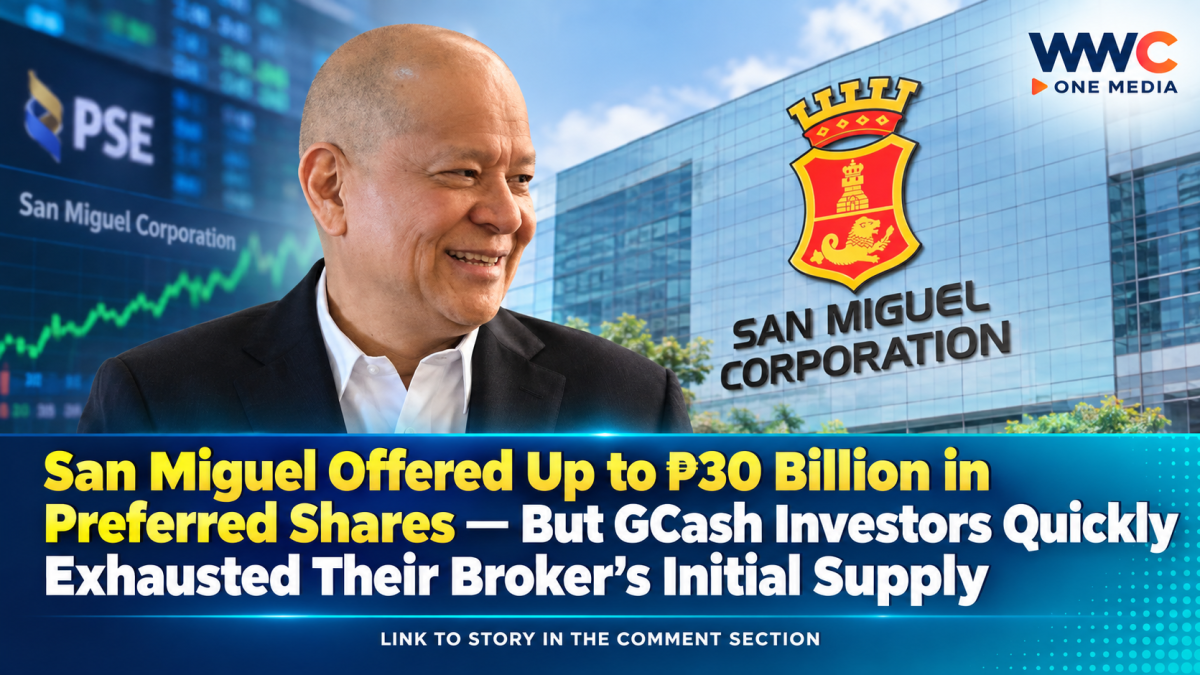
One of the clearest examples came from San Miguel Corp.’s recent ₱30-billion preferred share offering, where retail investors were able to subscribe through GStocks PH inside the GCash app — and demand quickly exceeded the initial number of shares allocated to broker AB Capital Securities across all three series offered on the platform.
According to information provided by GCash and reported by InsiderPH, demand for SMC2V reached 3.1 times AB Capital’s initial GStocks allocation, while SMC2W reached 1.3 times and SMC2X reached 1.7 times.
But that needs an important clarification.
Those oversubscription figures do not mean San Miguel’s entire ₱30-billion offering was oversubscribed by those multiples. They describe demand specifically for the initial inventory made available through AB Capital’s GStocks PH channel.
Still, the response provides another sign that digital platforms are changing how ordinary Filipinos access the Philippine capital market.
The San Miguel Shares Paid as Much as 8.6483% Annually
San Miguel offered three new subseries of its Series 2 perpetual preferred shares at ₱75 apiece.
SMC2V carried an initial annual dividend rate of 8.0401%, SMC2W offered 8.3570%, and SMC2X carried the highest rate at 8.6483%. The PSE formally confirmed those rates before the offer opened.
The size of the transaction was substantial.
San Miguel offered approximately 266.67 million preferred shares as its base offering, worth about ₱20 billion, plus an oversubscription option of roughly 133.33 million additional shares, potentially raising the total to ₱30 billion. All shares were priced at ₱75.
The securities were eventually listed on the Philippine Stock Exchange on August 3, 2026.
For retail investors accustomed to savings accounts or time deposits, dividend rates above 8% naturally attracted attention.
But these securities should not be confused with bank deposits.
Preferred shares are equity securities, and their market prices can move after listing. Dividends are governed by the terms of the issue, and investors also face corporate, interest-rate and liquidity risks.
These Were Not Ordinary San Miguel Common Shares
Another distinction matters for anyone seeing “San Miguel shares” inside GCash.
SMC2V, SMC2W and SMC2X are preferred shares, not San Miguel’s ordinary common stock.
San Miguel described the securities as cumulative, non-voting, non-participating, non-convertible, redeemable and reissuable perpetual preferred shares.
That means their investment characteristics are different from common SMC shares.
Common shareholders participate more directly in changes in the company’s equity value and normally have voting rights.
Preferred shareholders, by contrast, generally receive priority in dividend payments according to the securities’ terms but usually do not have the same voting rights or unlimited participation in the company’s upside.
For many investors, preferred shares therefore sit somewhere between the experience of owning a traditional stock and holding an income-oriented security.
That helps explain why they can appeal to people searching for regular cash distributions rather than primarily betting on a rising share price.
GStocks Made the Offering Available Without a Traditional Bank Account
The more disruptive part of the San Miguel transaction may have been how investors reached it.
GStocks PH is operated through licensed Philippine broker AB Capital Securities Inc. and integrated into GCash.
According to InsiderPH, fully verified GCash users could open a GStocks account and participate without needing a separate bank account.
The PSE lists AB Capital Securities as an active local broker serving retail, institutional and foreign clients, with no stated minimum investment requirement in the exchange’s broker directory.
For the San Miguel offer, GStocks also used a digital subscription meter that showed investors how much of AB Capital’s allocated inventory remained available.
Orders made while that initial inventory was still available were allocated on a first-come, first-served basis, according to InsiderPH.
Once the initial allocation was exhausted, investors could continue submitting subscription requests digitally, but final allocations then depended on additional availability.
That is an important difference from simply buying an already-listed stock on the exchange.
During an offering, the number of shares available through a particular broker can be limited even when investor demand is significantly larger.
The 3.1x Demand Figure Shows Where Retail Interest Was Strongest
Among the three San Miguel preferred-share series offered through GStocks, SMC2V generated the strongest demand relative to AB Capital’s initial allocation.
Requests reached 3.1 times the initial supply.
SMC2W attracted 1.3 times its allocation, while SMC2X reached 1.7 times.
Interestingly, SMC2V actually carried the lowest dividend rate of the three at 8.0401%.
SMC2X offered the highest at 8.6483%.
The numbers alone do not establish why GStocks investors favored one series over another. The three securities have different reset and redemption terms, so investors cannot simply compare headline dividend percentages and assume the highest rate is automatically the most attractive investment.
But the overall demand confirms that retail investors were willing to use an e-wallet-linked brokerage to participate in a major corporate capital-raising exercise.
San Miguel Wasn’t Raising ₱30 Billion Just to Expand
The fundraising also carries a less glamorous story behind its attractive dividend rates.
Most of the money was earmarked for debt management.
San Miguel said proceeds would be used to refinance existing short-term borrowings and repay bonds approaching maturity, while a smaller portion would support airport and infrastructure investments.
Up to ₱6.31 billion was earmarked to reduce short-term loans, including debt linked to the redemption of earlier preferred shares.
Another ₱6.02 billion was allocated toward Series C bonds maturing in March 2027.
Additional proceeds were set aside for Series J bonds that also mature in March 2027.
San Miguel also earmarked up to ₱5 billion for its infrastructure business, principally projects associated with the New Manila International Airport in Bulakan, Bulacan, and related developments.
So the offering served two purposes at once: refinancing part of San Miguel’s existing obligations while maintaining funding for some of the conglomerate’s largest infrastructure projects.
The Bigger Story Is GCash’s Growing Role in the Stock Market
San Miguel’s offering is significant, but it is part of a much bigger shift.
GStocks PH now has approximately 1.7 million users, according to GCash parent Mynt.
That represents around 53% of all online retail stock-market accounts recorded by the Philippine Stock Exchange in 2025, based on figures cited by Mynt.
The PSE recorded 3.64 million total stock-market accounts in 2025, including 3.22 million online retail accounts.
That means a platform embedded inside an e-wallet has rapidly become one of the most important gateways through which Filipinos access equities.
This transformation did not happen overnight.
The PSE previously said the introduction of trading through e-wallet platforms such as GCash and Maya was a major reason Philippine stock-market accounts jumped from 1.91 million in 2023 to 2.86 million in 2024.
PSE President Ramon Monzon has repeatedly described digital access as an important component of the exchange’s effort to expand retail participation.
San Miguel Wasn’t the Last Offering to Reach GCash Users
The model is already being repeated.
This month, property developer Arthaland Corp. also made its Series G and H preferred-share offering available through GStocks PH.
Those shares were offered at ₱500 each, carrying initial annual dividend rates of 7.3260% and 7.8105%, respectively.
That suggests San Miguel was not a one-off experiment.
GStocks is increasingly becoming a digital distribution channel not just for buying ordinary PSE-listed stocks after they begin trading, but for participating directly in IPOs and follow-on offerings during their subscription periods.
That could become particularly important as GCash parent Mynt prepares for its own planned stock-market listing.
Digital Access Removes Friction — Not Investment Risk
Putting a share offering inside an app makes investing considerably easier.
It does not make the investment itself safer.
San Miguel remains one of the Philippines’ largest diversified conglomerates, with operations spanning food and beverage, oil refining, power, infrastructure, toll roads and airports.
But preferred shares still carry risks.
Their market value can rise or fall after listing.
Higher market interest rates can make existing preferred shares less attractive.
Liquidity may be limited compared with heavily traded common stocks.
And while preferred shareholders generally have priority over common shareholders for dividends, they remain investors in a company rather than depositors protected by bank-deposit insurance.
Those distinctions become especially important as platforms such as GCash expose a much larger population to securities that previously might have been encountered primarily through traditional banks and brokers.
That May Be the Real Significance of San Miguel’s ₱30-Billion Deal
San Miguel has raised large amounts of money from Philippine investors many times before.
What changed this time was where some retail investors were able to participate.
Instead of contacting a broker by phone, visiting a bank or completing a separate traditional investment process, GCash users could enter GStocks PH, view the offering and submit an order digitally.
And the available initial allocations did not sit there waiting for buyers.
Demand through AB Capital exceeded the broker’s original allotment for every one of the three San Miguel preferred-share series.
That does not prove every GCash user suddenly wants to become a stock investor.
But it shows what can happen when a major Philippine corporate offering is placed inside a financial app already used by millions.
The next stage of Philippine retail investing may therefore be less about convincing people to visit the stock market.
It may be about bringing the stock market to an app already sitting in their pocket.



Leave a Reply