
SINGAPORE — September 17, 2026 — Singapore companies are being urged to tell employees plainly how artificial intelligence could change their jobs, as the government acknowledges a growing contradiction in the country’s AI push: workers are being encouraged to adopt the technology rapidly, yet many remain worried that the same tools could eventually replace them.
Acting Manpower Minister and Senior Minister of State for Digital Development and Information Jasmin Lau told employers on Thursday that silence among staff should not be mistaken for support. Speaking at the launch of SG AI Xchange, she said workers want to know whether management is considering retrenchments, slower hiring or significant changes to their roles as companies automate more work.
Her message was unusually direct: when automation is coming, employees should be told what could change and what retraining will be needed. Companies should also distinguish between workforce changes caused by AI and those resulting from weaker business conditions, so employees do not automatically assume every restructuring decision is technology-driven.
That call for transparency comes as surveys show a sizeable gap between AI use and AI confidence in Singapore.
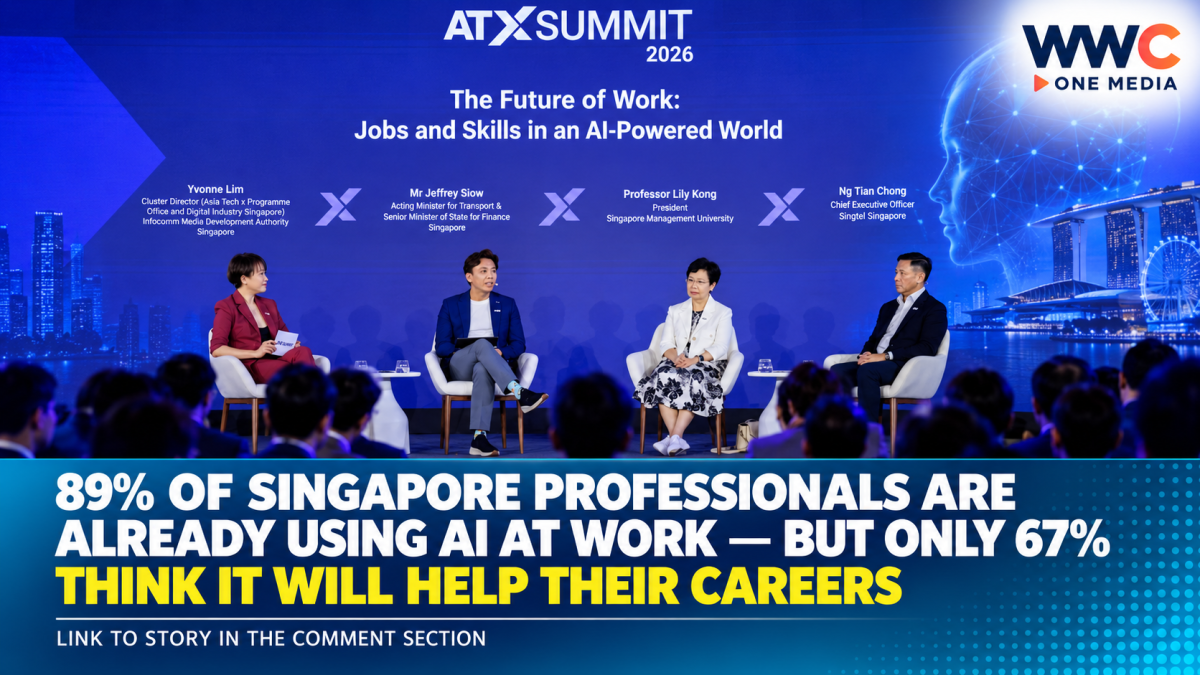
89% use AI at work — but only 67% think it will help their careers
A Robert Walters survey reported by The Business Times found that 89% of professionals in Singapore were already using AI at work, yet only 67% believed the technology would have a positive effect on their careers.
That placed Singapore among the less optimistic markets surveyed in the region. Respondents cited automation-driven job displacement, skills becoming obsolete and the possibility of unfair AI-assisted employment decisions among their main concerns.
A separate ADP survey painted an even sharper picture of job insecurity.
Only 15% of workers surveyed in Singapore said they felt their jobs were secure, below the Asia-Pacific average of 18% and global average of 22%. ADP said the results suggested employees were thinking not only about whether they had jobs today, but whether their roles would remain relevant as technology changed.
Those surveys measure worker perceptions rather than actual future job losses, but they help explain why Lau said employers should not assume a workforce that is not openly resisting AI is comfortable with what is happening.
Government data, however, does not show mass AI job losses — at least not yet
Singapore’s official employment data paints a more complicated picture.
The Ministry of Manpower’s first dedicated survey of AI adoption found that 28.5% of firms had adopted AI in some form, while 71.5% had not. Only 3.8% had integrated AI deeply into their core business processes, indicating that implementation remained relatively early across much of the economy.
Among companies that had adopted AI, 6.2% reported reducing headcount.
By comparison, 18.9% said they had redesigned jobs, while 13.9% created new AI-related positions. More than 70% of AI-adopting firms reported improvements in worker productivity.
MOM therefore says the evidence so far points more strongly toward tasks and jobs being redesigned rather than widespread replacement of workers. The ministry repeated that assessment in Parliament on September 9, saying firms were more commonly creating new roles or modifying existing ones than cutting employment after adopting AI.
But the government has also cautioned that those findings describe the current stage of adoption.
As AI spreads more deeply through businesses, its effect on employment could become larger than what current surveys show.
That distinction is important: today’s data does not prove AI will never cause significant displacement. It shows that Singapore has not yet seen broad-based job destruction attributable to AI in the firms surveyed.
Even the decline in job vacancies has not been pinned on AI
Concerns have also grown that companies may avoid layoffs while quietly cutting hiring, especially for younger employees whose entry-level tasks can increasingly be automated.
Official numbers offer some reassurance but do not eliminate the longer-term question.
Singapore’s total job vacancies declined from 77,700 in December 2025 to 73,300 in March 2026, but MOM said that decrease was mainly in non-PMET positions.
Entry-level PMET vacancies actually edged higher from 32,500 to 32,800 over the same period.
Among AI-adopting companies surveyed by MOM, about 8% reported lowering hiring, compared with 19% redesigning jobs and 14% creating AI-related positions.
So far, the government says there is insufficient evidence to attribute the broader reduction in vacancies to AI replacing fresh graduates.
Yet recruiters have identified another challenge: businesses increasingly want workers who can already apply AI in real commercial settings.
The Business Times reported in June that employers looking for AI talent were often prioritising experienced candidates, potentially creating a tougher entry point for graduates even as new AI-related roles appear. An Aon survey cited in the report found only 24% of Singapore firms felt confident about hiring AI talent.
Lau says there is now a ‘groundswell’ of anxiety around AI
At Thursday’s event, Lau acknowledged that unease is spreading beyond established workers.
She said there was “some groundswell” of anti-AI sentiment among workers and younger students, driven partly by fears that AI could take away future jobs and aspirations. Environmental concerns surrounding the enormous computing and energy requirements of AI are also contributing to scepticism, she said.
The government’s stated position is not to slow AI adoption simply because anxiety exists.
Lau said Singapore wants businesses to adopt AI where it creates genuine economic value and better jobs, while stressing that the country is not pursuing AI without regard for its consequences.
That balancing act is becoming one of Singapore’s biggest workforce-policy challenges.
On one side is the risk of moving too slowly and allowing companies and workers to become less competitive.
On the other is the risk that businesses automate faster than employees can retrain — or that workers lose trust because decisions affecting their livelihoods are made without explanation.
Singapore is spending heavily to get workers comfortable with AI
The government’s answer so far has centered heavily on training.
Just one day before Lau’s speech, Singapore launched more than 200 AI-related training courses, with eligible citizens who attend selected programmes receiving six months of complimentary access to premium AI tools such as ChatGPT Plus, Google AI Pro, Manus AI and Microsoft 365 Personal.
The initiative is intended to let workers move beyond classroom instruction and practise with the same types of tools increasingly appearing in offices.
Singapore has also set a target of supporting 100,000 workers to become “AI Bilingual” — people who combine knowledge of their existing professional domain with enough AI fluency to apply the technology effectively in their work.
SkillsFuture has additionally developed an AI-readiness assessment designed to steer workers toward courses matching their current capabilities.
Prime Minister Lawrence Wong, speaking at the launch of the new Skills and Workforce Development Agency initiatives on Wednesday, said workers should not become an afterthought when businesses transform. The aim, he said, is for greater productivity to be accompanied by better skills, jobs and career prospects.
Singapore’s AI investment is accelerating at the same time
The pressure to adapt is unlikely to disappear because Singapore is simultaneously trying to become one of Asia’s key locations for developing and deploying AI.
Lau said the country now has close to 100 AI Centres of Excellence spanning industries including finance and manufacturing. She said AI capabilities were being built in sectors including semiconductors, medtech, mobility, energy and chemicals.
Major technology companies are also expanding locally.
Anthropic plans to open a Singapore office in October and hire for multiple roles, while Google Cloud opened a Singapore Engineering Centre this week. Databricks has pledged to invest more than US$350 million over three years in Singapore, including initiatives aimed at developing AI capabilities.
The economic upside is already visible elsewhere. Singapore’s non-oil domestic exports surged 46.2% year on year in August, with electronics exports soaring 131.8% as AI-related demand boosted shipments, according to government data reported by Reuters.
So Singapore is not debating AI from the sidelines. The technology is increasingly tied to investment, exports, skills policy and its position as a regional business hub.
The labour market is still holding up
For all the anxiety, Singapore’s broader labour market has remained relatively resilient.
Total employment increased by 10,700 in the second quarter of 2026, marking the 19th consecutive quarter of expansion. Overall unemployment stood at 2.0% in June, while resident unemployment was 2.9%.
Retrenchments did rise from 3,830 in the first quarter to 4,500 in the second, but MOM said the increase was concentrated in outward-facing sectors and was driven primarily by business restructuring rather than evidence of broad AI-driven layoffs.
That distinction supports Lau’s appeal for employers to explain why jobs are changing.
A company cutting positions because demand has weakened presents a different problem from a company replacing specific tasks with AI — but employees may not know the difference unless management tells them.
The issue is shifting from ‘Will AI take jobs?’ to ‘Who gets told what is coming?’
Singapore’s latest debate suggests the question is becoming more nuanced than whether AI simply creates or destroys employment.
Government surveys indicate that current adoption has mostly resulted in job redesign, new roles and productivity improvements, rather than widespread headcount reductions.
But worker surveys show that many employees remain uncertain about their futures even while they are already using AI regularly.
That gap between the official employment numbers and what workers feel is exactly what Lau wants employers to address.
Training people to use AI may help.
Providing access to premium tools may help.
Creating new AI jobs may help.
But if employees suspect that management has already decided which positions will disappear and refuses to say so, technical training alone is unlikely to remove the anxiety.
For Singapore, the next phase of the AI transition may therefore depend not only on how quickly companies adopt the technology — but how clearly they tell workers what that adoption actually means for them.




Leave a Reply