
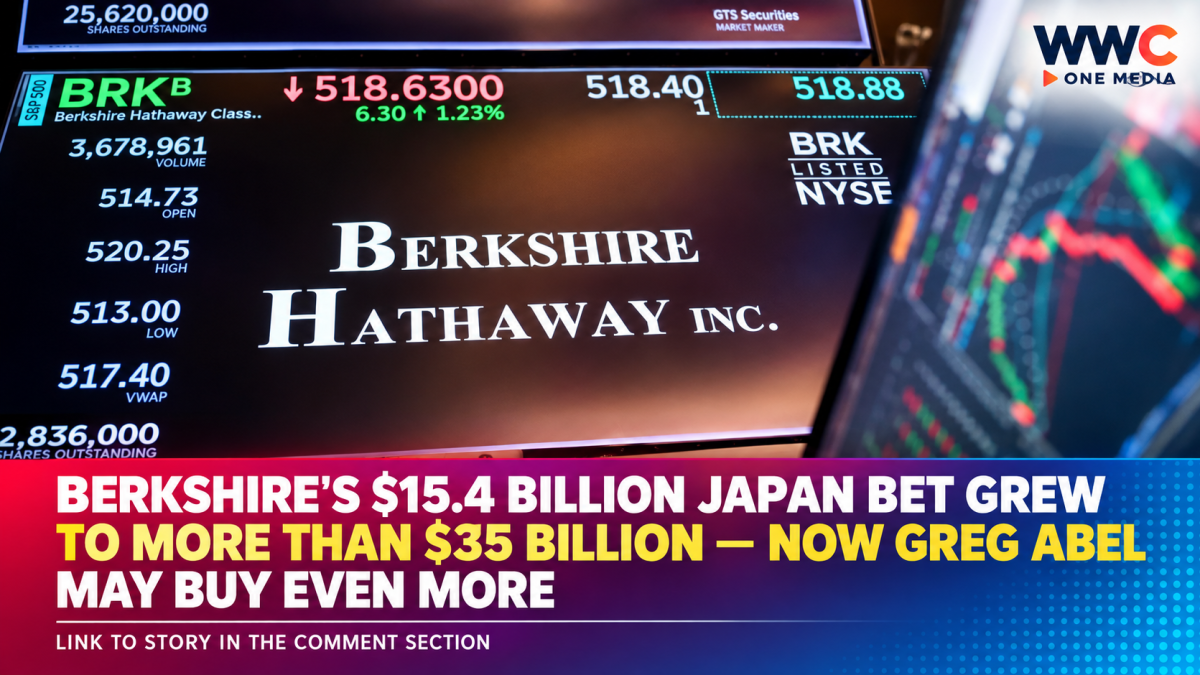
TOKYO — September 17, 2026 — Berkshire Hathaway may not be finished buying Japan.
The U.S. conglomerate is considering increasing its already substantial holdings in Japan’s five biggest trading houses — Mitsubishi Corp., Mitsui & Co., Itochu, Marubeni and Sumitomo Corp. — signaling that one of Warren Buffett’s most closely watched international investment strategies is continuing under new chief executive Greg Abel.
Japan Foreign Trade Council Chairman Masahiro Okafuji, who is also chairman of Itochu, said after meeting Abel this month that he believes Berkshire intends to keep the investments for the long term and is considering purchasing even more shares. Berkshire now owns more than 10% of each of the five trading houses, according to the Japan Times report based on Bloomberg coverage.
But there is an important distinction behind the headline:
Berkshire has signaled interest in increasing its holdings; it has not announced that it will immediately raise every stake to 15%.
The latest comments suggest the relationship has room to expand, rather than establishing a new formal ownership target.
Berkshire’s Japan Bet Has Already Become Enormous
The size of the investment helps explain why any additional buying attracts so much attention.
At the end of 2025, Berkshire said its five Japanese trading-house investments had a combined cost basis of $15.382 billion.
Their market value at that point?
$35.368 billion.
That represented an unrealized gain of nearly $20 billion before counting the dividends Berkshire had already collected. The five companies paid Berkshire about $862 million in dividends during 2025 alone, according to Berkshire’s annual report.
At year-end 2025, Berkshire reported stakes of:
Mitsubishi at 10.8%, Mitsui at 10.4%, Itochu at 10.1%, Marubeni at 9.8% and Sumitomo at 9.7%. Subsequent purchases pushed Marubeni and Sumitomo above 10%, meaning Berkshire eventually crossed the threshold at all five companies.
Itochu separately confirmed that Berkshire’s voting-rights stake had risen from 9.54% in March 2025 to 10.07% by February 27, 2026, after Berkshire acquired additional shares through its National Indemnity subsidiary.
That makes the latest discussion about further buying less of a sudden change in strategy and more of a continuation of a position Berkshire has been building for years.
Greg Abel Is Continuing a Strategy Started Under Warren Buffett
Berkshire’s Japanese investment began under Buffett, who started accumulating the trading houses around 2019 before publicly revealing stakes of roughly 5% in each company in 2020.
By November 2022, Berkshire had already lifted all five holdings above 6%.
The initial strategy came with an important restriction: Berkshire said it would generally keep its ownership below 9.9% unless the companies themselves approved a larger position.
That restriction has since been relaxed.
Berkshire disclosed in its 2025 annual report that the five companies had agreed to allow it to increase its holdings moderately above the original ceiling.
And Abel appears to have no intention of abandoning the strategy now that he has succeeded Buffett as Berkshire’s CEO.
During a September 2 CNBC interview from Japan, Abel said Berkshire had sought permission from the trading houses before crossing 10%. He described the investments as positions Berkshire intends to own for many decades and said the relationships could also generate additional business opportunities inside and outside Japan.
That point matters because one of the biggest questions surrounding Berkshire after Buffett’s departure as chief executive was whether Abel would continue some of his predecessor’s most distinctive capital-allocation decisions.
In Japan, the answer so far appears clear: Berkshire is staying — and may buy more.
Why Berkshire Likes Japan’s ‘Sogo Shosha’
The five companies are known in Japan as sogo shosha, or general trading houses.
Calling them simply “trading companies” understates what they actually do.
Their businesses stretch across energy, metals, food, chemicals, machinery, infrastructure, retail, finance, logistics, technology and investments around the world.
That diversification resembles, in some respects, Berkshire itself.
Okafuji said Berkshire particularly appreciates the companies’ global networks and capital-allocation capabilities, characteristics he described as creating an economic “moat” around their businesses.
Abel has also pointed to their use of cash.
The trading houses have been increasing dividends, buying back shares and redeploying capital into businesses expected to generate higher returns. In his September interview, Abel said Berkshire expects their underlying earnings to continue growing and sees potential for further increases in dividends and repurchases.
That combination — diversified earnings, substantial cash generation and shareholder returns — closely matches the kind of businesses Berkshire has historically preferred to own for long periods.
Berkshire Has Another Advantage: It Borrowed in Yen
There is another part of the investment strategy that has received less attention than Berkshire’s stock gains.
Berkshire has financed much of its Japanese investment with yen-denominated borrowing.
At the end of 2025, the company said the amount it had borrowed in Japan was approximately equivalent to the original cost of its trading-house shares.
The average borrowing cost was only 1.2%, with a weighted-average maturity of approximately 5.75 years.
That structure helps match Berkshire’s yen assets with yen liabilities, reducing its exposure to movements in the Japanese currency.
And even though Japanese bond yields have risen sharply, Abel said earlier this month that the increase was not yet a fundamental problem for the five trading houses. He also indicated that Berkshire remained open to raising additional yen financing when appropriate.
For Berkshire, therefore, the Japanese strategy is not simply a stock-market bet.
It combines equity ownership, local-currency financing and potentially deeper commercial partnerships with some of Japan’s biggest corporations.
Could Berkshire Eventually Own 15%?
That is where Thursday’s comments become particularly interesting.
Okafuji said Berkshire was viewed as an unusually patient shareholder and discussed a scenario in which its ownership could potentially rise toward 15%. But the remarks should not be interpreted as confirmation that Berkshire has formally decided to purchase a 15% stake in every company.
No new regulatory filing announcing 15% ownership has been disclosed in the report.
Nor did Abel announce an exact percentage target during his CNBC interview.
What he did make clear was that Berkshire had previously obtained permission to exceed 10%, intends to remain invested for decades and continues to look for incremental opportunities with the five companies.
That leaves plenty of room for further purchases without establishing a fixed endpoint.
There Is Also a Potential Conflict Berkshire Will Have to Manage
The relationship becomes more complicated as Berkshire’s stakes grow.
Okafuji noted that Berkshire is simultaneously a major shareholder and a potential business partner of the trading houses. That could create conflicts of interest if Berkshire and one of the Japanese companies pursue a large transaction together while Berkshire also owns significant stakes in competing trading houses.
That issue becomes more relevant as cooperation expands beyond passive share ownership.
Abel said Berkshire has been discussing additional opportunities with the companies both in Japan and overseas.
Berkshire has also broadened its Japanese footprint beyond the five trading houses.
Earlier this year, it announced a 2.49% strategic investment in Tokio Marine Holdings, one of Japan’s largest insurers, with both companies exploring opportunities to cooperate on global investments and acquisitions.
So Berkshire’s Japan strategy increasingly looks less like five isolated stock investments and more like a network of long-term corporate relationships.
The Buffett Effect Has Already Changed How Investors Look at Japan
When Berkshire first disclosed the investments in 2020, Japanese trading houses were often valued more cheaply than major U.S. companies despite producing substantial profits.
Buffett’s purchases helped draw international attention to the sector.
The companies subsequently increased dividends and share buybacks while Japanese corporate-governance reforms pushed listed firms to focus more heavily on capital efficiency and shareholder returns.
Berkshire’s own numbers show how dramatic the revaluation became.
Its approximately $15.4 billion cost basis had grown to $35.4 billion in market value by December 2025.
And Berkshire does not appear to view that increase as a reason to exit.
Instead, Abel is describing the holdings as multi-decade investments.
That May Be the Biggest Signal in This Story
The headline is that Berkshire could buy more shares.
The deeper story is what has not changed after Buffett handed over the CEO role.
Berkshire still sees Mitsubishi, Mitsui, Itochu, Marubeni and Sumitomo as unusually attractive long-term assets.
It still uses inexpensive yen borrowing to support its Japan strategy.
It still wants deeper relationships with the businesses.
And instead of cashing out after billions of dollars in gains, Berkshire is discussing whether to put even more money in.
The five holdings were worth more than twice Berkshire’s original cost by the end of 2025, yet Abel’s message since taking over has been about decades, not exits.
That is why the possibility of moving beyond today’s roughly 10%-plus stakes matters.
For Berkshire, Japan is no longer a small overseas experiment started by Warren Buffett.
It has become one of the conglomerate’s most important long-term investments outside the United States — and Greg Abel appears willing to make the bet even bigger.



Leave a Reply