
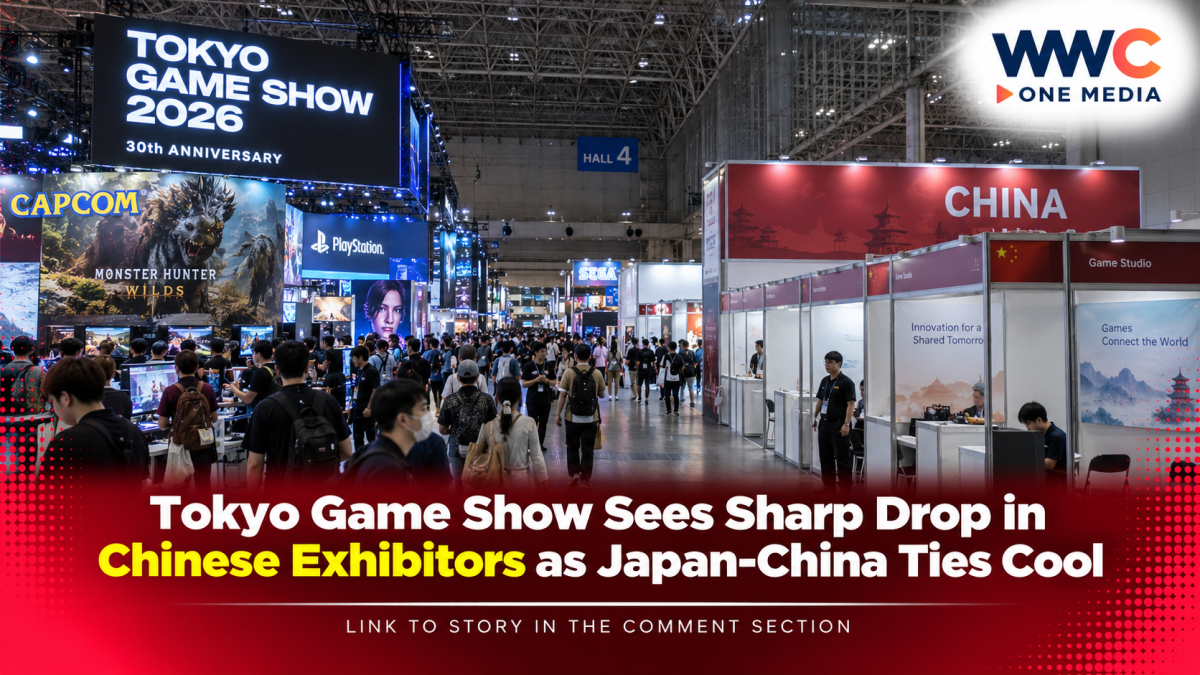
Tokyo Game Show 2026 is opening at record scale—but one major presence has noticeably shrunk.
The number of mainland Chinese exhibitors at Japan’s biggest gaming event has fallen sharply from last year, as strained Japan-China relations appear to be affecting participation by Chinese game companies.
According to figures cited by Niko Partners, mainland Chinese exhibitors at TGS 2026 numbered 72, compared with 112 last year, a decline of roughly 36%. Hong Kong participation also dropped from 18 companies to just two.
The decline is particularly striking because the overall Tokyo Game Show is expanding.
TGS reaches record size despite Chinese pullback
The 2026 edition marks the 30th anniversary of Tokyo Game Show and is the event’s longest edition yet, running for five days from September 17 to 21 at Makuhari Messe in Chiba.
Organizers announced 1,138 exhibitors from 53 countries and regions, surpassing last year’s record of 1,136 exhibitors. The show has 3,999 exhibition booths and has expanded its venue footprint.
In other words, the Chinese decline is not evidence that Tokyo Game Show as a whole is shrinking.
Instead, it represents a notable change in the composition of international participation.
Major Chinese gaming names are missing
Several prominent Chinese companies that have appeared at Tokyo Game Show previously are absent from the 2026 exhibitor lineup, according to Japanese and Korean media reports.
Those companies include NetEase Games, Perfect World Games and other major Chinese publishers. Tencent’s Level Infinite is reportedly participating in the business-to-business section rather than maintaining the same type of consumer-facing presence.
The absence of major publishers is significant because Chinese developers and publishers have become increasingly visible at international gaming events in recent years.
It also contrasts with the situation at Gamescom 2026 in Germany, where reports said around 60 Chinese companies participated—the largest Chinese presence at that event to date.
Japan appears to be the exception
That contrast has led industry analysts to question whether the decline represents a broader retreat by Chinese gaming companies or a more Japan-specific decision.
Niko Partners’ analysis, as reported by Korean media, points toward geopolitical tensions and reduced China-Japan exchanges as possible factors making high-profile participation in Japan less attractive for some major companies.
However, there is an important caveat: the individual companies have not publicly confirmed that geopolitical tensions were the reason for their withdrawal.
The connection is therefore an industry interpretation rather than a stated explanation from every absent exhibitor.
Taiwan tensions add another layer
The change comes amid worsening political relations between Beijing and Tokyo following Japanese Prime Minister Sanae Takaichi’s remarks about a possible Japanese response to a Taiwan contingency.
A Japanese-language report from JoongAng Ilbo said the tensions have extended into the gaming industry, noting that several major Chinese companies were absent from TGS 2026. It also reported that China’s esports delegation is skipping the League of Legends competition at the 2026 Asian Games in Aichi-Nagoya.
These developments have fueled speculation that political tensions are beginning to influence parts of the normally highly international gaming business.
Still, participation decisions can also be influenced by marketing strategies, product schedules, budgets and the commercial value of individual events.
South Korean gaming companies fill more of the spotlight
While Chinese participation has declined, South Korean companies are maintaining a strong presence at this year’s show.
Korean publishers including Nexon, Netmarble and NCSoft are among the companies participating, according to Korean media reports. Their presence comes as Korean game developers increasingly target the Japanese and wider Asian markets.
That gives TGS 2026 a noticeably different international lineup even as the event itself reaches record scale.
A gaming show caught in a larger geopolitical shift
The developments highlight how the video-game industry is increasingly intertwined with international markets and geopolitics.
Games are global products, with developers, publishers, investors and players spread across borders. Major exhibitions such as Tokyo Game Show therefore serve not only as showcases for new titles but also as important business and networking platforms.
For TGS 2026, the headline number remains impressive: 1,138 exhibitors from 53 countries and regions.
But behind that record is another story.
Chinese participation has dropped significantly, major publishers are missing from the consumer-facing exhibition, and industry observers are linking the change to the increasingly complicated relationship between Beijing and Tokyo—although the companies themselves have not universally confirmed that explanation.
As Tokyo Game Show celebrates 30 years at record scale, the shrinking Chinese presence could become one of the clearest signs yet of how geopolitical tensions are reaching even the global gaming industry.
WWC ONE MEDIA G,A



Leave a Reply