
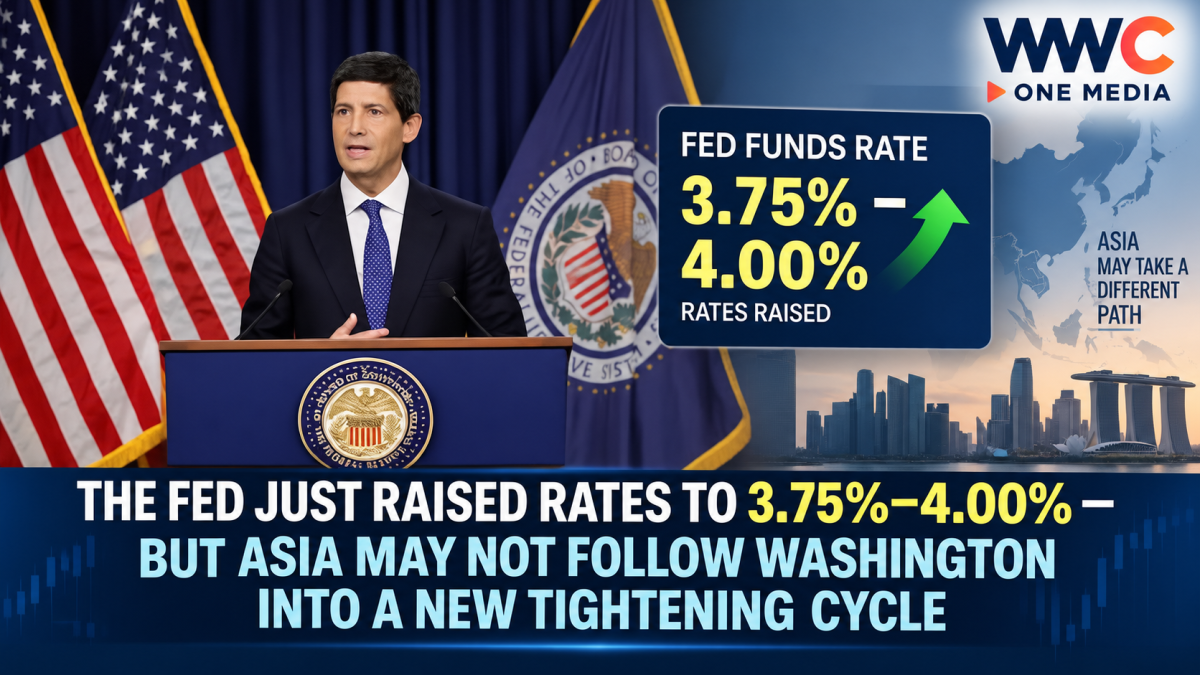
WASHINGTON/SINGAPORE — The global interest-rate story has flipped again.
For much of 2026, investors had been debating when the United States Federal Reserve might eventually begin cutting borrowing costs.
Instead, on Wednesday, September 16, the Fed did the opposite.
The Federal Open Market Committee unanimously raised its benchmark federal funds target range by 25 basis points to 3.75%-4.00%, delivering its first increase since 2023 as inflation remained stubbornly above target and the American economy proved stronger than many policymakers had expected.
The move itself was largely priced in by the time it arrived.
The bigger surprise was what came next.
Fed projections showed policymakers now see the federal funds rate at a median 4.1% at the end of 2026, up sharply from the 3.8% projected in June — effectively consistent with roughly one additional quarter-point increase if the economy develops broadly as officials expect.
That was enough to send the U.S. dollar to a seven-week high and force investors across Asia to reconsider one of the biggest assumptions underpinning financial markets this year:
What if this is not a one-off increase?
What if higher rates are back?
Why the Fed suddenly changed direction
The simplest answer is inflation.
The Fed wants inflation to average 2% over the longer term.
Yet the latest U.S. Consumer Price Index showed consumer prices were 3.4% higher in August than a year earlier, while prices rose 0.4% during August alone. Core inflation excluding food and energy stood at 2.4%.
The Fed’s preferred inflation gauge tells a similar story.
Its September projections put PCE inflation at 3.7% for 2026, slightly above the 3.6% officials expected in June.
Core PCE inflation is projected at 3.4%.
Inflation is therefore easing much more slowly than policymakers would like.
At the same time, the economy has not weakened enough to force the Fed to prioritise growth over prices.
The central bank now expects U.S. real GDP to expand 2.3% in 2026, while unemployment is projected at only 4.1%. Both forecasts improved compared with June.
That combination gives the Fed room to tighten.
Growth is still solid.
The labour market is holding up.
Inflation is still too high.
So the central bank believes the economy can withstand somewhat more expensive money.
The Fed itself says inflation risks remain heavily tilted upward
One detail inside the new projections is particularly striking.
Of the 18 policymakers submitting forecasts, 17 said the risks surrounding their PCE inflation outlook were weighted to the upside.
For core inflation, 15 saw the risks tilted upward.
That means policymakers are not simply forecasting inflation to remain high.
Most of them also see a greater chance that inflation turns out worse than their central estimate rather than better.
Geopolitical shocks, elevated energy prices and trade-related costs have all complicated the inflation outlook, while domestic spending and investment have remained resilient. The Fed said economic activity continued to expand at a “solid pace” when announcing Wednesday’s move.
But calling this a “new hiking cycle” may still be premature
This is the most important accuracy distinction in the story.
The Fed raised rates.
Its projections indicate some additional tightening.
But it has not promised a long sequence of increases.
CNA found analysts sharply divided over whether September marks the beginning of a genuine new tightening cycle or merely a small adjustment designed to accelerate the fall in inflation.
Bank of America economists see more increases potentially coming relatively quickly.
Macquarie expects another 50 basis points of tightening spread between late 2026 and early 2027.
Goldman Sachs went further after Wednesday’s announcement, changing its forecast to expect another 25-basis-point hike in October.
But other analysts are less convinced.
OCBC does not expect an aggressive hiking cycle.
Natixis has argued that September could still turn out to be essentially a one-off adjustment if incoming inflation numbers improve.
The Fed’s own projections are forecasts, not commitments.
The next move still depends on inflation, employment and financial conditions.
Markets are already betting rates remain higher for longer
Even without certainty over the next meeting, markets reacted quickly.
The dollar climbed to its strongest level in seven weeks after the decision, while short-term U.S. Treasury yields rose as investors priced in a greater probability of further tightening.
That matters enormously for Asia.
Higher American yields make dollar-denominated assets relatively more attractive.
Money that might otherwise move into Asian bonds or equities can instead remain in U.S. assets.
That can strengthen the dollar and weaken Asian currencies.
And when local currencies weaken, countries importing oil, food, machinery or other dollar-priced goods can face another inflation problem.
The Fed can therefore tighten financial conditions in Asia even when Asian central banks do absolutely nothing.
Hong Kong followed almost immediately — but Hong Kong is a special case
Hong Kong is one of the clearest examples of direct Fed transmission.
The Hong Kong Monetary Authority raised its Base Rate by 25 basis points to 4.25% on Thursday after the Fed’s move.
That happens because the Hong Kong dollar is linked to the U.S. dollar through the territory’s currency-board system.
Hong Kong interest rates therefore tend to move with U.S. monetary conditions much more closely than rates in independently floating Asian currencies.
But there is an important consumer caveat.
The HKMA Base Rate is primarily the rate used for its Discount Window mechanism.
It does not automatically mean Hong Kong banks immediately raise mortgage or prime lending rates by exactly the same amount.
Individual banks still make those decisions according to local liquidity and funding conditions.
So “Hong Kong raised rates” is accurate.
“Every Hong Kong mortgage just became 0.25 percentage points more expensive” would not be.
Japan could hike too — but not because the Fed told it to
Japan presents almost the opposite case.
The Bank of Japan’s policy board is meeting on September 17 and 18, with economists expecting it could lift its short-term policy rate from 1% to 1.25%, which would be its highest level in roughly three decades.
But the reasons are primarily Japanese.
Inflation remains persistent.
A weak yen has raised import costs.
And the BOJ has spent years trying to move away from the ultra-low and negative rates that defined Japanese monetary policy for decades.
The Fed’s hawkish shift complicates the yen outlook because higher American rates support the dollar.
But Tokyo’s decision will ultimately be about Japan’s own inflation and wage conditions.
That distinction is essential when discussing whether Asian central banks will “follow” the Fed.
Sometimes they move in the same direction for completely different reasons.
South Korea already started tightening before Washington
The same is true in South Korea.
The Bank of Korea raised its benchmark rate to 3% on August 27, its second consecutive increase.
The Korean central bank therefore began tightening before the Fed’s September move.
Why?
Inflation, household debt, property-market pressures and the won have all created reasons for caution.
But the latest BOK meeting minutes also showed policymakers are divided.
One member opposed the August increase and argued the central bank should allow time to assess the impact of earlier hikes on indebted households and vulnerable parts of the economy.
That makes another Korean increase possible, but not automatic.
A stronger dollar after the Fed hike adds pressure by potentially weakening the won.
Still, the BOK must balance that currency issue against domestic debt and growth risks.
India is already seeing the currency pressure
India demonstrates another channel.
The rupee entered Thursday near a six-week low and traders were closely watching whether it would weaken through 96 rupees per dollar after the Fed’s hawkish message strengthened the U.S. currency.
India also has its own inflation problem.
Consumer inflation accelerated to 4.82% in August, its highest reading under the current inflation series, strengthening arguments that the Reserve Bank of India may eventually need tighter policy regardless of Washington.
India is particularly vulnerable to another factor: oil.
As a major crude importer, a combination of a strong dollar and high oil prices can increase India’s import bill twice — once because crude itself becomes more expensive and again because the currency used to buy it becomes more costly.
That can worsen inflation and the current account simultaneously.
And the Philippines has already reversed course too
The Philippines offers another example of how dramatically Asia’s interest-rate environment has changed.
The Bangko Sentral ng Pilipinas spent the earlier part of the year cutting rates as inflation slowed and policymakers attempted to support growth.
But in June it reversed direction and raised its benchmark policy rate by 25 basis points, its second consecutive increase at the time.
Like other central banks, the BSP must now weigh domestic inflation against currency and external financing pressures.
A persistently stronger U.S. dollar could reduce policymakers’ flexibility to lower rates even if local growth slows.
That does not mean every Fed increase forces a BSP increase.
It means the cost of ignoring global dollar conditions becomes higher.
Singapore is different: MAS does not set a Fed-style policy interest rate
For Singapore, the transmission mechanism is more subtle.
Unlike the Fed, the Monetary Authority of Singapore does not primarily conduct monetary policy by setting a conventional policy interest rate.
Its framework is centred on managing the Singapore dollar nominal effective exchange rate, or S$NEER, against a basket of currencies belonging to Singapore’s major trading partners.
MAS has long explained that because Singapore is an exceptionally open economy, the exchange rate has a stronger influence on inflation than a conventional policy interest rate.
That means there will not necessarily be a Singapore equivalent of a Fed announcement saying: “We are raising the policy rate by 25 basis points.”
Instead, changes in global interest rates influence local liquidity, money-market conditions and the Singapore dollar.
Singapore mortgages therefore do not automatically rise the morning after a Fed hike
This is particularly important for homeowners.
Many Singapore floating-rate home loans are linked to SORA — the Singapore Overnight Rate Average.
MAS defines SORA as the volume-weighted average rate for unsecured overnight Singapore-dollar borrowing between banks.
That is a Singapore-dollar market rate.
It is not the federal funds rate.
U.S. monetary policy can influence Singapore financial conditions, but there is no mechanical formula saying:
Fed +0.25 percentage points = Singapore mortgage +0.25 percentage points tomorrow.
CNA notes that any effect can take time to filter through local SORA and then into individual mortgage packages.
For households, the right number to monitor is therefore not simply the Fed rate.
It is the relevant compounded SORA rate and the specific margin written into the home-loan agreement.
The stronger dollar could matter more immediately than Asian rate hikes
For much of the region, currencies may be the first pressure point.
The dollar’s jump after Wednesday’s decision reflected both the actual Fed increase and the expectation that American rates could stay elevated for longer.
If that move continues, Asian currencies could weaken.
That can create several consequences simultaneously.
Imported goods become more expensive in local-currency terms.
Dollar-denominated corporate debt becomes harder to service.
Foreign investors may shift money toward higher-yielding U.S. assets.
And local central banks may become more reluctant to cut rates because lower domestic rates could put even more pressure on their currencies.
This is how one Federal Reserve decision can tighten financial conditions thousands of kilometres away without another central bank copying it.
But a strong U.S. economy is not automatically bad news for Asia
There is another side to the story.
BlackRock’s Asia-Pacific fixed-income team told CNA that the Fed is raising rates partly because the American economy remains resilient.
That economic strength can support global trade, corporate earnings and Asian exporters.
In other words, a Fed hike caused by strong demand is different from one delivered into a collapsing economy.
If American consumers and companies continue spending, Asian manufacturers, technology exporters and commodity suppliers can still benefit.
That helps explain why Asian shares actually edged higher on Thursday despite the hawkish Fed.
Investors were worried about higher short-term rates, but falling long-term yields and resilient growth expectations provided some counterweight.
So “Fed hike equals Asian market crash” is far too simplistic.
Wall Street itself gave a mixed message
U.S. stocks initially reacted negatively.
The Dow Jones Industrial Average dropped about 1.2%, the S&P 500 fell roughly 0.45%, while the Nasdaq was nearly flat.
The bond market’s reaction was equally revealing.
Short-term yields climbed as investors priced additional Fed action.
Longer-dated yields were less aggressive, flattening the yield curve.
That can be interpreted as investors believing the Fed may succeed in containing inflation — but also that additional rate hikes could eventually slow economic growth.
Markets therefore heard two messages simultaneously:
Rates may rise further.
But they probably cannot rise indefinitely without economic consequences.
How high could U.S. rates actually go?
The Fed’s median forecast currently provides the clearest official guide.
Policymakers see the federal funds rate at:
4.1% at the end of 2026, 4.1% at the end of 2027, 3.9% in 2028 and 3.6% in 2029, compared with a longer-run estimate around 3.2%.
That is a striking shift from June, when officials had expected the rate to end 2026 at 3.8% and decline to 3.6% in 2027.
But even this new path is not a return to the most aggressive tightening period of the previous inflation cycle.
JPMorgan Asset Management’s Tan Hui told CNA that rates may remain elevated through 2027 but saw a limited probability of them returning above 5%.
So the current debate is not necessarily about another historic rate shock.
It is about whether markets became too confident that the next move would always be down.
The political pressure on the Fed makes the decision even more closely watched
The Fed’s move also came despite repeated public calls from U.S. President Donald Trump for substantially lower interest rates.
Following Wednesday’s decision, Trump again said U.S. rates should be 1% or less.
Fed Chair Kevin Warsh and the FOMC nevertheless approved the quarter-point increase unanimously.
The central bank sets monetary policy independently under its statutory mandate, and Warsh has framed the September decision around inflation, economic resilience and the goal of restoring price stability.
For markets, that independence matters because investors must price the path implied by economic data and Fed decisions rather than assume presidential preferences will determine interest rates.
The biggest risk is a second inflation wave
Central banks now face an uncomfortable choice.
If they underreact to inflation and price pressures become embedded again, they may need even larger increases later.
If they raise rates too aggressively, they can weaken housing, business investment, employment and consumption.
The Fed is effectively betting that the U.S. economy is currently strong enough to absorb modest tightening.
Its September projections reinforce that view: growth was upgraded, unemployment was revised lower and inflation remained above target.
But monetary policy works with delays.
The full impact of Wednesday’s increase may not show up for months.
That is why the question “Is this a new tightening cycle?” cannot yet be answered with certainty.
For Asia, there will not be one answer
Hong Kong moved almost immediately because of its dollar-linked monetary system.
Japan is considering another increase for domestic inflation reasons.
South Korea is already at 3% after consecutive hikes.
India faces renewed inflation and rupee pressure.
The Philippines has also tightened after earlier easing.
Singapore’s monetary policy works through the exchange rate, while local mortgage costs depend on Singapore-dollar money-market rates such as SORA rather than directly on the federal funds rate.
Those are fundamentally different systems.
What they share is exposure to one common force:
the U.S. dollar.
A Fed that keeps rates higher for longer can strengthen that dollar, tighten global financing conditions and restrict how freely Asian central banks can support their own economies.
The real surprise is how quickly the entire rate narrative changed
Only days before Wednesday’s decision, a Reuters poll showed many economists still expected the Fed to remain on hold for the rest of 2026.
Instead, the Fed raised rates.
Now Goldman Sachs expects another hike in October.
Bank of America sees further tightening.
Markets are pricing a meaningful chance that another move arrives quickly.
And the Fed’s own median projection points to at least some additional tightening by year-end.
That is why September 16 matters.
It was not just a 25-basis-point move.
It shattered the assumption that the global interest-rate cycle was inevitably heading downward.
For Asia, however, the next phase will not be a synchronized march behind Washington.
Different economies have different inflation rates, currencies, debt problems and growth conditions.
The Fed has reopened the door to higher rates.
Now every Asian central bank has to decide how much of that pressure it can afford to import — and how much it can afford to resist.



Leave a Reply