
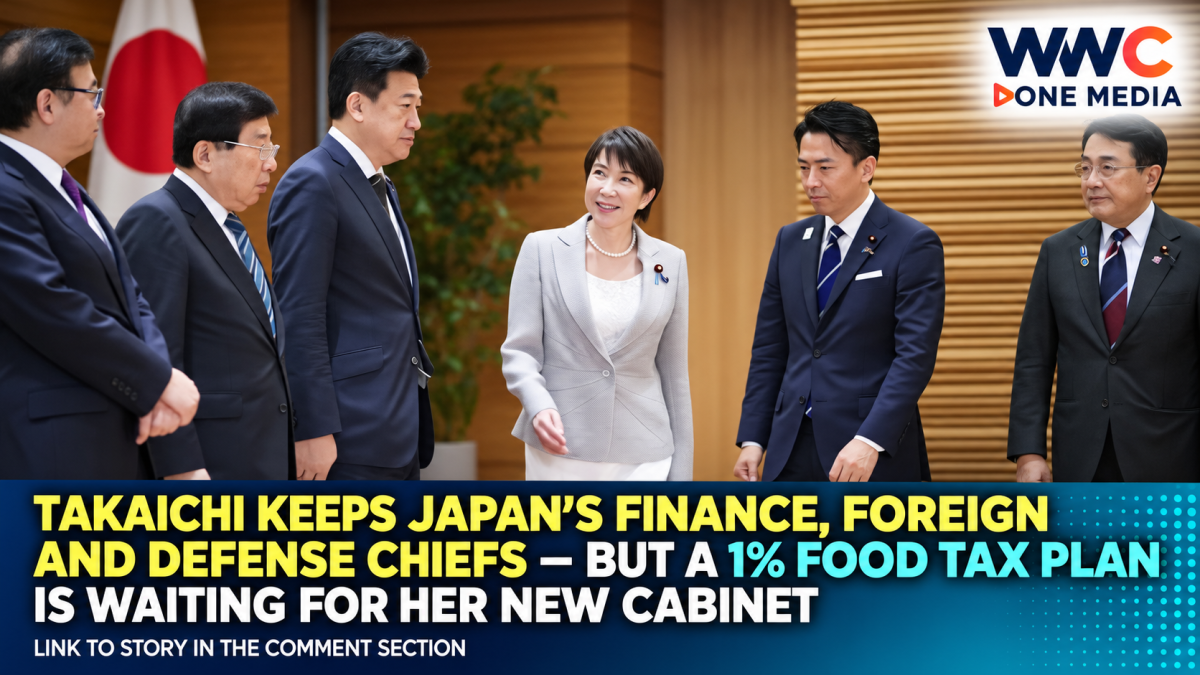
TOKYO — Prime Minister Sanae Takaichi has reshuffled Japan’s government without dismantling the team that built her economic, diplomatic and security agenda.
Instead of using her first Cabinet reshuffle for a dramatic political reset, Takaichi retained several of the ministers sitting at the centre of Japan’s biggest immediate policy battles: the yen, government debt, relations with Washington and Beijing, the Bank of Japan’s tightening cycle, defense expansion and a controversial plan to slash the consumption tax on food.
Finance Minister Satsuki Katayama stays.
Foreign Minister Toshimitsu Motegi stays.
Defense Minister Shinjiro Koizumi stays.
Chief Cabinet Secretary Minoru Kihara stays.
And economic revitalization minister Minoru Kiuchi, a prominent advocate of expansionary policy, also remains in place.
That makes the reshuffle less about changing Takaichi’s policy direction than about determining who will have to defend it when parliament returns.
And the first big test is already sitting on the table.
Japan wants to cut the food consumption tax from 8% to 1%
Two days before the reshuffle, Takaichi’s government approved the outline of one of its most politically prominent economic measures: a two-year reduction in Japan’s consumption tax on food from 8% to 1%, beginning in April 2027.
The plan also includes payments intended to offset the remaining tax burden.
But the government’s outline did not fully explain how it would replace the lost revenue. Reuters estimates the food-tax reduction would create a revenue shortfall of roughly ¥5 trillion.
That is why Takaichi’s personnel choices matter beyond ordinary Cabinet politics.
Keeping Katayama at the Finance Ministry provides continuity at the ministry expected to explain how Japan can deliver tax relief without destabilising its already stretched public finances.
Keeping Kiuchi in the economic-policy portfolio sends a different signal: Takaichi has not abandoned the expansionary approach that underpins her tax-and-spending agenda.
The new Cabinet therefore contains both sides of the tension inside Takaichi’s economic strategy.
Stimulate growth.
Reduce the cost-of-living burden.
But convince investors that Japan can still control its debt.
Bond markets are making that balance much harder
Japan enters the reshuffle with government borrowing costs at levels not seen for decades.
The benchmark 10-year Japanese government bond yield rose above 3% this week, reaching roughly three-decade highs, as investors questioned how much additional borrowing could be required to finance tax cuts and government spending.
Japan’s gross public debt is approximately twice the size of its economy, giving it the highest debt burden among major advanced economies by that measure.
Takaichi has pledged to keep new government-bond issuance around ¥40 trillion for the fiscal 2027 budget.
But Reuters notes that the promise is already being scrutinised because government ministries’ spending requests have risen toward levels last seen during the pandemic era, while Japan is also preparing for potentially higher defense expenditure.
So the political challenge is not simply whether lawmakers like the food-tax cut.
It is whether the government can show where the money comes from.
Katayama may be the most strategically important person Takaichi kept
Finance Minister Satsuki Katayama’s reappointment is particularly important because she has become central to both Japan’s domestic fiscal debate and its international currency management.
Reuters reported that Katayama played a leading role in discussions with U.S. Treasury Secretary Scott Bessent surrounding the rare joint U.S.-Japan intervention in currency markets in late July.
Japan had been struggling with a severely weakened yen, which raises the local-currency cost of imported oil, food and other goods.
Katayama, a former Finance Ministry bureaucrat, is generally viewed by analysts as more fiscally cautious than some of the administration’s stronger advocates of stimulus.
Reuters cited analysts saying her retention could provide some reassurance to bond investors concerned about Takaichi’s spending agenda. That is an attributed market assessment, not a guarantee that yields will fall.
Her task now becomes unusually difficult:
defend a tax cut,
prepare the 2027 budget,
control bond issuance,
manage the yen,
and do all of that while interest rates are rising.
Kiuchi represents the other side of the economic argument
Takaichi also retained Minoru Kiuchi, the minister overseeing economic revitalization.
Kiuchi has publicly expressed sympathy for the concept of running a “high-pressure economy,” meaning policy designed to keep aggregate demand strong in order to promote investment, wages and growth.
He has also expressed concern about the Bank of Japan raising borrowing costs too quickly.
When the BOJ raised rates in June, meeting minutes showed Kiuchi pressing the central bank on the possible economic consequences of its decision.
His retention was therefore interpreted by market analysts quoted by Reuters as evidence that Takaichi has not materially retreated from her expansionary fiscal orientation, even after the rise in bond yields.
That leaves Katayama and Kiuchi inside the same administration carrying somewhat different policy instincts.
The Cabinet will need both.
And the Bank of Japan could make everything more expensive
The reshuffle comes immediately before another major event.
The Bank of Japan is widely expected to raise its main policy rate by 25 basis points to 1.25%, which would put Japanese rates at their highest level in more than three decades.
Higher rates can help contain inflation and support the yen.
But they also increase the government’s borrowing costs over time as old debt matures and new bonds are issued at higher yields.
That is unusually important for Japan because the government carries such a large outstanding debt load.
The BOJ is also reducing the enormous bond purchases that helped suppress Japanese yields for years.
Takaichi therefore faces a fiscal environment very different from the ultra-low-rate era that supported earlier versions of aggressive stimulus.
Foreign Minister Motegi remains during a sensitive period with Washington and Beijing
Takaichi also kept Toshimitsu Motegi as foreign minister.
Motegi has been actively engaged with the administration of U.S. President Donald Trump and has met Secretary of State Marco Rubio multiple times, according to Japan Times reporting.
His retention provides continuity just as Japan faces significant uncertainty in its two most consequential great-power relationships.
Tokyo remains closely aligned with Washington on regional security while also managing an increasingly difficult relationship with Beijing.
Japan has particular concerns about developments around Taiwan and the East China Sea, while economic ties with China remain significant.
The government is also preparing to revise Japan’s key national-security documents later this year.
That helps explain the second major holdover.
Shinjiro Koizumi remains at Defense
Defense Minister Shinjiro Koizumi stays in place as Japan continues one of the most significant expansions of its postwar defense posture.
The Takaichi government is preparing another strategic review this year, and defense spending is one of the pressures confronting the budget.
Japan has been expanding missile units, electronic-warfare capabilities and military infrastructure across its southwestern islands, areas that sit close to Taiwan and the East China Sea.
Koizumi also carries domestic political significance.
He ran against Takaichi for the LDP leadership in 2025, as did Motegi and then-Internal Affairs Minister Yoshimasa Hayashi.
The Japan Times has noted that retaining prominent former leadership contenders inside senior government and party positions has the practical effect of keeping them directly involved in implementing the administration’s agenda, rather than operating entirely outside it. That is the newspaper’s political analysis rather than a stated motive from Takaichi.
The most politically significant newcomer comes from another party
The reshuffle does contain one major structural change.
Hiroshi Nakatsuka of the Japan Innovation Party is joining the government as the minister responsible for deregulation.
Reuters says he is the first JIP politician to enter the Cabinet since the party joined Takaichi’s coalition.
That is important because Takaichi’s coalition itself is relatively new.
For 26 years, the LDP’s traditional junior governing partner was Komeito.
That partnership collapsed in October 2025 after Komeito said the LDP had not adequately addressed its concerns over political-funding reform following the party’s political-funds scandal.
Takaichi then reached a coalition agreement with JIP, also known as Nippon Ishin no Kai, paving the way for her to become Japan’s first female prime minister on October 21, 2025.
For almost a year, however, JIP did not hold a Cabinet portfolio.
Nakatsuka’s appointment changes that.
Why giving JIP a Cabinet seat matters
A coalition partner can support a government in parliament without formally participating in executive decision-making.
Putting a JIP politician inside the Cabinet creates a more direct form of governing responsibility.
The party now has one of its own members publicly defending Cabinet decisions.
It also gains direct influence over the regulatory-reform portfolio.
At the same time, JIP becomes more visibly associated with the government’s successes and failures.
That potential trade-off had already been noted in Japanese political coverage before the reshuffle.
For Takaichi, the immediate advantage is institutional cooperation.
Her LDP controls the Lower House overwhelmingly after February’s election, but the ruling camp still does not command a straightforward majority in the Upper House.
That means upper-house negotiations can still matter even after the LDP’s historic lower-house victory.
The February election radically strengthened Takaichi’s position
Seven months before this reshuffle, Japanese voters transformed the parliamentary arithmetic.
In the February 8, 2026 Lower House election, the LDP won 316 of 465 seats, giving the party a two-thirds majority by itself.
With JIP included, the ruling coalition controlled 352 seats.
The result was historically large for the LDP.
It also gave the Lower House ruling bloc the constitutional numbers necessary in certain circumstances to override rejection by the Upper House on ordinary legislation, although the procedures and requirements vary depending on the legislation involved.
That power reduces—but does not eliminate—the political importance of winning cooperation in the Upper House.
Takaichi’s government therefore enters the autumn with substantial Lower House strength but still faces incentives to negotiate.
The reshuffle follows an equally cautious LDP leadership shake-up
A day before reorganising the Cabinet, Takaichi reshuffled the LDP leadership.
Again, she chose relatively limited change.
She retained Taro Aso as party vice president, Shunichi Suzuki as secretary-general and Takayuki Kobayashi as policy chief.
Former Economy Minister Hiroshi Kajiyama became chair of the LDP General Council, while former Deputy Chief Cabinet Secretary Hideki Murai took over the Diet affairs portfolio.
Takaichi said the appointments were designed to create a structure capable of implementing the commitments the LDP made during February’s election campaign.
Taken together, the party and Cabinet changes point to the same immediate objective:
keep most of the existing political machinery operating while bringing JIP further into the governing structure.
The political-funding scandal has not completely disappeared
One more appointment is likely to draw attention.
Jiji Press reported that Yoshihiro Seki, a former senior economy ministry official and LDP lawmaker, was set for his first Cabinet appointment. Jiji noted that Seki had been connected to the former Abe faction involved in the LDP political-funds scandal and described his appointment as the first Cabinet entry by a lawmaker linked to that episode since the scandal emerged.
That should be described carefully.
Association with the political-funds controversy is not itself the same as a criminal conviction, and reporting should distinguish between lawmakers being identified in factional funding irregularities and any separate legal finding against an individual.
The broader issue remains politically relevant because Komeito cited the LDP’s response to political-finance problems when it ended its 26-year coalition with the party last year.
Cost of living is likely to dominate the new Cabinet’s first weeks
For ordinary Japanese households, however, the most immediate question is not who moved from one ministry to another.
It is prices.
Reuters says Takaichi is under pressure because households continue to face elevated living costs, creating the political rationale behind her food-tax proposal and other relief measures.
A lower food tax is easy to communicate politically.
Funding it is much harder.
The government says it does not intend to finance the reduction simply by issuing deficit-covering bonds, and Katayama has stressed the administration’s commitment to reducing the debt-to-GDP ratio over time.
But a revenue loss approaching ¥5 trillion still has to be offset somewhere.
That could mean other revenue, expenditure cuts, stronger-than-expected tax receipts or another fiscal mechanism.
Those details are likely to become central to parliamentary debate.
Defense spending creates a second expensive commitment
At the same time, Japan is preparing for further national-security investment.
The government’s strategic review could result in additional defense spending as Tokyo responds to regional military developments involving China, North Korea and Russia.
The recent election of a government-backed governor in Okinawa could also affect Tokyo’s ability to pursue military infrastructure plans in Japan’s strategically important southwest.
None of that spending occurs in isolation.
Food-tax relief, defense, social security, debt servicing and economic stimulus all compete inside the same national budget.
And higher interest rates mean a growing portion of future government expenditure could be absorbed simply by servicing existing debt.
That is why the new Cabinet’s economic team may matter as much as the headline personnel changes.
Takaichi’s reshuffle is therefore notable for what did not change
Cabinet reshuffles often create headlines through dismissals.
This one is notable because the highest-profile portfolios were left largely intact.
Katayama remains responsible for finance.
Motegi remains responsible for diplomacy.
Koizumi remains responsible for defense.
Kihara remains the government’s principal spokesman and coordinating minister.
Kiuchi remains influential over economic policy.
And JIP finally moves inside the Cabinet through Nakatsuka.
The lineup suggests that Takaichi does not view the government’s main challenge as needing a new policy direction.
The challenge is implementing the existing one under more difficult economic conditions.
That last sentence is an analytical reading of the personnel pattern, consistent with reporting from Japan Times and Reuters rather than an official government characterization.
The timing could hardly be more complicated
Japan now has several major policy decisions converging almost simultaneously.
The Bank of Japan is tightening monetary policy.
Bond yields have hit multi-decade highs.
The yen remains sensitive to U.S.-Japan interest-rate differences.
The government is proposing a two-year food-tax cut.
A fiscal 2027 budget must be assembled.
Defense strategy is under review.
And parliament will soon begin scrutinising how the government plans to pay for its promises.
That is the context in which Takaichi chose stability.
Changing the people running finance, foreign affairs or defense would have created another layer of uncertainty.
Instead, she has left the central structure standing.
So this is less a reset than a test of the existing strategy
Takaichi’s Cabinet reshuffle does change the government.
JIP gains its first minister.
Some secondary portfolios change hands.
New lawmakers receive ministerial responsibility.
But the officials responsible for the government’s most sensitive economic, diplomatic and security files remain where they were.
That makes the political message relatively clear even without treating it as an endorsement or criticism.
Takaichi is entering the autumn parliamentary session with largely the same senior team.
What changes now is the environment around them.
Japan’s borrowing costs are higher.
Markets are scrutinising fiscal policy more closely.
The BOJ is tightening.
Households want relief from rising prices.
And the government is asking parliament to support one of its largest consumer-tax changes in years.
The reshuffle may therefore be remembered less for who entered the Cabinet than for what the retained ministers were immediately asked to deliver.
The personnel story is continuity.
The policy story is whether that same team can make tax cuts, debt control and higher spending coexist.




Leave a Reply