
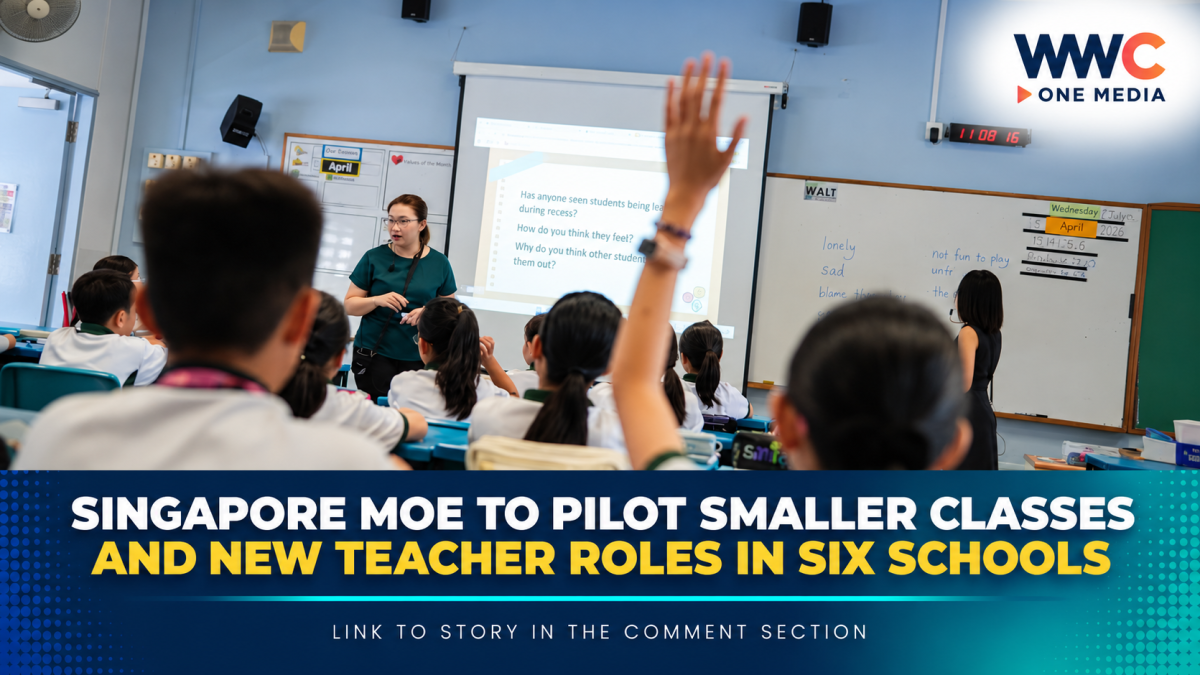
Singapore’s Ministry of Education (MOE) will pilot smaller classes, flexible learning spaces and redesigned teacher responsibilities in six schools from January 2027 as part of efforts to strengthen teaching and student development.
The pilot will involve three primary schools — St Anthony’s Canossian Primary School, Woodgrove Primary School and Zhangde Primary School — and three secondary schools: Commonwealth Secondary School, Deyi Secondary School and Jurongville Secondary School.
Education Minister Desmond Lee announced the plans at the annual Schools Work Plan Seminar, saying the changes are intended to give teachers more time and space to focus on students’ learning and development.
Under the pilot, MOE will explore classrooms with movable and modular furniture that can be rearranged for whole-class lessons, small-group activities and other forms of learning.
The ministry will also study whether smaller classes could benefit more students, particularly in situations where closer teacher attention and more timely feedback could improve learning.
However, Lee noted that smaller classes would not automatically reduce teachers’ workloads, as teachers could end up teaching more classes. MOE will therefore examine smaller class sizes alongside other measures designed to create additional capacity for teachers.
Another proposal would allow teachers to focus on two of three responsibilities outside classroom teaching: form teacher duties, co-curricular activities and committee work.
The aim is to reduce the amount of time teachers spend switching between different responsibilities and allow them to devote more attention to classroom teaching and interactions with students.
MOE will also explore greater support from coaches, instructors, non-teaching staff and external partners for activities such as CCAs and other student development programmes.
The pilot schools will have flexibility to adapt the changes according to their individual needs. Woodgrove Primary, for example, plans to allow teachers to take on two of the three non-classroom responsibilities based on their strengths, preferences and the school’s needs.
Deyi Secondary will have every teacher serve as a form teacher while taking on either a CCA or committee role. The school also plans to use student development officers to help manage CCAs and routine administrative work.
The changes will also include greater use of technology. MOE’s Teacher Workspace platform, which brings student information, tools and everyday workflows together, will be rolled out to all MOE schools by 2027.
The ministry said the platform is intended to reduce administrative work and give teachers a more complete view of students’ needs and development.
The six-school pilot will allow MOE to assess how the different approaches work in practice before considering whether some of them could be introduced more widely across Singapore’s education system.



Leave a Reply