
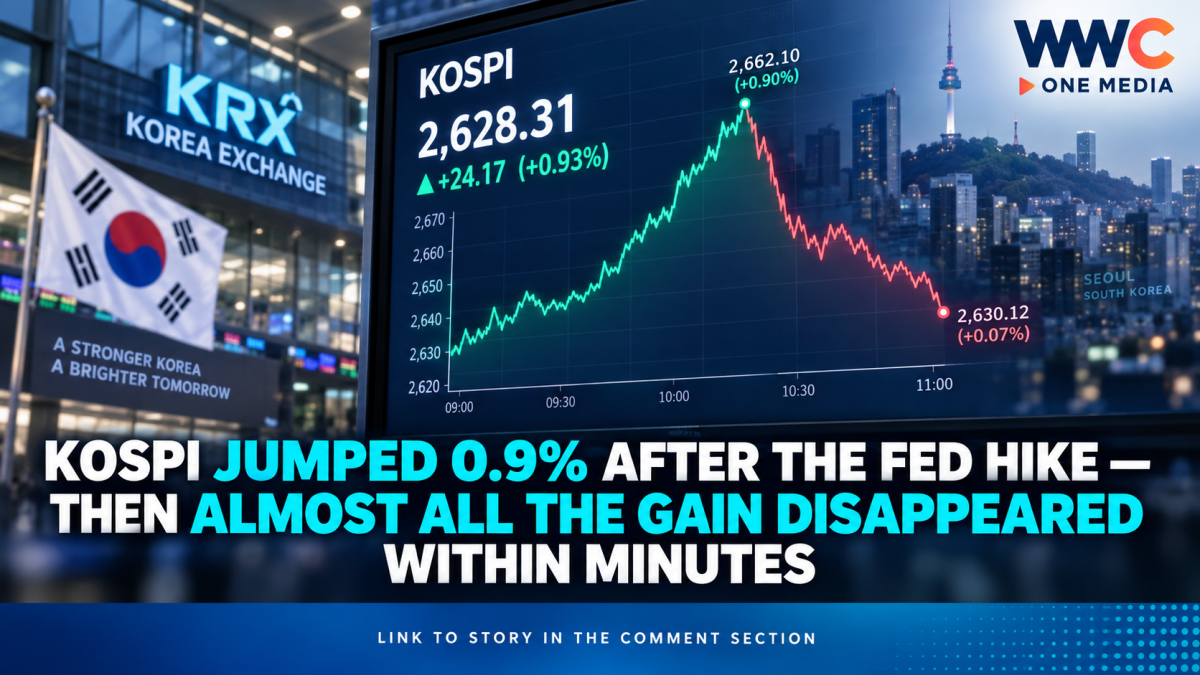
SEOUL — South Korean stocks initially brushed aside the Federal Reserve’s first interest-rate hike in more than three years on Thursday, September 17, but the optimism faded almost as quickly as it arrived.
The benchmark KOSPI opened 61.05 points, or 0.91%, higher at 6,779.02, despite Wall Street closing lower after the Fed increased U.S. rates overnight. But by 9:14 a.m., the index was up only 6.49 points, or 0.1%, at 6,724.46, according to the Korea Herald.
That rapid retreat may be more revealing than the positive opening itself.
Investors had largely anticipated the Fed’s quarter-point move. What they are still trying to price is what comes next: another U.S. rate increase, possible additional tightening from the Bank of Korea, a firmer dollar and uncertainty over whether South Korea’s crucial semiconductor rally has enough strength left to carry the market higher.
In other words, Korea survived the first Fed hike.
The harder question is whether it can absorb the next one.
The Fed did exactly what markets feared — and expected
The Federal Reserve unanimously raised the federal funds target range by 25 basis points to 3.75%-4.00%, its first increase since July 2023.
The central bank said U.S. economic activity remained solid, domestic spending was resilient and capital investment strong, but inflation was still elevated. It said the rate increase would support a more timely return toward its 2% inflation objective.
The fact that the hike was widely anticipated helped explain why Seoul shares did not immediately tumble.
South Korean financial authorities reached a similar conclusion Thursday morning, saying the Fed move should have a limited near-term market impact because much of it had already been reflected in asset prices. Finance Minister Koo Yun-cheol, Bank of Korea Gov. Shin Hyun-song and other senior financial officials nevertheless agreed to closely monitor currency and government-bond volatility and said stabilisation measures could be deployed if necessary.
That is the difference between a rate hike and a rate shock.
The 25-basis-point increase itself was no surprise.
The future path is.
Samsung helped lift the market — SK Hynix did not
The opening rally was partly supported by technology shares, but even within Korea’s semiconductor giants, the picture was mixed.
At 9:14 a.m., Samsung Electronics was up 0.3%, while SK Hynix had fallen 0.8%. Battery maker LG Energy Solution dropped 0.82%, while KB Financial gained 1.47% and defense company Hanwha Aerospace rose 1.14%.
Earlier in the session, Samsung had traded nearly 1% higher, while SK Hynix was only slightly negative, illustrating how quickly sentiment shifted after the opening bell. The KOSDAQ also started higher, reaching about 820.66 shortly after 9 a.m. before extending its gains.
That divergence matters because the KOSPI has become extraordinarily dependent on Korea’s largest semiconductor companies.
When Samsung and SK Hynix rally together, they can pull the entire benchmark sharply higher.
When they weaken, the reverse can happen with remarkable speed.
Korea’s chip rally had already lost momentum before the Fed meeting
Thursday’s cautious trading did not begin with Jerome Powell’s successor or the Federal Reserve.
Korean chip shares were already under pressure.
The Korea Herald reported earlier this week that more than 200 trillion won — roughly US$147 billion — had been erased from the combined market capitalisation of the KOSPI and KOSDAQ over about a month, with Samsung Electronics and SK Hynix responsible for a large share of the decline.
Samsung’s market value had fallen to about 1,449.9 trillion won, nearly 30% below its June peak, while SK Hynix had dropped to roughly 1,233.8 trillion won, around 40% below its June high.
Investors have been reassessing whether the extraordinary AI-driven demand boom can sustain the valuations reached earlier this year.
Concerns about the pace of artificial-intelligence development have added to those doubts.
That means Thursday’s market was confronting two very different forces simultaneously:
lower valuations that tempt bargain hunters — and uncertainty over whether the chip cycle has already peaked.
The opening jump may have been a relief trade
Seoul Economic Daily reported that investors appeared to view much of the Fed risk as already priced into markets.
Falling oil prices and improved sentiment toward AI-related shares also helped buyers return at the open.
The KOSPI briefly traded above 6,780 before pulling back.
That kind of movement often happens when markets prepare for a potentially negative event, then discover that the actual outcome is close to what was expected.
Investors who sold beforehand can buy back.
Short sellers can cover positions.
But neither necessarily means that the fundamental risk has disappeared.
And Korea’s next monetary-policy decision may prove more important domestically than the Fed’s September hike.
The Bank of Korea already raised rates twice — and may have to do it again
South Korea entered the Fed decision in a very different position from where it stood only a few months ago.
The Bank of Korea raised its benchmark rate in both July and August, taking it to 3%. Those were Korea’s first back-to-back increases since early 2023.
After the Fed moved to 3.75%-4.00%, the maximum policy-rate gap between the United States and South Korea widened to 1 percentage point.
That gap matters because higher U.S. yields can increase the relative attraction of dollar assets, creating pressure on currencies such as the Korean won.
Analysts cited by Yonhap said South Korea’s own combination of inflation, currency pressure, household debt and elevated property prices could push the BOK toward another increase before year-end.
One analyst, Kim Myung-sil of iM Securities, said the BOK appears to be debating the timing and speed of additional tightening more than whether further tightening will occur at all. A possible November increase has been discussed, although that remains an analyst expectation rather than a predetermined decision.
The BOK is not united on how aggressively to tighten
Further Korean rate increases are not automatic.
Minutes from the BOK’s August meeting showed disagreement inside the Monetary Policy Board even though it ultimately approved the increase to 3%. One policymaker dissented, highlighting risks to more vulnerable sections of the economy and arguing for time to assess the effect of earlier tightening.
That leaves the BOK facing a difficult balancing act.
Inflation above target argues for higher rates.
A weaker won can reinforce that case by making imported energy and other foreign goods more expensive.
High Seoul property prices and household borrowing create another reason to avoid overly loose monetary conditions.
But raising rates also makes mortgages, business financing and other debt more expensive.
For Korean equity investors, the question is therefore no longer simply whether the Fed is hawkish.
It is how much of that hawkishness the BOK will ultimately have to match.
Korea’s economy is giving the BOK room to stay hawkish
One reason policymakers can contemplate more tightening is that the economy has remained resilient.
The Korea Herald reported that South Korea’s nominal GDP posted its fastest second-quarter growth rate in 47 years, helped by exports and AI-related investment.
The BOK has said robust economic growth and inflation above its target are expected to persist for some time, making the timing and pace of further rate increases an active policy question.
That economic strength is good news for corporate earnings.
But markets face an awkward paradox.
Strong growth can support stock prices.
Strong growth can also give central banks enough confidence to raise interest rates further.
So data that would normally be bullish may now carry a second message: the economy is strong enough to withstand tighter money.
The Korean won is becoming another number investors cannot ignore
At 9:14 a.m. Thursday, the dollar was quoted at around 1,374.3 won, 2.7 won higher than the previous session’s reference level reported by the Korea Herald.
The exchange rate matters especially for South Korea because the country imports much of its energy and raw materials.
A weaker won can raise import costs.
That can add to inflation.
And persistent inflation can increase the likelihood that the BOK keeps rates high or lifts them further.
At the same time, the effect is not universally negative for Korean companies. Major exporters such as semiconductor, automobile and shipbuilding groups generate substantial revenue abroad, meaning currency movements can sometimes benefit their reported earnings when foreign income is converted back into won.
The market effect therefore depends on which companies investors own.
Foreign investors have only just started returning
Another important backdrop emerged Thursday from fresh Bank of Korea data.
Foreign investors became net buyers of Korean shares in August for the first time after seven consecutive months of selling, purchasing a net US$400 million of equities.
That improvement followed an extraordinary US$20.7 billion in net foreign stock selling during July.
The August turnaround suggests foreign sentiment toward Korean equities was beginning to stabilise.
But the scale of the previous outflow also shows how rapidly global investors can move capital when risk perceptions change.
If U.S. rates continue rising and Treasury yields become more attractive, international investors will again have to decide whether Korean equities offer enough additional return to justify currency and market risk.
That is why the Fed matters to Seoul even when the Korean economy itself is doing reasonably well.
Wall Street’s reaction was much less enthusiastic
The KOSPI’s positive opening also contrasted with what happened in New York.
After the Fed announcement, the Dow Jones Industrial Average fell 1.21%, the S&P 500 dropped 0.45%, and the Nasdaq Composite was almost unchanged, slipping 0.01%.
That divergence does not necessarily mean Korean investors were more optimistic about the Fed.
Timing matters.
Asian markets opened after investors had several additional hours to digest the decision, including movements in currencies, Treasury yields and commodities.
And because the increase had been heavily anticipated, some traders could treat the event as the removal of one immediate uncertainty.
Still, the fact that the KOSPI’s 0.91% opening gain narrowed to barely 0.1% within minutes shows that enthusiasm was limited.
The Fed itself is signalling this may not be over
The Federal Reserve’s new projections make the Korean market’s caution easier to understand.
The September policy projections show a substantial majority of Fed participants expecting the federal funds rate to end 2026 above its current midpoint, consistent with further tightening if inflation does not improve sufficiently.
Reuters likewise reported that the Fed flagged additional hikes in the coming months after September’s increase.
The Fed has not promised another move.
Future decisions will depend on inflation, employment and economic activity.
But markets are now confronting a very different interest-rate narrative from the one that dominated previous easing periods.
The debate is no longer about when rates will fall.
It is increasingly about how high they may need to go before inflation finally retreats.
For Korean stocks, that puts even more pressure on earnings
Higher interest rates change the mathematics of investing.
When cash and government bonds offer better yields, investors demand more compensation for taking the extra risk of owning stocks.
Highly valued growth companies can be particularly sensitive because much of their valuation depends on profits expected far in the future.
Korea’s technology sector therefore faces a double test.
Companies such as Samsung Electronics and SK Hynix must convince investors that AI and memory-chip demand can continue generating enormous earnings.
At the same time, those earnings must be strong enough to justify valuations in a world where both U.S. and Korean interest rates are rising.
That is a much higher bar than during an easing cycle.
The real signal was not that KOSPI rose — it was how quickly the rally faded
A simple headline could say Korean shares rose despite the Fed.
Technically, that was true during the early session.
But it misses what happened underneath.
The KOSPI opened 0.91% higher at 6,779.02.
Minutes later, it was up only 0.1% at 6,724.46.
Samsung remained positive.
SK Hynix was negative.
The won was under pressure.
And analysts were already discussing when the Bank of Korea could deliver another hike.
That looks less like investors ignoring the Fed and more like a market struggling to decide whether the bad news had already been priced in.
For now, South Korean equities have absorbed the Federal Reserve’s first hike since 2023 without a major breakdown.
But the next phase may be considerably more difficult.
Because if the Fed raises rates again — and the BOK follows — Korea’s record-setting stock market will increasingly need earnings, rather than cheaper money, to do the heavy lifting.

Leave a Reply