
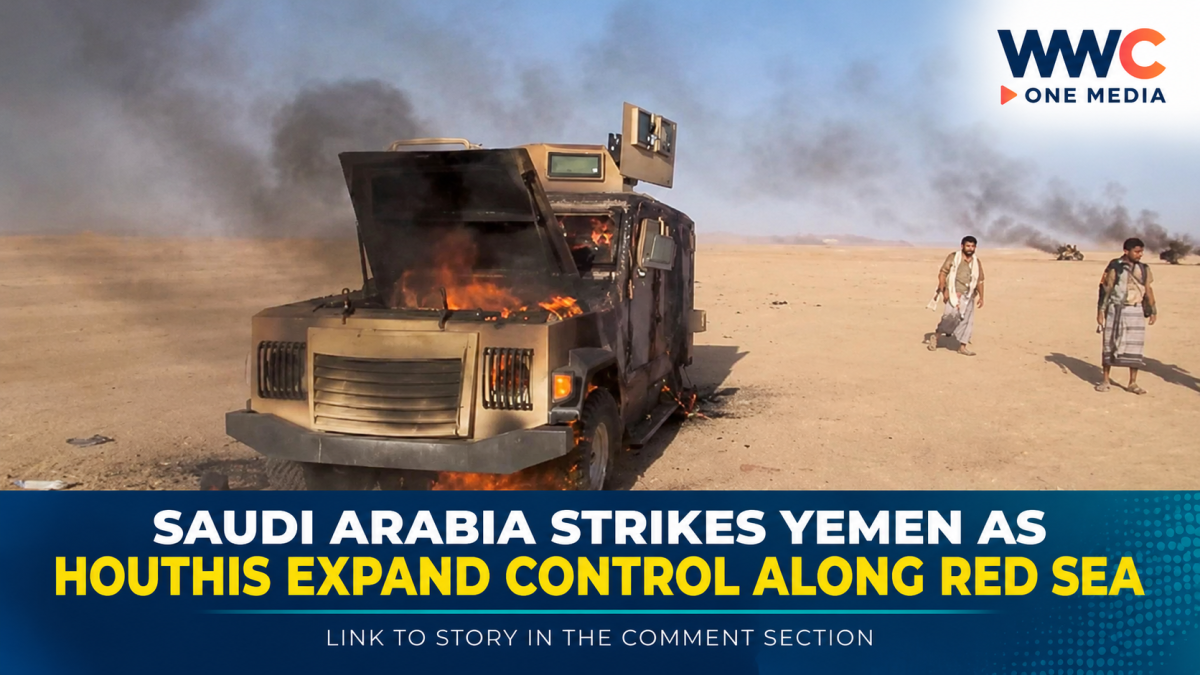
Saudi Arabia has launched air strikes against Houthi positions in Yemen as the Iran-aligned group consolidates recent territorial gains along the Red Sea coast, adding a new front to the wider Middle East conflict.
The Houthis said Saudi warplanes carried out hundreds of strikes in Yemen this week. Officials in Yemen’s Saudi-backed government have acknowledged that Saudi and allied forces were conducting air strikes against Houthi positions, although Riyadh has not publicly confirmed the reported number of attacks.
The escalation follows a rapid Houthi advance through towns along Yemen’s Red Sea coast and the seizure of strategically located islands near the Bab el-Mandeb Strait, one of the world’s important maritime chokepoints.
Houthi fighters have also captured military equipment abandoned by Saudi-backed forces during their retreat. Houthi military spokesman Yahya Saree claimed that the group had shot down a Saudi F-15 fighter jet, although no independent evidence had immediately emerged to confirm the claim.
The Houthis have also launched attacks toward Saudi Arabia over the past week, triggering security alerts in several parts of the kingdom. Saudi authorities said their air defences intercepted a Houthi drone south of Mecca before it entered restricted airspace. The Houthis denied targeting the holy city.
The renewed fighting is creating additional risks for global energy supplies. Saudi Arabia’s East-West oil pipeline, which provides an alternative route for transporting crude when shipments through the Strait of Hormuz are disrupted, was damaged in an attack attributed to Iran-aligned fighters in Iraq.
The pipeline’s prolonged closure could affect a significant portion of global oil supplies. Saudi authorities have not announced when full operations will resume, while US officials have said they expect oil flows through the pipeline to restart within days.
Oil markets have already reacted to the widening conflict. Brent crude traded around US$108 a barrel on Wednesday, close to its highest level since May, while US diesel prices reached another record high.
The latest escalation marks a sharp reversal after years of reduced fighting between Saudi Arabia and the Houthis. Saudi Arabia has led a coalition against the group since 2015, but a period of relative calm followed a ceasefire arrangement in recent years.
The conflict intensified again after the Houthis declared a naval blockade against Saudi Arabia in July and began launching attacks toward the kingdom. Their latest advance has now brought the fighting closer to critical shipping routes around the Red Sea and Bab el-Mandeb.
Saudi Crown Prince Mohammed bin Salman has sought US military assistance as the situation has deteriorated. So far, US involvement has largely focused on intelligence support rather than direct military intervention.
The United States previously carried out a two-month campaign against the Houthis in 2025 before reaching a ceasefire. The latest Houthi advances have raised questions about whether Washington will become more directly involved as Saudi Arabia attempts to protect its territory and maintain access to vital oil-export routes.
The widening conflict in Yemen adds another layer of uncertainty to an already volatile Middle East, with developments around the Red Sea, Bab el-Mandeb and Strait of Hormuz increasingly linked to global energy and shipping security.


Leave a Reply