
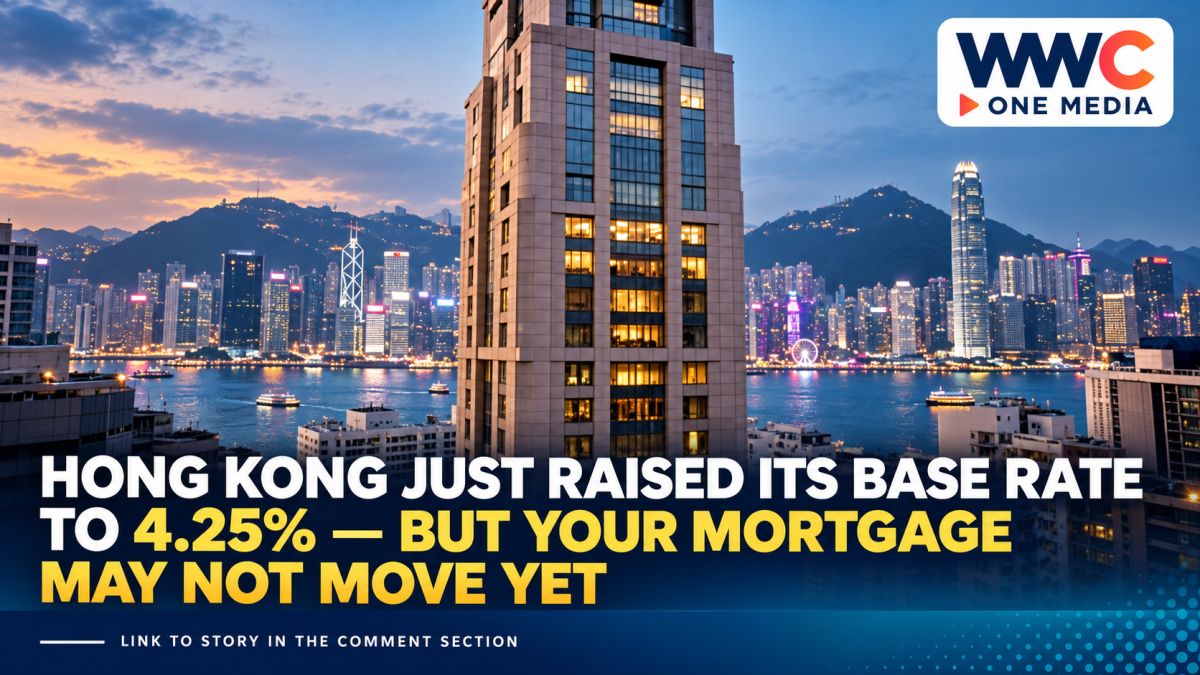
HONG KONG — Hong Kong has raised its benchmark Base Rate for the first time in more than three years, following the U.S. Federal Reserve higher and putting renewed pressure on borrowers just as the city’s property market was trying to regain its footing.
The Hong Kong Monetary Authority raised its Base Rate by 25 basis points to 4.25% on Thursday, September 17, hours after the Federal Reserve lifted the federal funds target range by the same amount to 3.75%–4.00%.
It was the first rate increase by both central banks since July 2023.
But Hong Kong homeowners should pay close attention to one important distinction:
The HKMA’s Base Rate is not a retail mortgage rate.
It is the rate used as the basis for calculating the cost of borrowing through the HKMA’s Discount Window. Hong Kong’s commercial banks separately determine their prime lending, savings and mortgage rates according to their own funding costs and market conditions.
That makes the next move by banks such as HSBC, Hang Seng Bank, Bank of China (Hong Kong) and Standard Chartered arguably more important to households than Thursday morning’s headline number.
Why Hong Kong had little choice but to follow the Fed
The explanation starts with Hong Kong’s currency.
The Hong Kong dollar has been linked to the U.S. dollar under the Linked Exchange Rate System since 1983.
Under the current framework, the HKMA keeps the currency inside a trading band of roughly HK$7.75 to HK$7.85 per U.S. dollar.
Because of that peg, Hong Kong cannot conduct monetary policy as independently as an economy with a freely floating currency.
Hong Kong dollar interest rates normally move broadly in the same direction as U.S. rates. If the gap becomes too wide, investors can move money between Hong Kong dollars and U.S. dollars to exploit the difference, creating pressure on the exchange rate.
That is why a Federal Reserve decision made thousands of kilometres away in Washington can eventually affect mortgages, corporate borrowing and deposits in Hong Kong.
Why exactly 4.25%?
The HKMA does not simply copy the Federal Reserve’s headline rate.
Its Base Rate is determined by a preset formula.
The rate is set at the higher of:
50 basis points above the lower end of the U.S. federal funds target range, or the average of the five-day moving averages of Hong Kong’s overnight and one-month interbank rates.
Following the Fed’s increase, the lower end of the U.S. target range became 3.75%.
Add 50 basis points and the result is 4.25%.
The alternative HIBOR-based calculation was around 2.50%, according to reporting citing the HKMA’s Thursday calculation, so the U.S.-rate formula produced the higher figure and became the new Base Rate.
The change took effect immediately.
This does NOT automatically mean mortgages just rose 0.25 percentage point
This is where the difference between Hong Kong’s Base Rate and actual borrowing costs matters.
Retail lending rates are commercial decisions made by individual banks.
The HKMA itself says Hong Kong’s Best Lending Rate — commonly known as the prime rate — is determined by individual banks, although movements in interbank funding costs can influence those decisions.
That means Thursday’s 25-basis-point HKMA increase does not automatically mean every homeowner’s mortgage repayment rises by exactly 25 basis points.
As of Thursday morning, major lenders had yet to announce whether they would change their retail lending rates.
HSBC, Hang Seng and Bank of China (Hong Kong) were reported to have prime lending rates around 5%, while Standard Chartered and several other major banks were around 5.25% ahead of their latest decisions.
Those bank announcements are now the number borrowers should watch.
HIBOR may matter more to many mortgage borrowers
Another number deserves attention: HIBOR, the Hong Kong Interbank Offered Rate.
Many Hong Kong mortgages are linked to HIBOR rather than directly to the HKMA Base Rate.
The official Hong Kong Association of Banks fixing showed one-month HIBOR at 2.95% on September 16, up from about 2.91% a day earlier.
Three-month HIBOR stood at about 3.12%, while the 12-month rate was 3.75%.
Those figures illustrate why Hong Kong’s borrowing environment can sometimes diverge from the United States even while the currency peg remains intact.
Local banking liquidity, deposit competition and capital flows can all influence Hong Kong dollar funding costs.
The result is that a Fed hike may reach homeowners indirectly and unevenly rather than through a simple one-for-one increase overnight.
The timing is awkward for Hong Kong’s property market
The rate increase arrives just as Hong Kong housing appeared to be emerging from a long downturn.
Private home prices rose for more than a year before suffering a setback in July.
Official data showed prices falling 0.5% in July 2026, the first monthly decline since March 2025.
South China Morning Post, citing Rating and Valuation Department figures, put the decline at 0.46%, with the second-hand home-price index slipping to 321.5 from 323 in June.
Even after that decline, residential prices were still up about 7.3% for the year to July, according to CBRE figures cited by the newspaper.
A renewed period of higher interest rates could complicate that recovery.
Higher mortgage costs generally reduce what buyers can afford, discourage some investors and increase financing expenses for developers.
That does not guarantee Hong Kong home prices will fall — supply, employment, mainland Chinese demand, government measures and investor sentiment also matter — but the return of monetary tightening removes one source of support the market enjoyed during the earlier easing cycle.
Commercial property may be even more exposed
Hong Kong’s commercial property sector is already dealing with tighter credit conditions.
Industry figures cited by the South China Morning Post this week showed only around 20% of commercial property transactions in 2026 involved mortgage financing, sharply below levels seen during the market’s stronger years.
Property specialists said banks had become more conservative about approving commercial-property loans and warned of a potential feedback loop between weaker demand and tighter credit.
A new rate-hiking cycle could make financing even more expensive for office, retail and industrial property investors.
The risk is particularly relevant because Hong Kong faces monetary conditions tied to the United States even when its own property cycle differs substantially from America’s.
Why did the Fed raise rates in the first place?
The move began in Washington.
The Federal Reserve lifted its benchmark range by 25 basis points to 3.75%–4.00% on September 16, its first increase since July 2023.
Persistent U.S. inflation was the central reason.
August U.S. consumer prices were 3.4% higher than a year earlier, while the Fed’s preferred inflation measures remained above its long-term 2% goal. Energy prices and resilient consumer demand have added to inflation concerns.
The decision was unanimous.
More importantly for Hong Kong, Federal Reserve policymakers signalled the possibility that Thursday’s imported rate increase may not be the last one.
New projections indicated policymakers expected another increase before the end of 2026, which would take the U.S. target range to around 4.00%–4.25% if delivered in another quarter-point step.
Goldman Sachs went further on Thursday, shifting its forecast to another 25-basis-point increase as soon as the Fed’s October meeting.
That forecast is not a certainty. Future Fed decisions will depend on inflation, employment and other economic data.
But it means Hong Kong borrowers cannot automatically assume the September hike is a one-off.
Hong Kong’s unusual dilemma
The latest move highlights a structural reality of the Hong Kong economy.
The currency peg provides exchange-rate stability — something particularly valuable for a major international financial centre.
But that stability comes with a trade-off.
Hong Kong effectively imports a significant part of U.S. monetary conditions even when its own economy, property market and inflation picture may call for something different.
When Washington cuts, Hong Kong usually gets easier monetary conditions.
When Washington tightens, Hong Kong feels pressure in the opposite direction.
The system has survived major global shocks since its introduction in 1983, and the HKMA continues to describe currency stability under the Linked Exchange Rate System as one of its central responsibilities.
For consumers, however, the abstract mechanics of a currency board become very tangible when they reach a monthly mortgage statement.
There is another twist: Hong Kong rates do not always copy America perfectly
“Tracking the Fed” does not mean every Hong Kong interest rate moves by the exact same amount at the exact same time.
Local liquidity conditions can cause HIBOR to trade substantially below or above comparable U.S. rates.
That gap matters.
Ahead of Thursday’s decision, one-month HIBOR was only 2.95%, significantly below the new 3.75% lower bound of the U.S. federal funds range.
The HKMA has previously explained that interest-rate differentials can cause funds to move between Hong Kong dollars and U.S. dollars until arbitrage and exchange-rate adjustments help restore balance.
HKMA chief executive Eddie Yue said Thursday that the interest-rate gap between Hong Kong and the United States could widen and put some downward pressure on the Hong Kong dollar, while describing financial markets as orderly.
That means local liquidity may partly determine how quickly Thursday’s tightening works its way through the economy.
Savers could eventually benefit too
Higher rates are painful for borrowers, but the effect is different for depositors.
If Hong Kong banks eventually raise savings or fixed-deposit rates, people holding cash could earn higher returns.
The same banking economics that put upward pressure on loan rates can therefore improve deposit yields.
But again, those changes are not automatic.
Deposit rates are set commercially by individual banks, just like prime lending rates.
For consumers, the consequences of Thursday’s decision could therefore vary sharply depending on whether they are borrowers or savers.
Hong Kong’s broader economy enters the rate hike from a stronger position
The tightening also arrives during a period of renewed momentum in parts of Hong Kong’s financial sector.
Reuters reported earlier this month that the city’s IPO market raised about US$83.5 billion during the first eight months of 2026, up 76% from a year earlier, helping attract finance professionals and companies back to the territory.
More than 400 companies had expanded or established operations in Hong Kong during 2026, bringing more than HK$53 billion in foreign direct investment and creating over 8,600 jobs, according to figures cited by Reuters.
That strength provides some cushion against tighter financial conditions.
But the picture is uneven.
Residential property has only recently regained some ground, while commercial real estate remains under pressure and households are still highly sensitive to changes in borrowing costs.
The next announcement may matter more than Thursday’s
The HKMA has now done what Hong Kong’s exchange-rate framework strongly pointed toward: it followed the Fed.
The next question cannot be answered by looking only at the HKMA.
It will be answered by the banks.
If HSBC, Hang Seng, Bank of China (Hong Kong), Standard Chartered and other lenders raise their prime rates, the Fed’s September decision will move much more directly into household and business finances.
If banks hold their retail rates steady because local funding conditions remain relatively comfortable, the immediate impact on many borrowers could be much smaller.
And beyond that sits another risk.
The Federal Reserve is signalling that another U.S. rate increase could still come before the end of 2026.
If that happens, Hong Kong could once again find itself following Washington higher.
So the real story is not simply that Hong Kong’s Base Rate just reached 4.25%.
It is that, after more than three years without a rate increase, the direction of travel has suddenly changed — and homeowners, businesses and property investors are waiting to see how far Hong Kong’s banks follow.

Leave a Reply