
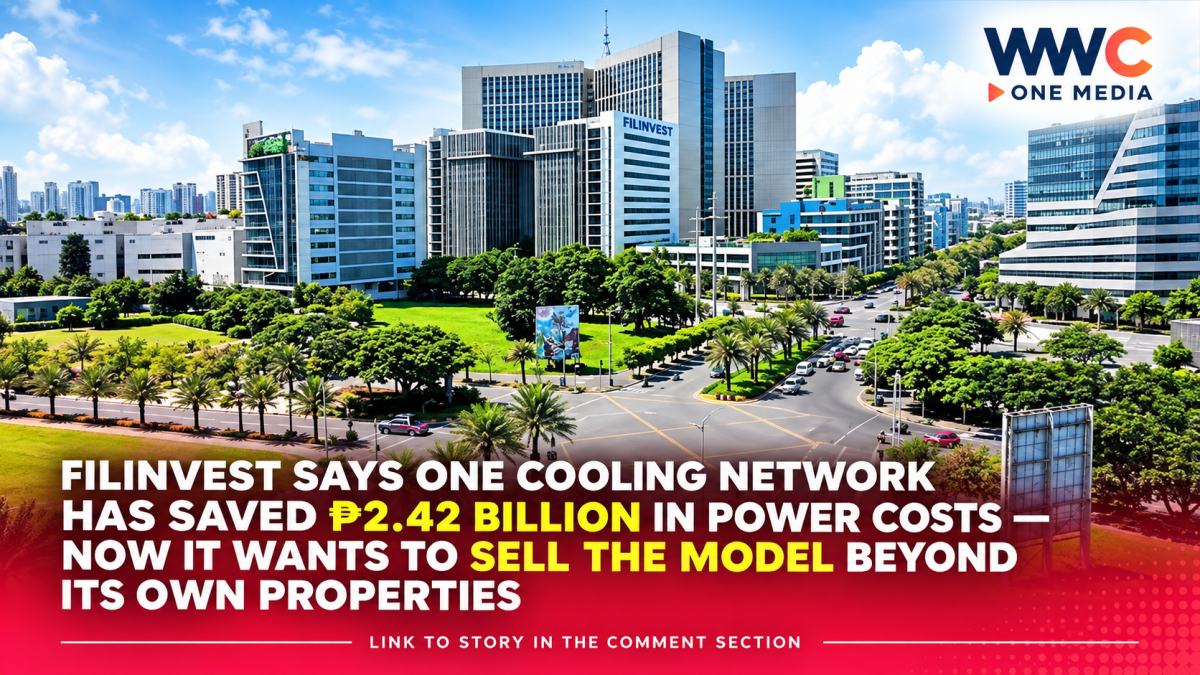
MANILA, Philippines — Filinvest has spent years using a giant centralized cooling system to keep offices in Alabang comfortable. Now the company says the technology has saved enough electricity to be worth roughly ₱2.42 billion—and it wants other Philippine property owners to buy into the same idea.
Philippine DCS Development Corp. or PDDC, the joint venture between Filinvest Land Inc. and French energy group ENGIE, is expanding its energy-efficiency business beyond Filinvest developments as rising electricity costs push malls, offices, hotels and large commercial estates to look harder at one of their biggest power expenses: air-conditioning.
At the heart of that strategy is Filinvest City’s district cooling network in Muntinlupa.
As of the end of June 2026, PDDC says the system had avoided more than 108 gigawatt-hours of electricity consumption since 2017, representing approximately ₱2.42 billion in energy-cost savings at current prices.
It also prevented an estimated 76,000 metric tons of carbon dioxide emissions, according to figures cited by Filinvest and BusinessMirror.
Those numbers are company calculations rather than an independently audited estimate of cash profits.
But they illustrate why Filinvest increasingly sees cooling not simply as an operating expense—but as a business opportunity.
One cooling plant, 16 buildings
Traditional commercial buildings commonly operate their own chillers and air-conditioning infrastructure.
A district cooling system approaches the problem differently.
Instead of every building maintaining a separate cooling plant, a centralized facility produces chilled water and distributes it through a network of pipes to multiple buildings.
PDDC’s Northgate Cyberzone system currently serves 16 office buildings in Filinvest City. Centralizing the equipment allows cooling demand to be pooled, potentially improving utilization while reducing duplication of expensive machinery inside individual properties.
PDDC General Manager Jonathan Urbano says its current facilities operate at about 0.60 kilowatt per ton of refrigeration, translating to energy savings of at least 40% compared with the relevant conventional systems used as their benchmark.
Filinvest has separately said air-conditioning can account for a very large share of electricity consumption in certain commercial properties, making cooling an obvious target when building owners seek immediate efficiency gains.
That matters particularly in the Philippines, where high temperatures and humidity mean large malls, offices, hotels and business-process outsourcing facilities can run cooling equipment for long periods every day.
Saving electricity on cooling therefore does something efficiency projects elsewhere in a building may struggle to achieve: attack one of the property’s biggest recurring power loads.
The ₱2.42-billion figure needs context
The headline number is striking.
But it does not mean Filinvest received ₱2.42 billion in additional profit.
PDDC says the Northgate system has avoided more than 108 GWh of electricity use, which it calculates would amount to roughly ₱2.42 billion at current electricity prices.
In other words, it is an estimate of the cost of electricity that otherwise might have been consumed—not necessarily an audited accounting gain booked by Filinvest or its tenants.
That distinction matters when evaluating large corporate sustainability claims.
Energy savings can lower operating expenses and reduce exposure to future power-price increases, but the financial outcome also depends on project construction costs, financing, maintenance, service fees and the period over which the infrastructure operates.
And PDDC has invested heavily to achieve those efficiencies.
Filinvest is taking the technology outside Filinvest
The bigger development now is what comes next.
PDDC says it is opening its cooling services to property owners and developers outside the Filinvest group, effectively transforming an infrastructure solution originally deployed within Filinvest developments into a service business of its own.
The company provides the entire project cycle—from financing and engineering to construction, installation, operations and maintenance.
That model could remove one of the largest barriers for property owners contemplating major energy-efficiency upgrades: the upfront capital bill.
Rather than requiring a client to build and finance an entire cooling plant itself, PDDC can invest in and operate the infrastructure under longer-term arrangements.
It is an approach Filinvest and ENGIE are already using for some projects.
ENGIE said its Festival Mall and Quest Hotel Clark projects were structured as 20-year Build-Own-Operate-Transfer energy-efficiency performance projects, covering design, installation, operation and maintenance.
That means Filinvest’s bet is becoming broader than simply saving electricity inside its own buildings.
It is trying to monetize the expertise needed to help other companies save electricity too.
PDDC now controls 27,600 tons of cooling capacity
Northgate is no longer PDDC’s only major installation.
The company says its portfolio has expanded to projects including Festival Mall, Clark International Airport, Quest Hotel and PBCom Tower in Makati, among other properties.
Across its portfolio, PDDC now manages about 27,600 tons of refrigeration capacity.
The company reports cumulative energy savings of approximately 120,000 MWh and avoided carbon emissions totaling roughly 84,000 metric tons.
Those figures mean Northgate still accounts for most of the savings the company has reported so far.
But newer projects could begin expanding the totals more rapidly.
One of the most important is sitting just a few kilometers away.
Festival Mall is becoming the next big test
Filinvest is spending more than ₱400 million on a comprehensive cooling-system upgrade at Festival Mall in Alabang.
The project became particularly notable because the Board of Investments approved it as the country’s first complex energy-efficiency project to receive fiscal incentives under the CREATE MORE Act.
PDDC was subsequently formally recognized as the Philippines’ first registered Third-Party Project Developer for such a project under the program.
The upgraded Festival Mall cooling system is expected to reduce cooling-related energy consumption by approximately 36%.
Separate Filinvest and ENGIE disclosures put expected annual electricity savings at about 5,691 MWh, with projected savings of at least ₱56.9 million per year.
BusinessWorld and BusinessMirror also reported that the system is designed to maintain indoor temperatures around 23°C to 24°C while using less electricity.
That detail addresses a question consumers may immediately have when they hear the phrase “energy efficiency.”
Saving electricity does not necessarily mean simply making a mall warmer.
The business case is instead to deliver the same—or better—cooling with less energy.
One published savings figure deserves caution
There is an inconsistency in public materials surrounding the Festival Mall project that should not be ignored.
The BOI’s November 2025 announcement said the project is projected to save 36% of energy and referred to approximately 168 GWh of energy savings and 118,040 metric tons of avoided CO₂.
However, subsequent Filinvest-related reporting describes projected savings of 5,691 MWh annually and about 3,983 tons of CO₂ avoided each year.
Because those figures appear to use different time horizons, presenting the 168-GWh number as an annual saving would create a misleading comparison.
The clearer near-term metric is therefore the one explicitly described as annual:
about 5.7 GWh of electricity and ₱56.9 million in projected electricity costs saved per year.
The much larger 168-GWh estimate should be treated as a longer-term project figure unless authorities or the company clarify otherwise.
Quest Hotel shows how much cooling performance can vary by property
Filinvest’s other projects demonstrate that the savings potential is not identical everywhere.
At Quest Hotel Clark, the planned energy-efficiency project is expected to cut cooling energy consumption by about 50%, according to ENGIE and BusinessWorld.
That is substantially higher than Festival Mall’s projected 36% reduction.
The difference helps explain why PDDC offers customized systems rather than treating district cooling as a one-size-fits-all product.
Hotels, malls, offices, airports and mixed-use estates have different operating hours, occupancy patterns and cooling demands.
The economic case therefore depends on the property.
Why the government is offering incentives
Energy efficiency has become a formal part of Philippine energy policy rather than merely a corporate environmental initiative.
Republic Act No. 11285, the Energy Efficiency and Conservation Act, created a national framework intended to encourage more efficient use of electricity and promote investment in energy-saving technologies.
The BOI likewise allows qualifying energy-efficiency facilities and projects to register for investment incentives, particularly where they can demonstrate meaningful reductions in energy consumption, natural-resource use or greenhouse-gas emissions.
The logic is straightforward.
Every megawatt-hour a commercial building no longer needs is electricity that does not need to be generated, purchased and transmitted to that facility.
At scale, energy efficiency can therefore function almost like additional electricity supply—not by building another generator, but by reducing the demand the existing grid must serve.
That is why PDDC chairman Joseph Yap has argued that energy never consumed can effectively become additional capacity available elsewhere in the economy.
Filinvest is also pairing efficiency with renewable electricity
Cooling is only part of the group’s wider sustainability strategy.
Filinvest REIT said in its 2025 integrated report that all 16 of its managed office properties in Alabang and Cebu were already using 100% renewable electricity, while renewable-power procurement helped the REIT avoid 12,056 tons of Scope 2 emissions during the year.
That creates a two-step strategy.
First, use less electricity through measures such as centralized cooling.
Then source more of the electricity that remains from renewable generation.
For property operators, the first step can be particularly attractive because efficiency can lower operating expenses whether electricity comes from coal, gas, solar, wind or geothermal sources.
The real business Filinvest is trying to build
For years, district cooling at Northgate could have been viewed largely as hidden infrastructure.
Office workers saw comfortable buildings.
Tenants received electricity bills.
Few people thought about the chilled-water pipes running beneath the development.
But after almost a decade of operation, PDDC now has something potentially more valuable than the original cooling plant: an operating track record it can sell.
The company says its wider portfolio has already saved 120 GWh of energy.
Northgate alone accounts for more than 108 GWh.
Festival Mall could add nearly 5.7 GWh of savings every year if projections are achieved.
And PDDC is now offering the same model to companies that have no connection to Filinvest.
That changes the story.
Filinvest is no longer simply asking whether energy-efficient cooling can lower its own operating expenses.
It is betting that saving other companies’ electricity can become a business in itself.
And if Philippine power costs remain a major expense for commercial property owners, the hottest opportunity in real estate infrastructure may turn out to be keeping buildings cool.



Leave a Reply