
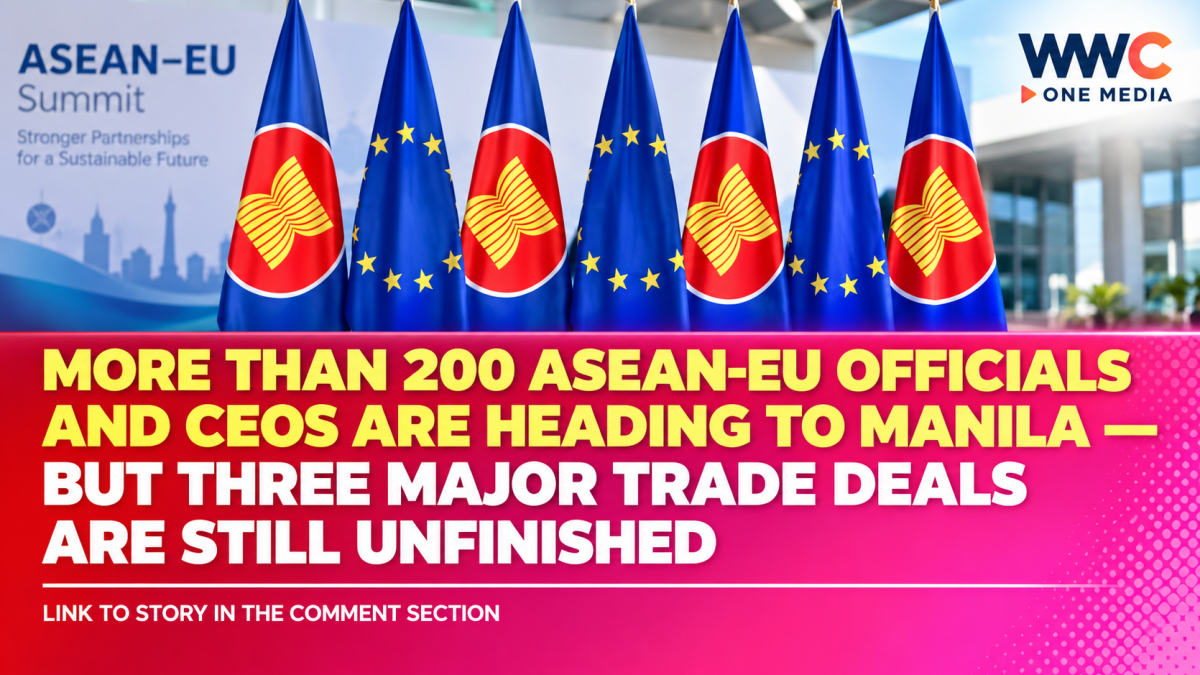
MANILA, Philippines — More than 200 government officials, business executives and development-sector representatives from Southeast Asia and Europe are expected to converge in Manila on September 22 as ASEAN and the European Union try to deepen an economic relationship already worth hundreds of billions of euros.
But behind the upbeat business sentiment is an unfinished agenda.
The 12th ASEAN-EU Business Summit will take place alongside meetings of ASEAN economic ministers at a time when the European Union is pursuing separate free-trade agreements with the Philippines, Malaysia and Thailand—three negotiations that could significantly expand Europe’s commercial access to some of Southeast Asia’s fastest-growing markets.
The Manila gathering is an official ASEAN 2026 side event jointly organized by the EU-ASEAN Business Council and the European Chamber of Commerce of the Philippines, with discussions expected to focus on green energy, inclusive finance, artificial intelligence and digital connectivity, and health and nutrition.
The timing is deliberate.
The Philippines is chairing ASEAN in 2026 and is hosting a series of economic meetings from September 14 to 22 as the regional bloc prepares for the 49th ASEAN Summit and related summits in November. The Philippine government says those meetings are intended to advance regional economic integration and its priority economic initiatives under the chairship.
European companies are increasingly looking toward ASEAN
The business case for closer ASEAN-EU ties is becoming harder to ignore.
A September survey by the EU-ASEAN Business Council, covering around 150 European business leaders, found that 78% of respondents expected trade and investment in ASEAN to increase over the next five years, up from 71% in 2025.
The same share—78%—said they intended to expand in at least one ASEAN market.
Among companies considering changes to their supply chains, 67% identified ASEAN as a potential destination, compared with 29% for South Asia and 24% for China.
Those figures represent the views of companies participating in the EU-ABC survey rather than all European businesses, but they help explain why Southeast Asia has become increasingly important in corporate diversification strategies.
The survey also found that 61% of respondents ranked ASEAN as offering the strongest economic opportunities among the emerging markets covered, marking the fourth consecutive year the region topped that survey measure.
That optimism comes despite substantial concerns.
Some 73% of respondents said there were too many non-tariff barriers for efficient supply-chain use, while 67% identified the lack of harmonized regulations across ASEAN as a significant challenge. Uncertainty surrounding US tariff policy was also cited by 81% as having weakened business confidence.
In other words, European companies see growth—but they also want fewer obstacles.
ASEAN-EU trade is already worth nearly €275 billion
The relationship is already enormous.
According to the European Commission, trade in goods between the European Union and ASEAN reached about €274.9 billion in 2025, making ASEAN collectively the EU’s third-largest trading partner outside Europe, behind only the United States and China.
Two-way ASEAN-EU trade in services amounted to €139.2 billion in 2024.
European foreign investment is also substantial.
The European Commission puts the stock of EU foreign direct investment in ASEAN at €363.4 billion in 2024, while ASEAN investment stock in the EU stood at €294.1 billion.
ASEAN itself attracted a record $243.9 billion in total foreign direct investment in 2025, up 9.7% from 2024, according to ASEAN’s official investment promotion platform citing UNCTAD data.
That helps explain why Brussels is trying to deepen commercial links with individual Southeast Asian economies rather than waiting for a single region-to-region free-trade agreement.
The EU already has deals with Singapore and Vietnam
The European Union has long pursued the broader ambition of an ASEAN-EU free-trade area, but negotiations at the regional level have proved difficult.
Instead, Brussels has increasingly pursued bilateral agreements.
The EU already has free-trade agreements with Singapore and Vietnam. Negotiations with Thailand restarted in 2023, talks with the Philippines resumed in 2024, and negotiations with Malaysia restarted in 2025.
Indonesia is further ahead: negotiations on an EU-Indonesia comprehensive economic agreement have already been concluded, with subsequent legal and approval procedures moving forward.
That leaves the Philippines, Malaysia and Thailand as three of the most closely watched active negotiations.
EU-ABC Executive Director Chris Humphrey said the business group hopes those talks will produce agreements offering expanded market access, fewer regulatory barriers and more efficient customs procedures.
Those outcomes, however, still depend on negotiators reaching agreement on the remaining issues.
The Philippines wants its EU deal finished soon
For Manila, the business summit comes as the Philippines and EU attempt to bring their own FTA negotiations toward a conclusion.
The European Commission says formal EU-Philippines FTA negotiations originally began in 2015, stalled after two negotiating rounds and were eventually revived in March 2024.
The negotiations have since accelerated.
European Commission records list six formal negotiating rounds between October 2024 and May 2026, while another full round ran from June 29 to July 3, 2026. During the latest talks, negotiators discussed areas including market access for goods and services, rules of origin, government procurement, geographical indications, energy and raw materials.
Philippine Trade Secretary Cristina Roque said in July that Manila wanted negotiations completed before the ASEAN Summit in November, although difficult issues—including agriculture—remained under discussion, according to the Philippine Star.
That timetable represents the Philippine government’s objective, not a guarantee that a final agreement will be reached by then.
The European Commission has said negotiations are continuing and that it wants an ambitious agreement “as soon as possible.”
Why an EU deal matters to Philippine exporters
The European Union is already one of the Philippines’ biggest economic partners.
Goods trade between the Philippines and EU reached €17.6 billion in 2025, with the EU accounting for 8.3% of Philippine goods trade and ranking as the country’s fourth-largest trading partner, according to European Commission figures.
The EU also held about €15.4 billion in foreign direct investment stock in the Philippines in 2024.
At present, the Philippines benefits from the EU’s GSP+ trade preference system, under which many Philippine exports enter the European market at reduced or zero tariffs, provided the country meets requirements tied to international conventions covering areas including labor rights, human rights, environmental protection and governance.
A comprehensive FTA would go further, potentially creating a longer-term framework covering not only tariffs but services, investment, government procurement, digital trade, intellectual property, sustainability and regulatory cooperation.
The precise benefits and obligations, however, will depend on the final negotiated text, which has not yet been completed.
Energy, AI and payments move onto the agenda
The September 22 summit will not be limited to tariffs.
Its agenda reflects how modern trade relationships increasingly extend into areas that barely featured in traditional trade negotiations.
One session will examine how European and Southeast Asian financial institutions can help mobilize capital for ASEAN’s energy transition.
Another will focus on artificial intelligence, cross-border payments, digital infrastructure and trusted connectivity, examining whether greater interoperability can make it easier for companies to operate across ASEAN’s fragmented national markets.
Participants announced by organizers include Philippine Energy Secretary Sharon Garin, Budget Secretary Kim Robert De Leon, Indonesian Vice Minister of Trade Dyah Roro Esti, Malaysian Deputy Minister of Investment, Trade and Industry Sim Tze Tzin, European Commission Director-General for Trade and Economic Security Ditte Juul Jørgensen, and ASEAN Deputy Secretary-General Satvinder Singh.
Executives from companies including HSBC, Prudential, Swift, FrieslandCampina and Coca-Cola Europacific Partners are also expected to participate.
Manila becomes the meeting point—but the negotiations continue
The Manila gathering therefore comes at an unusual intersection.
European companies surveyed by the EU-ASEAN Business Council are expressing strong interest in expanding across Southeast Asia. ASEAN is attracting record foreign investment. Bilateral trade with Europe is already measured in hundreds of billions of euros.
At the same time, businesses continue to complain about regulatory fragmentation, customs complexity and non-tariff barriers.
And the three trade agreements that could address some of those issues—the EU’s negotiations with the Philippines, Malaysia and Thailand—remain unfinished.
That makes September 22 more than another conference on the ASEAN calendar.
The summit will provide government and business representatives with another venue to discuss how to translate growing commercial interest into investment and easier cross-border trade.
But the more consequential work will continue at negotiating tables after the speeches end.
European businesses are signaling that they want more ASEAN exposure. The unresolved question is how quickly governments can turn that appetite into actual trade rules.

Leave a Reply