
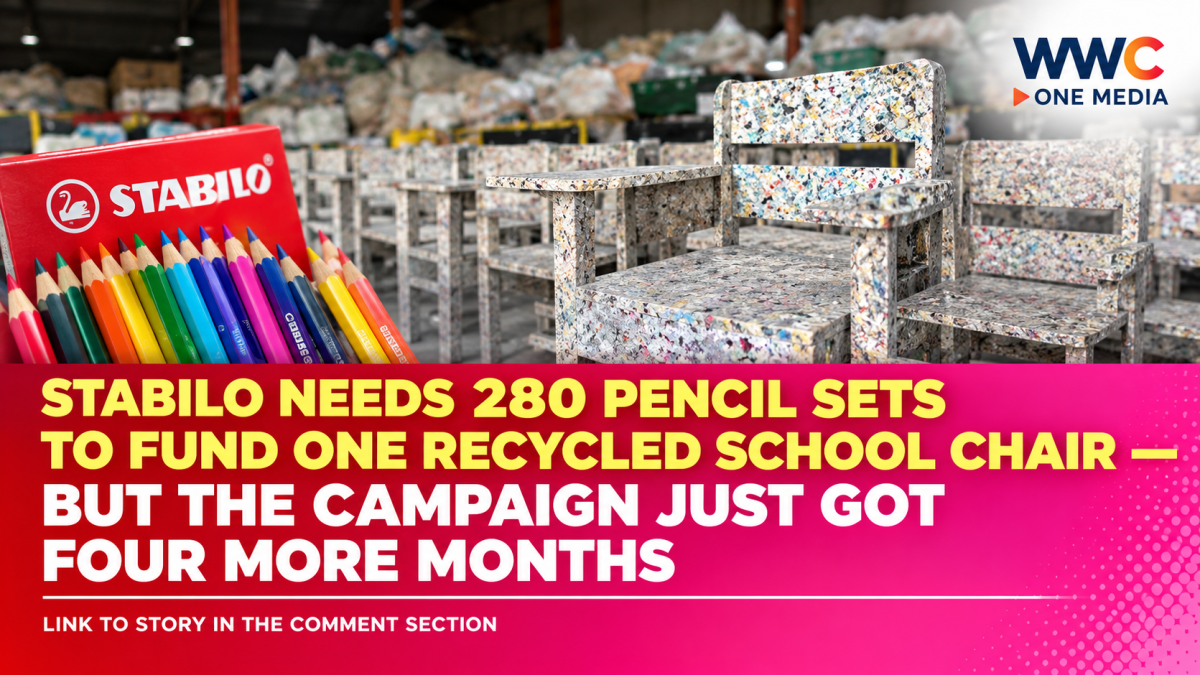
MANILA, Philippines — A box of colored pencils is being turned into something much bigger than an art project.
STABILO Philippines, recycling social enterprise The Plastic Flamingo, National Book Store and Pandayan Bookshop are extending a campaign that converts sales of selected colored-pencil sets into funding for school chairs made from discarded plastic—linking consumer spending, waste recovery and public-school support in one circular-economy program.
Under the “Color with STABILO. Provide Chairs for Students” campaign, every 280 participating STABILO colored-pencil sets sold funds one recycled-plastic school chair that will eventually be donated to a selected public school.
And the project now has more time to grow.
Although The Plastic Flamingo initially promoted the campaign as running from May 1 through August 31, current National Book Store mechanics show the program has been extended through December 31, 2026. Partner updates in early September also said the initiative had already accumulated roughly 3,000 kilograms of plastic waste.
That extension could significantly expand the number of chairs eventually reaching Filipino classrooms.
About 20 kilos of discarded plastic for one chair
The idea behind the program is simple: take plastic that might otherwise end up in a landfill, waterway or the ocean and turn it into something students can use every day.
“Twenty kilos of plastic waste—that’s what it takes to make one chair,” STABILO Philippines said in material cited by InsiderPH.
The Plastic Flamingo processes locally collected plastic into recycled material that can be turned into classroom furniture. The chairs used in the STABILO campaign are described as being made from 100% recycled plastic and designed to be waterproof and resistant to termites.
The 20-kilogram figure is consistent with another major Plastic Flamingo school project this year.
In March, logistics group CMA CGM and The Plastic Flamingo donated 500 recycled-plastic chairs made from 10,000 kilograms of plastic waste to three public schools in Parañaque City—an average of about 20 kilograms of recovered material per chair. BusinessMirror reported that the seats went to Marcelo Green High School, San Antonio National High School and Masville Senior High School.
That earlier project also illustrated why recycled furniture has become part of The Plastic Flamingo’s broader strategy: some students in the beneficiary schools had been using damaged chairs without proper writing surfaces and, in some cases, were writing on their laps.
The campaign has already collected around 3,000 kilos
By early September, updates circulated by Pandayan Bookshop said the STABILO campaign had accumulated about 3,000 kilograms of plastic waste and confirmed that the initiative would continue until the end of the year.
By weight alone, that demonstrates how quickly relatively small pieces of discarded packaging can accumulate when collected at scale.
But there is an important distinction: the number of chairs ultimately funded is determined by sales of participating STABILO products, not simply by the kilograms of plastic recovered.
National Book Store’s official mechanics specify that every 280 qualifying sets sold generates funding for one chair, while the total number of chairs will depend on cumulative sales of participating products during the campaign.
That makes the program both a recycling initiative and a consumer-linked fundraising campaign.
Which STABILO products count?
National Book Store lists participating STABILO Swans Arty Colored Pencils in 12- and 24-color sets, with selected products carrying promotional discounts.
A portion of purchases goes toward manufacturing the recycled school chairs, which will be distributed to selected public schools after the campaign. The National Book Store promotion is covered by DTI Fair Trade Permit No. FTEB-255101 Series of 2026.
InsiderPH said participating products are also available through Pandayan Bookshop branches and online channels.
For families already buying art materials, that turns an otherwise routine school-supply purchase into a small contribution toward classroom infrastructure.
This is bigger than one STABILO campaign
The STABILO partnership is only one part of The Plastic Flamingo’s rapidly expanding school-chair program.
The organization says it has now managed more than 1,400 metric tons of plastic waste, operates through more than 300 collection points, and has deployed more than 6,355 recycled-plastic school chairs across the Philippines. Those figures are company-reported and reflect The Plastic Flamingo’s wider network of corporate and community partnerships rather than the STABILO campaign alone.
That represents substantial growth during 2026.
As of March, The Plastic Flamingo said it had diverted 1,378,264 kilograms of plastic since beginning operations in 2018 and that partners had already donated about 4,200 school chairs across Luzon, Visayas and Mindanao.
Since then, additional partnerships have continued adding seats.
Megawide backed a program involving 200 recycled chairs for schools in Carmona, Cavite and Taytay, Rizal, representing around 4,000 kilograms of plastic according to The Plastic Flamingo.
Security Bank Foundation also reported in August that it donated 50 recycled-plastic chairs manufactured by The Plastic Flamingo to Clarin Elementary School in Plaridel, Misamis Occidental.
The numbers show that the underlying model is moving beyond isolated recycling drives and into repeat corporate partnerships.
Why companies are turning waste into classroom furniture
For businesses, projects like this address two highly visible problems at once.
The first is plastic waste.
The Plastic Flamingo collects discarded material from communities, companies, coastal areas and partner organizations, then sorts and processes it into recycled eco-boards. Those boards can become chairs, desks, tables, bins and other products rather than returning to the waste stream.
The second is classroom infrastructure.
A recycled chair does not solve the Philippines’ wider education challenges, but it provides a tangible end product that students can immediately use—and gives companies a visible way of connecting environmental spending with social impact.
That combination has attracted partners across logistics, construction, banking, utilities and consumer products.
For STABILO, there is an additional connection: the customers purchasing the products that finance the chairs are often students and parents themselves.
A pack of colored pencils therefore becomes the entry point into a much larger story about consumption, waste and education.
The real test comes after December 31
The campaign’s extension gives STABILO and its partners roughly four additional months beyond the original August deadline to generate more qualifying sales and collect more plastic.
But the most important measure will come after the promotion closes.
National Book Store’s rules make clear that the final number of donated chairs will depend on cumulative sales during the campaign.
That means the strongest measure of the program’s impact will not simply be how much plastic was collected or how many colored pencils were sold.
It will be how many students ultimately sit in the finished chairs.
For now, however, the circular-economy equation is unusually easy to understand:
280 qualifying pencil sets help fund one chair. About 20 kilograms of discarded plastic can become that chair. And what once looked like waste can end up supporting a Filipino student in class.




Leave a Reply