
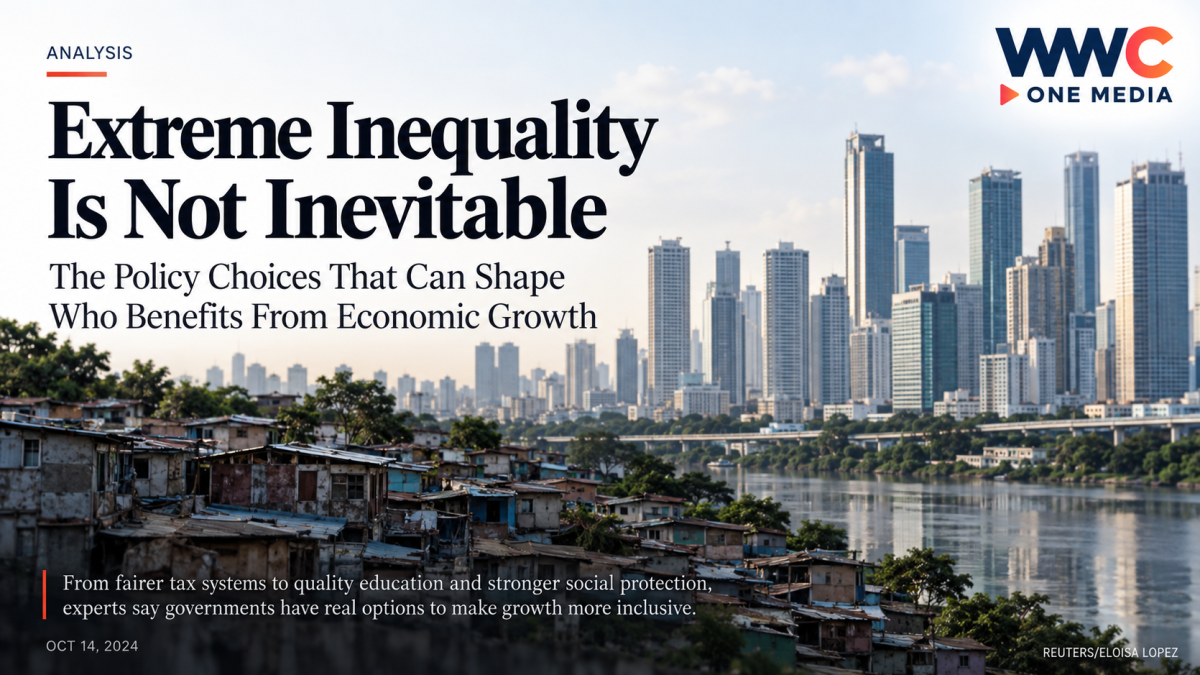
BANGKOK — Extreme economic inequality is often treated as an unavoidable consequence of modern capitalism, but a growing body of economic research suggests that the distribution of income and wealth is strongly influenced by institutions and public policy.
The debate is particularly important across developing and emerging economies, where rapid economic growth can coexist with large differences in wealth, access to education, healthcare, housing and economic opportunity.
A recent Bangkok Post opinion article argues that societies do not simply have to accept extreme inequality as an inevitable feature of economic life. Instead, the author contends that choices involving taxation, public spending, labor protections and economic institutions can influence how widely the benefits of growth are distributed.
Inequality Is More Than a Difference in Income
Economic inequality is not simply about how much money one person earns compared with another.
Researchers also examine differences in wealth, access to education, healthcare, housing, employment opportunities and ownership of productive assets.
That distinction matters because two countries can have similar levels of economic output while producing very different outcomes for households depending on their tax systems, social protections and access to public services.
Research on Thailand, for example, has long examined the relationship between income, wealth and political power, with scholars describing substantial disparities in the distribution of assets and economic opportunity.
Why Policy Can Change the Picture
Taxation is one of the clearest mechanisms governments can use to influence inequality.
Progressive tax systems can collect a larger share of income from higher earners and use public revenue to finance services such as education, healthcare and infrastructure.
But taxation is only one part of the equation.
Government spending can also affect inequality by expanding access to services that lower-income households might otherwise struggle to afford. Investments in schools, healthcare, transportation and social protection can influence people’s opportunities over many years.
Labor-market institutions also matter. Wage policies, employment protections and workers’ ability to negotiate can affect how economic gains are divided between businesses and employees.
Growth Does Not Automatically Mean Equal Gains
Economic growth can increase living standards without necessarily benefiting every group equally.
When productivity and national income rise, the distribution of those gains depends partly on who owns businesses and assets, who has access to high-paying employment and how effectively public institutions redistribute resources.
This is why economists distinguish between economic growth and distributional outcomes.
A country can become richer overall while some households see much smaller improvements in their living standards.
The reverse is also possible: policies that broaden access to education, healthcare and economic opportunity can allow a larger share of the population to participate in growth.
Thailand’s Inequality Debate
Thailand provides an important case study because inequality has been a longstanding subject of economic and political research.
Studies have examined disparities in land ownership, wealth concentration, income distribution and access to economic opportunities.
The challenge is not simply reducing the gap between rich and poor.
Policymakers must also consider economic growth, productivity, investment, employment and the ability of businesses to remain competitive.
That creates difficult trade-offs.
Policies intended to reduce inequality can have different effects depending on how they are designed and implemented. Economists therefore continue to debate the appropriate balance between redistribution, incentives and economic efficiency.
The Global Picture Is Changing
Inequality also cannot be understood entirely within national borders.
Globalization, technological change and the expansion of digital industries have changed how income and wealth are generated.
At the same time, technology can create new opportunities while rewarding workers and companies with access to capital, advanced skills and digital infrastructure.
Artificial intelligence has added another layer to that debate because its effects on productivity, employment and wages will depend partly on how the technology is adopted and who has access to it.
Extreme Inequality Is a Policy Question
The central argument of the Bangkok Post commentary is therefore less about whether inequality exists and more about how much inequality societies choose to tolerate and what mechanisms they use to address it.
There is no single policy capable of eliminating inequality.
Instead, governments face a combination of choices involving taxation, education, healthcare, labor markets, social protection, competition policy and economic development.
The outcomes of those choices can differ significantly across countries.
Extreme inequality may be persistent, but it is not simply a force of nature. The larger question is whether governments can design institutions that allow economic growth to translate into broader opportunity—and how societies decide where that balance should lie.



Leave a Reply