
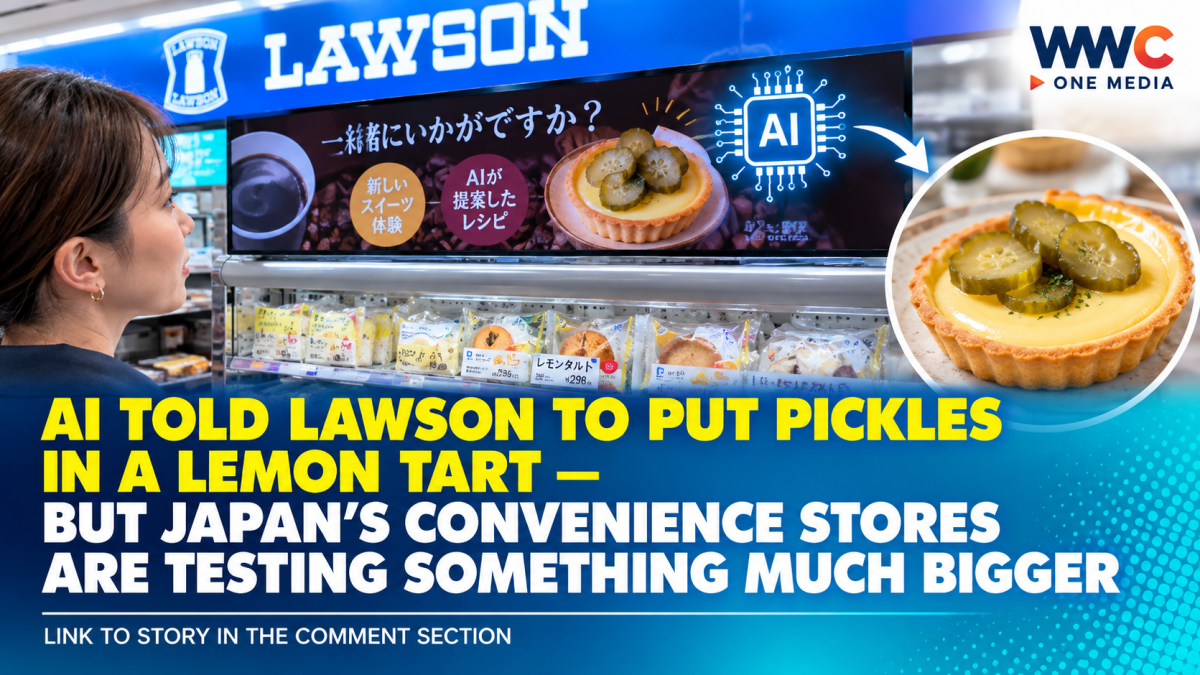
TOKYO — A lemon tart flavored with pickles sounds like the kind of idea that might get laughed out of a product-development meeting. In Japan, artificial intelligence helped put it on the shelf instead.
Lawson, one of Japan’s biggest convenience-store chains, is preparing to launch three foods whose concepts originated with generative AI, including a pickle-flavored lemon tart, a fermented-ingredient red-bean-and-butter bread and a salad deliberately designed to look like a parfait.
The products go on sale on September 29, 2026, mainly across Tokyo and the wider Kanto-Koshinetsu region. Lawson says it asked AI for ideas built around an unusual brief: create combinations that would make customers wonder what they were looking at—but still taste good.
And Lawson is not alone.
Rival FamilyMart is also using AI to help develop new desserts, including a sweet-potato canelé topped with caramel sauce, after an earlier AI-assisted cream biscuit sandwich performed well enough in testing to encourage the chain to pursue more AI-generated concepts.
Japan’s convenience-store battle is therefore entering a strange new phase.
For decades, chains competed over better rice balls, sandwiches, fried chicken and coffee.
Now they are asking machines a much more dangerous retail question:
What would humans never think to sell?
Lawson deliberately told AI to ignore the market
One of the most interesting details in Lawson’s experiment is what the company did not give its AI.
For the idea-generation stage, Lawson says it deliberately avoided feeding the system past sales figures or market-trend data.
The goal was to prevent the AI from simply reproducing what had already sold and instead generate combinations unconstrained by normal category thinking.
That is almost the opposite of how retailers normally use artificial intelligence.
AI systems are commonly deployed to study consumer behavior, predict demand or optimize inventory.
Lawson instead used generative AI as an artificial brainstorming partner.
Its brief centered on three concepts: combinations consumers had not encountered before, products that could trigger an immediate “What is this?” reaction, and items that would still be genuinely enjoyable to eat.
That produced some very un-convenience-store-like suggestions.
The most obvious is the lemon tart.
Yes, the pickle lemon tart is real
Lawson’s Lemon Tart — Pickle Flavor will cost ¥270 including tax.
It originated from the AI suggestion of combining lemon tart with pickles.
Human developers then refined that idea by using chopped pickles for acidity, lemon for freshness and cheese for richness while deliberately reducing sweetness.
Lawson says developers repeatedly adjusted the balance of the different sour elements before arriving at the final product.
It will be sold at roughly 4,700 Lawson stores across Tokyo, Kanagawa, Saitama, Chiba, Ibaraki, Tochigi, Gunma, Yamanashi and parts of Niigata and Nagano. Natural Lawson stores are excluded.
So despite the eye-catching AI headline, the computer did not output a recipe that went directly into production.
It supplied the odd premise.
Humans had to make it edible.
AI also came up with fermented an-butter bread
The second Lawson product may be less shocking but is arguably more technically interesting.
The Sake-Starter An-Butter Yogurt Bread, priced at ¥181, came from an AI concept built around combining multiple fermented ingredients with Japan’s familiar red-bean-and-butter pairing.
The final product uses bread made with a sake fermentation starter, chunky red-bean paste, margarine containing fermented butter and yogurt cream.
Again, the AI provided the starting direction rather than the final formula.
Lawson’s developers determined how the ingredients would actually be combined and balanced.
That distinction is important because food development involves far more than generating an appealing flavor description.
Products have to survive manufacturing, distribution, shelf-life requirements, food-safety rules and cost targets before a chain can put them into thousands of refrigerated cases.
Then there is the ‘parfait’ that is actually a salad
Lawson’s third product looks like dessert but is intended as a meal.
The Japanese-Style Parfait Salad With Rice Vermicelli costs ¥475 and grew out of the AI concept of making a salad visually resemble a parfait.
It includes seven ingredients such as red-core radish, cucumber, okra and imitation crab alongside rice vermicelli, finished with a Japanese-style jelly dressing based on white dashi.
About 3,800 stores in Tokyo and surrounding prefectures are expected to carry it.
The product illustrates what AI may contribute best in creative industries.
It does not necessarily know how to manufacture something better than experienced humans.
But it can throw together categories humans normally keep separate.
Dessert presentation plus salad.
Pickles plus lemon tart.
Yogurt plus an-butter bread.
The commercial question is whether surprise translates into repeat sales—or only one-time social-media curiosity.
Lawson wants shoppers to know AI was involved
The company is not hiding the experiment.
Lawson says store displays will explicitly use phrases such as “AI-generated idea” and “Did AI think of this?” to make the technology itself part of the marketing.
That means AI is doing two jobs.
First, it is helping generate products.
Second, its involvement becomes a reason to try those products.
A customer who might ignore another ordinary lemon tart may buy one simply because a machine suggested adding pickles.
In that sense, the novelty of AI has become part of the product proposition.
Lawson says it will study customer reaction and sales before deciding how broadly to expand the approach, with future projects potentially incorporating sales and market data as well.
The company had conducted limited experimental sales in some areas in April, but describes the September rollout as its first full-scale release of generative-AI-inspired products.
FamilyMart is taking almost the opposite approach
FamilyMart’s experiment is particularly useful because its methodology differs from Lawson’s.
Where Lawson intentionally avoided historical market data during brainstorming, CNA reported that FamilyMart fed sales information into AI while developing its latest dessert.
The result is a French-style canelé made with sweet-potato purée and topped with caramel sauce, scheduled to reach stores nationwide later in September.
Japanese business reporting cited in overseas coverage says the product is expected to sell for around ¥285 and that FamilyMart is considering roughly 10 AI-planned products during fiscal 2026.
That creates an interesting A/B test between two different philosophies.
Lawson is asking AI to be weird.
FamilyMart is asking AI to help identify what consumers are likely to buy.
If both approaches produce successful products, Japanese retailers may discover that generative AI can serve both as a creativity engine and a predictive product-planning tool.
FamilyMart already tested the idea in July
This is not FamilyMart’s first attempt.
CNA reported that the chain test-launched an AI-suggested biscuit sandwich filled with thick milk cream in July.
The experiment performed well enough that FamilyMart decided to pursue AI more seriously in product development and plans additional launches.
That success matters because convenience-store shelves are notoriously unforgiving.
Japanese chains introduce huge numbers of new products every year.
Shelf space is limited.
Poor sellers disappear quickly.
So an AI-generated idea that survives beyond an experimental launch represents something more meaningful than a publicity stunt.
It suggests the technology may actually be able to participate in one of retail’s hardest jobs: repeatedly predicting what people will buy next.
But AI is not replacing the food developers
This is where much of the viral framing around the story can become misleading.
Neither Lawson nor FamilyMart says AI simply designed finished products without human intervention.
Lawson states explicitly that its human product-development staff repeatedly produced prototypes, conducted testing and adjusted flavor and appearance before approving the final foods.
FamilyMart similarly told AFP that AI was primarily used during idea generation, with human specialists remaining involved in development.
So the more accurate description is not:
“AI is making convenience-store food.”
It is:
“AI is joining the product-development meeting.”
And that may ultimately be more consequential.
FamilyMart is already using AI far beyond recipes
Food concepts are only one part of FamilyMart’s AI strategy.
The company introduced an AI-assisted ordering system at 500 stores in June 2025.
That system analyzes data including a store’s past sales, nearby pedestrian traffic, demographic patterns, temperature, humidity, rainfall, sunshine and calendar information to recommend how much food each outlet should order.
The goal is to reduce two of convenience retail’s most expensive problems: running out of popular items and throwing away food that does not sell.
In January 2026, FamilyMart also began testing AI shelf scoring, using images from store cameras to assess merchandising conditions and help optimize product selection.
And in March, it rolled out generative-AI assistance for writing recruitment advertisements across roughly 16,400 stores, aimed at helping franchise operators facing labor shortages.
So the canelé is not an isolated gimmick.
It is part of a wider attempt to inject AI into multiple layers of convenience-store economics.
Japan’s stores are also under pressure to automate
There is a practical reason convenience chains are experimenting so aggressively.
Store operations are labor-intensive.
Employees have to handle checkout, food preparation, stocking, deliveries, cleaning, ticketing, parcel services and countless other tasks.
FamilyMart is simultaneously rolling out a new POS system to approximately 16,500 stores, saying the combination of new registers, automated change machines and payment terminals is designed to cut register-related work by about 20% per day.
That gives the AI dessert story a broader business context.
Japan’s convenience chains are not adopting technology merely because artificial intelligence is fashionable.
They are looking for faster product development, better demand prediction, lower waste and reduced workloads.
A machine that proposes sweet-potato canelé is cute.
A system that helps decide what should be produced, how much should be sent to each store and whether it is selling quickly enough could have a much bigger financial impact.
The supermarket lesson: data can make products safer, but maybe less surprising
Retailers have always relied on consumer data.
The limitation is that historical data tend to reward things that resemble previous successes.
If chocolate desserts sold last year, an algorithm trained entirely on sales may recommend another chocolate dessert.
That can reduce risk.
It can also reinforce sameness.
Lawson’s unusual experiment deliberately tries to break that loop by denying the brainstorming model its normal historical signals.
The result—pickle tart included—is almost a test of whether AI can act more like an eccentric junior employee than a forecasting machine.
FamilyMart’s approach appears more commercially conservative: use sales patterns and trends to guide what kind of new product might work.
Neither strategy has yet proved that AI can consistently generate hits.
But the difference between them could teach retailers a great deal about where AI adds the most value.
The risk: novelty is not the same as demand
There is an obvious danger to the Lawson strategy.
Consumers may photograph a pickle tart without buying a second one.
Products designed to surprise can generate social-media attention but still fail as repeat purchases.
That is why Lawson says sales performance and customer reaction from this batch will inform future AI development.
This is also where human judgment remains critical.
AI does not pay for unsold inventory.
It does not negotiate with factories.
It does not manage customer complaints if a flavor combination fails.
Retail executives do.
So AI-generated product development is likely to remain constrained by the same commercial discipline that governs every other convenience-store launch.
The ideas can be wild.
The margins cannot.
The bigger battle is for Japan’s next hit convenience-store food
Japan’s convenience stores have built global reputations around products that appear simple but are intensely engineered.
Rice balls need the correct rice texture after hours on a shelf.
Sandwiches have to maintain freshness.
Cream desserts must survive nationwide logistics.
Hot foods have to taste consistent across thousands of locations.
Success is often determined by tiny adjustments to texture, portion, price and packaging.
AI now adds a new variable to that machine.
It can analyze patterns humans overlook.
It can generate combinations humans might dismiss before testing.
And because product-development teams can ask it for hundreds of ideas almost instantly, it potentially changes the economics of brainstorming.
That does not guarantee better food.
It may simply produce more candidates from which humans choose.
But in an industry where a single breakout product can sell millions of units, generating one unexpected winner can justify a lot of failed experiments.
Pickles in dessert may be the least important part of the story
The obvious headline is the pickle tart.
It is strange, visual and easy to share.
But the more important experiment is happening behind the product.
Lawson is testing whether AI can expand human creativity by ignoring what sold before.
FamilyMart is testing whether AI can use consumer data to design something with a better chance of selling.
Both still depend on humans to decide what tastes good enough to reach the shelf.
That is why Japan’s latest convenience-store battle is not really about whether a computer can cook.
It is about whether a computer can help answer the question retail companies spend billions trying to solve:
What will people want next—before people themselves know the answer?
And if a pickle-flavored lemon tart sells out, Japan’s convenience-store aisles could become one of the most unexpected testing grounds for generative AI yet.




Leave a Reply