
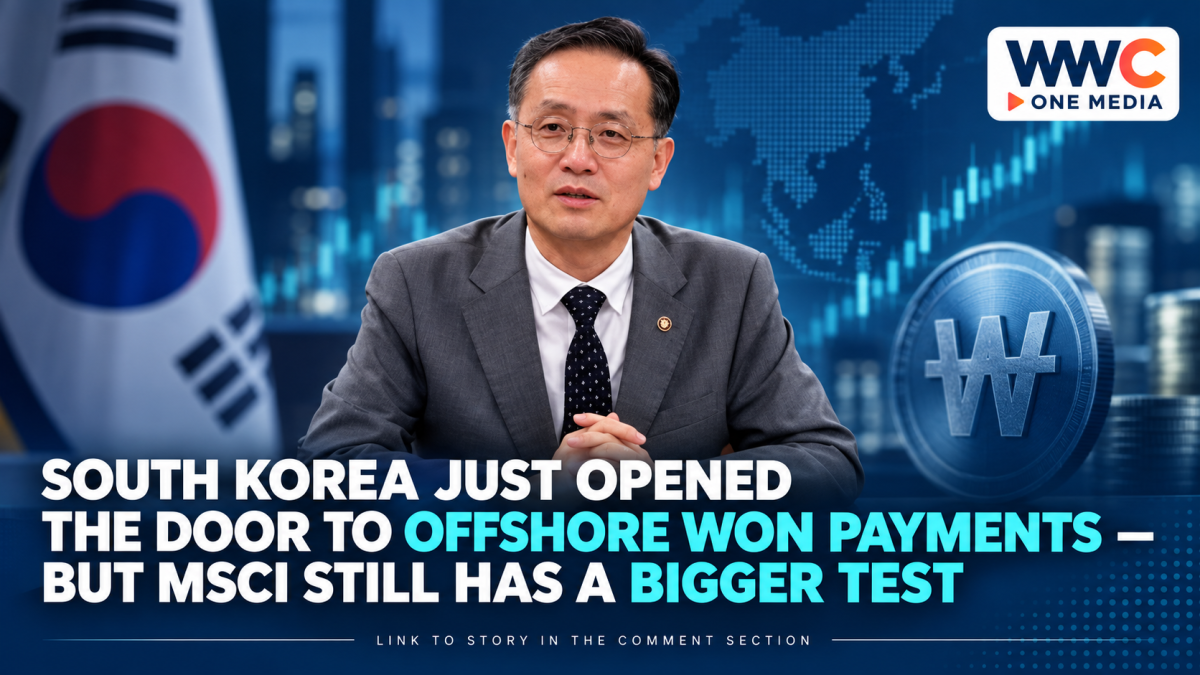
SEOUL — South Korea is tearing down one of the biggest barriers separating the Korean won from the world’s major currencies.
The government on Wednesday, September 16, formally introduced a new licensing regime that will allow approved foreign financial institutions to conduct won-denominated business for customers outside Korea, including payments, remittances, investments and certain lending and borrowing transactions.
The new institutions will be known as Registered Foreign Institutions for KRW Business, or RFI-Ks. They will be able to use omnibus accounts at Korean foreign-exchange banks and connect transactions to the Bank of Korea’s Won International Wire Network, reducing the need for every foreign customer to maintain a separate bank account in Korea.
It is one of South Korea’s most consequential foreign-exchange reforms in decades.
But it also comes with a major caveat.
Opening an offshore settlement channel does not instantly turn the won into a dollar, euro or yen.
The won accounted for only about 1.8 percent of global foreign-exchange turnover in the Bank for International Settlements’ 2025 survey, and global index provider MSCI said as recently as June that limited offshore convertibility remained one of the most important obstacles keeping Korea classified as an emerging rather than developed market.
So Seoul has opened another door.
Now it has to convince global banks, investors and companies to actually walk through it.
What Korea Has Changed
Until now, an overseas investor or business trying to settle many won-denominated transactions faced an additional layer of Korean banking infrastructure.
Foreign customers generally had to establish accounts with foreign-exchange banks in Korea for settlement, even when they already had won accounts with financial institutions overseas.
Under the new RFI-K framework, an authorized foreign financial institution can serve nonresident customers directly and aggregate transactions through an omnibus won account maintained with a Korean foreign-exchange bank.
That could make something that sounds simple actually much easier.
For example, an investor in the United States could maintain won with an eligible bank outside Korea and use those funds for Korean shares or bonds without needing an additional individual settlement account in Korea.
An overseas company could likewise keep won abroad and potentially use those funds to pay a Korean supplier.
The permitted businesses for registered RFI-Ks include remittances, investments, securities lending and borrowing, won payments, deposits and related fund-management activities, subject to Korea’s regulations.
That may sound technical.
But it attacks one of the basic reasons the won has remained difficult to use internationally: foreigners have historically found it considerably easier to trade exposure to the won than to obtain, hold and move the actual currency outside Korea.
Korea Is Creating a Special ‘Won License’ for Foreign Banks
Not every overseas bank automatically receives the new privileges.
Foreign institutions already registered to participate directly in Korea’s foreign-exchange market must make an additional registration with the Finance Ministry as an RFI-K before handling offshore won business.
Korea already has a sizable pool of potential candidates.
A Bank of Korea list dated March 11 contained 78 Registered Foreign Institutions, including branches or headquarters of major global banks such as HSBC, JPMorgan, Bank of America, Deutsche Bank, BNP Paribas, State Street, Standard Chartered, DBS, UBS and Royal Bank of Canada.
But the RFI-K system adds another layer of oversight.
Participating institutions must confirm that clients using their offshore won services are nonresidents, file monthly transaction reports with the Bank of Korea and comply with government restrictions designed to prevent excessive or destabilizing creation and use of offshore won liquidity.
Authorities have also said they will examine the financial soundness of participating institutions and monitor their transactions with the central bank.
In other words, Seoul is liberalizing the currency — but it is not abandoning control.
The Change Is Part of a Much Bigger Won Makeover
The September reforms are not an isolated move.
They follow the government’s Roadmap for KRW Internationalization, announced on July 19, which set out an ambition to move the won from what officials describe as a restricted currency toward a “freely convertible currency.”
The government identified a basic contradiction.
South Korea is one of the world’s major trading economies, home to companies such as Samsung Electronics, SK hynix, Hyundai Motor and LG.
Yet the currency used by that economy remains relatively difficult to obtain and settle outside its borders.
The Finance Ministry said in July that genuine internationalization would require Korea to establish an offshore won transaction and settlement system while removing institutional restrictions that discourage foreigners from using the currency.
The September RFI-K reform is a direct step toward delivering that promise.
The First Big Move Came in July: The Won Started Trading Around the Clock
Before tackling offshore settlement, Korea changed when the currency could be traded at home.
On July 6, South Korea launched around-the-clock onshore dollar-won trading.
The market now operates continuously from 6 a.m. Monday until 6 a.m. Saturday, rather than closing at 2 a.m. each trading day.
That itself was a dramatic change.
Until July 2024, Korea’s onshore currency market closed at 3:30 p.m. Seoul time. Authorities then extended trading until 2 a.m. to overlap more fully with London before moving to the current near-continuous weekday system this year.
Finance Minister Koo Yun-cheol described the July launch as a starting point for the won’s global expansion.
The logic is simple.
A London or New York asset manager cannot easily treat a currency as globally accessible if the underlying cash market is effectively unavailable during large parts of its own trading day.
Twenty-four-hour trading addressed the time-zone problem.
RFI-K is designed to attack the settlement problem.
But MSCI Had Already Delivered a Warning
The urgency behind the reforms became particularly clear in June.
On June 23, MSCI kept South Korea classified as an emerging market, despite years of reforms intended to win an upgrade to developed-market status.
MSCI acknowledged Korea’s progress.
But it said international investors continued to report unresolved accessibility problems.
One of the biggest was the won.
MSCI said the currency was still not deliverable offshore and warned that liquidity during Korea’s extended onshore FX trading hours remained insufficient to provide execution conditions comparable with developed-market currencies.
That distinction matters.
A country can extend market hours to 24 hours, but if hardly anyone is trading during the middle of the night, foreign institutions can still struggle to transact efficiently.
Korea’s own Finance Ministry acknowledged in August that late-night activity was increasing only gradually following the switch to 24-hour trading, and it introduced additional incentives to encourage banks to trade during those periods.
So the challenge is no longer only whether the infrastructure exists.
It is whether that infrastructure develops deep enough liquidity to be genuinely useful.
Why Korea Cares So Much About MSCI
The MSCI question sounds obscure outside financial markets, but the stakes are significant.
MSCI indexes are followed by some of the world’s largest asset managers and institutional investors.
South Korea is currently treated as an emerging market in MSCI’s classification system even though the International Monetary Fund and many other institutions regard it as an advanced economy.
MSCI considered reclassifying Korea between 2008 and 2014, but global investors identified offshore won convertibility and other market-access restrictions as major barriers.
More than a decade later, the currency issue is still prominent.
MSCI said in its 2026 review that an eventual reclassification would require the reforms not only to be announced but fully implemented, tested and accepted by international investors over time.
That means the RFI-K announcement itself will not automatically earn Korea developed-market status.
Foreign institutions will need to use it.
The settlement mechanism will need to work reliably.
And the broader won market will need to develop sufficient liquidity.
The Won Is Still Small Compared With the Dollar, Euro and Yen
The scale of that challenge becomes clearer in the latest global trading figures.
According to the Bank for International Settlements’ 2025 Triennial Central Bank Survey, average daily global foreign-exchange turnover reached about $9.6 trillion in April 2025.
The US dollar appeared on one side of roughly 89.2 percent of transactions.
The euro accounted for 28.9 percent, the Japanese yen 16.8 percent, the British pound 10.2 percent and China’s renminbi about 8.5 percent.
The Korean won’s share was about 1.8 percent, representing roughly $171 billion in average daily turnover. Because every FX trade contains two currencies, the BIS currency shares add up to 200 percent rather than 100 percent.
That does not make the won insignificant.
But it demonstrates the distance between Korea’s economic importance and the international role of its currency.
And Seoul wants to narrow that gap.
Why Would Korea Want More Foreigners Using Won?
The government sees several potential benefits.
If foreign investors and companies can obtain and settle won more easily, it could reduce some of the friction involved in buying Korean securities, financing Korean businesses and conducting trade with Korean companies.
The Finance Ministry says greater won internationalization could eventually lower companies’ costs for currency conversion, financing and exchange-rate hedging.
There is also a trade advantage.
Many Korean exporters and importers conduct international transactions in dollars even when neither side of a deal is American.
If more foreign companies become willing to invoice or settle directly in won, Korean businesses could reduce some of their reliance on an intermediary currency.
The government has said it intends to encourage more won-denominated trade, including through expanded trade-insurance incentives.
For Korea, the long-term ambition is therefore bigger than satisfying MSCI.
It wants the won to play a role internationally that is closer to the scale of the economy behind it.
But Making a Currency Global Also Creates New Risks
There is a reason Korea kept tight control over offshore won trading for so long.
Its foreign-exchange regime was shaped heavily by the 1997 Asian financial crisis, when Korea suffered severe foreign-currency liquidity stress and required an IMF rescue package.
Officials themselves have described the current reforms as a shift away from the restrictive approach developed in the aftermath of that crisis.
Opening more avenues for offshore won transactions can bring benefits — but it can also allow capital to move more quickly.
An offshore pool of won could potentially experience abrupt shortages or selling pressure during financial stress.
That is why Korea is simultaneously constructing safeguards.
The government’s July roadmap called for stronger monitoring of offshore won liquidity, expansion of financial safety nets and continued development of bilateral and multilateral currency-swap arrangements.
Bank of Korea Governor Hyun Song Shin has likewise said won internationalization must be pursued alongside a macroprudential framework capable of protecting financial stability.
So the government is trying to perform a delicate balancing act:
make the won easier to move without making Korea easier to destabilize.
Singapore and London Could Become Important Testing Grounds
Korea’s internationalization campaign is already being taken directly to major global financial centers.
In July, Deputy Finance Minister for International Affairs Moon Ji-sung travelled to London and Singapore for meetings with major financial companies and investors, where he promoted Korea’s economic outlook and the won-internationalization roadmap.
That makes strategic sense.
London remains one of the world’s dominant foreign-exchange hubs, while Singapore is Asia’s largest or among its largest FX centres depending on the measure used.
The existing roster of Korean-registered foreign institutions also includes numerous Singapore and London branches of major international banks.
If the RFI-K model gains meaningful adoption, those financial centres could become important places where offshore won activity develops.
This Is Not Yet a Fully Free Offshore Won Market
That distinction is essential when describing Wednesday’s announcement.
South Korea has created a mechanism enabling approved institutions to conduct and settle won business for overseas nonresident clients.
It has not simply removed every restriction on offshore won trading.
RFI-Ks require registration.
Their customers must meet nonresident requirements.
Transactions are subject to reporting.
Authorities retain powers to limit how institutions raise and use won funds and to control the scope of assets and liabilities where necessary.
The government is therefore opening the system in controlled stages rather than immediately creating a completely unrestricted offshore won market.
That is one reason “the won is now fully convertible” would be an overstatement.
The more accurate description is that Korea has established another major piece of the infrastructure needed to make full internationalization possible.
The Bigger Test Starts After the Rules Change
On paper, South Korea has moved rapidly in 2026.
It launched 24-hour foreign-exchange trading in July.
It published a formal roadmap for won internationalization later that month.
Now it has established the RFI-K framework allowing approved foreign financial institutions to handle won transactions for overseas customers without requiring those customers to establish separate Korean settlement accounts.
But currencies become global because people use them — not because governments announce that they can.
The real indicators will come next:
How many major banks obtain RFI-K licenses?
How much won liquidity develops outside Korean business hours?
Will foreign exporters begin accepting more won?
Will international investors find settlement materially easier?
And, eventually, will MSCI conclude that the accessibility problems it has cited for more than a decade have actually disappeared?
The September reform has made the won easier to take overseas.
Turning it into a genuinely global currency will depend on what happens once it gets there.



Leave a Reply