
MUMBAI — India has spent years building the world’s largest instant-payment network by making one thing almost irresistible:
UPI payments were effectively free.
Consumers could scan a QR code.
Merchants could receive the money.
Banks and payment apps processed billions of transactions without charging a conventional merchant discount rate.
That model helped transform India’s payment system.
Now the economics behind it are changing.
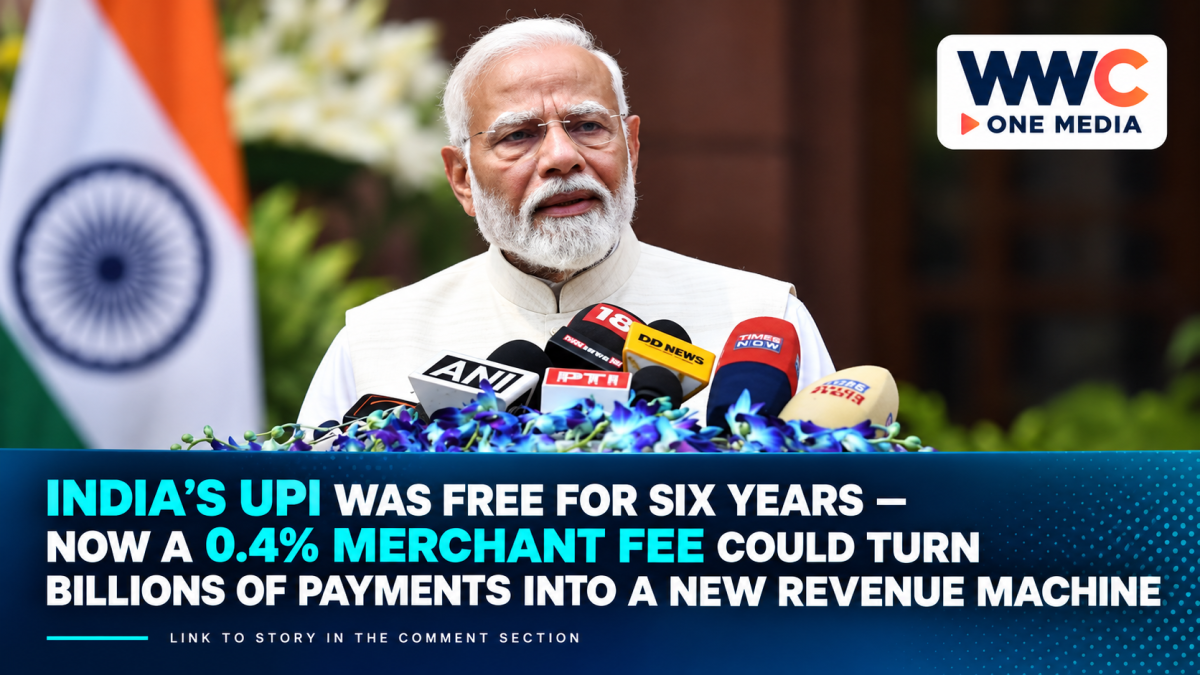
From Oct. 15, 2026, India’s National Payments Corporation of India will introduce a merchant discount rate, or MDR, of up to 0.4% on selected person-to-merchant UPI transactions above ₹2,000.
And investors immediately understood what that means.
Transactions that generated little or no direct fee revenue for companies such as Paytm, MobiKwik, banks and payment processors can finally start producing recurring income.
Shares of several payment-linked companies jumped after the announcement.
Paytm surged more than 7% intraday, reaching ₹1,855.50 on the National Stock Exchange, while MobiKwik and Yes Bank also climbed sharply as analysts began increasing earnings forecasts.
But the most important part of the change is what it does not do.
Ordinary UPI users are not suddenly being charged 0.4% every time they scan a QR code.
The fee sits on the merchant side of the transaction.
And most UPI payments will still remain free.
What exactly changes on October 15?
For standard person-to-merchant UPI payments above ₹2,000, the new MDR can reach 0.4%.
That means, before exemptions and special categories:
A ₹5,000 purchase could create a ₹20 MDR.
A ₹10,000 purchase could create a ₹40 MDR.
A ₹50,000 purchase could create a ₹200 MDR.
For ordinary merchant transactions of ₹75,000 or more, the charge is capped at ₹300.
So the fee does not continue rising indefinitely with the transaction value.
That cap matters for big-ticket purchases.
A ₹200,000 UPI payment will not necessarily generate an ₹800 merchant fee under the standard structure.
The applicable MDR would remain capped at ₹300.
Consumers still pay zero
This distinction has become one of the most important parts of the government’s message.
NPCI says the charge cannot be passed directly to consumers.
The Finance Ministry separately said payment apps are prohibited from imposing platform fees or hidden charges on users because of the new MDR framework. Banks have also been advised to ensure merchants do not directly pass the charge to customers.
Person-to-person transfers remain free.
So sending ₹5,000 to a friend or relative through UPI is different from using UPI to pay ₹5,000 to a commercial merchant.
The fee is aimed at monetising qualifying commercial payment flows, not at charging individuals for transferring money to one another.
Small merchants receive special protection
India is also trying to avoid making the country’s smallest vendors pay for the network that helped bring them into digital payments.
Merchants classified within the small-merchant framework — including those receiving up to ₹100,000 per month through UPI QR payments — will remain exempt from MDR.
UPI QR payments to merchants in rural and semi-urban areas are also exempt under the announced framework.
The government says roughly 96% of UPI merchant transactions will continue to remain free after the new system takes effect.
That makes the new regime much narrower than the headline “UPI is no longer free” might suggest.
UPI is not becoming a conventional card-payment system overnight.
India is selectively monetising the higher-value end of the network.
Railways, telecom, fuel and insurance get a different fee
Some sectors will not pay the full 0.4%.
Payments above ₹2,000 involving categories including railways, telecommunications, insurance and fuel will instead attract a flat ₹5 MDR.
That difference is important.
A ₹10,000 standard retail payment could theoretically attract ₹40 at 0.4%.
A qualifying payment in one of these special categories would incur only ₹5.
Moneycontrol reported that telecom, fuel and railway transactions alone account for more than 11% of merchant transaction volumes, making these carve-outs commercially significant.
Investment payments get another special rate
Capital-market transactions are treated separately again.
UPI payments involving mutual funds and stock investments will be charged 0.02%, capped at ₹300.
NPCI said the lower rate is intended to encourage continued retail participation in formal financial markets.
So there is no single universal UPI merchant fee.
The system now has multiple rates based on transaction type, merchant category, size and location.
Why payment-company stocks jumped
For payment companies, the important change is not simply the 0.4% headline.
It is the introduction of a commercial revenue stream into transaction volume that previously produced little direct fee income.
MobiKwik told the market that qualifying transactions which had previously generated no fee revenue would now become monetisable.
The company expects to earn money in two ways:
through its role as a third-party UPI application provider, and through its role as a merchant acquirer.
Customers will continue paying nothing, the company said.
Paytm made a similar point.
Its parent company said the new framework would generate additional merchant-business revenue from payment transactions that had previously been free.
That is why investors reacted so quickly.
The underlying UPI volume already exists.
The new rule creates the possibility of earning money from part of it without having to first build an entirely new payment network.
UPI processed more than 24 billion transactions in one month
The scale is enormous.
In August 2026 alone, UPI handled approximately 24.51 billion transactions worth ₹29.82 trillion, or roughly US$314 billion.
The network has become so large that the International Monetary Fund described it in 2025 as the world’s largest retail fast-payment system by transaction volume.
That means even a relatively narrow monetisation layer can potentially produce substantial revenue.
Payment firms do not need 0.4% of every UPI transaction.
They need only a fraction of a gigantic transaction base.
Only a small percentage of transactions may generate most of the money
This is where the economics become particularly interesting.
Economic Times’ BFSI research cited estimates that only around 4% of person-to-merchant UPI transactions are above ₹2,000, yet those transactions account for roughly two-thirds of P2M transaction value.
If that estimate is broadly accurate, the government has designed the system around a very specific compromise:
leave the overwhelming majority of everyday QR payments untouched;
but monetise the smaller number of higher-value transactions that contain most of the rupees moving through the system.
That helps explain why officials can simultaneously say most UPI payments will remain free while analysts still forecast billions of rupees in new industry revenue.
Nobody yet knows exactly how large that revenue will become
Analyst estimates vary substantially.
Before the final structure was announced, Jefferies estimated UPI fees could eventually generate around ₹50 billion to ₹100 billion annually for India’s payments industry.
Moneycontrol subsequently cited estimates that the ecosystem could generate as much as ₹160 billion annually under the 0.4% framework.
Bernstein has reportedly modelled a potential ₹220-billion annual revenue pool by FY2028, based on assumptions about the share of UPI transaction value that ultimately becomes chargeable.
Those numbers should not be treated as forecasts with certainty.
They depend on assumptions about:
eligible payment volumes;
merchant exemptions;
pricing competition;
how fees are shared;
changes in consumer behaviour;
and how quickly UPI continues growing.
But the range itself explains the excitement.
Even the lower estimates create a revenue pool worth billions of rupees.
Not all of that money goes to Paytm or PhonePe
This is another critical detail.
The entire 0.4% charge does not go to the app a consumer sees on the phone.
Several entities can be involved in one UPI transaction.
There is the consumer’s bank.
There is the merchant’s acquiring bank.
There may be a payment app.
There may be a merchant payments or processing provider.
NPCI says the largest portion of MDR revenue will go to the payer’s bank, with the remainder distributed among the acquiring bank, payment application and payment-service providers involved in processing the transaction.
That explains why banking stocks reacted alongside fintech stocks.
Yes Bank could be a major beneficiary
Yes Bank shares rose more than 4% on Sept. 16 after analysts highlighted its large role in UPI processing.
Citi reportedly pointed to the bank’s more than 40% share of UPI beneficiary volume as a reason it could receive a comparatively meaningful earnings boost.
Citi estimated Bank of Baroda, Punjab National Bank and IndusInd Bank could see around a 2% uplift to profit before tax, while Axis Bank, State Bank of India and Federal Bank could see roughly 1% to 2%, according to Economic Times’ reporting of the brokerage research.
Those are analyst estimates, not company guidance.
Actual benefits will depend on transaction mix and the final distribution of fee revenue.
Still, they reveal why the reform matters beyond fintech apps.
UPI is ultimately a bank-account-to-bank-account network.
Banks sit at the core of it.
Paytm may receive a particularly visible boost
Paytm is one of the companies investors can directly buy on the stock market to gain exposure to India’s digital-payments ecosystem.
That made its share reaction especially visible.
Jefferies increased its FY2028 and FY2029 earnings estimates for Paytm by around 10% to 12%, according to Economic Times.
It also lifted its FY2027 profit estimate by 18%.
JM Financial estimated the new MDR structure could produce incremental Paytm revenue of approximately ₹2.1 billion in FY2027 and ₹4.7 billion in FY2028.
Emkay Global used different assumptions and arrived at a significantly larger estimate for potential FY2028 UPI MDR revenue.
The divergence shows why investors should not treat any single analyst number as established fact.
The new rule creates revenue potential.
Exactly how much Paytm captures remains uncertain.
MobiKwik finally gets to monetise part of its UPI traffic too
MobiKwik’s response was unusually explicit.
It told investors that transactions that previously produced no payment revenue will now generate income for its payments business.
As an app provider, it can participate in fee-sharing on qualifying consumer UPI transaction value.
As an acquirer serving merchants, it can earn from merchant-side transaction activity.
That two-sided exposure helps explain why the stock initially rallied.
But payment-company share prices remain volatile, and a positive policy announcement does not guarantee that the eventual earnings impact will match early expectations.
PhonePe may benefit just before a potential IPO
The rule change could also matter enormously for companies that are not yet publicly traded.
Walmart-backed PhonePe dominates a large portion of Indian UPI traffic and has been preparing for a public listing.
Razorpay has also confidentially filed IPO documents and is reportedly seeking to raise hundreds of millions of dollars.
Both businesses operate in markets where investors have long asked the same question:
How do you monetise enormous payment volume when the most important payment rail itself is free?
The new MDR begins providing an answer.
Economic Times’ BFSI research said the change could strengthen the monetisation narrative for both PhonePe and Razorpay ahead of their listings.
Google Pay is in a different position
Alphabet-backed Google Pay is one of UPI’s dominant consumer-facing apps.
It can potentially receive a portion of fee revenue connected to transactions it facilitates.
But Google Pay is only one participant in the chain.
The new system does not mean Alphabet receives 0.4% every time someone pays a merchant through Google Pay.
The payment fee is divided among the institutions involved.
This distinction is essential when comparing payment apps.
Headline UPI market share does not automatically translate directly into equivalent MDR revenue.
A company’s position as issuer, acquirer, app provider or processing platform matters.
Why India kept UPI free for so long
India’s zero-fee policy was not accidental.
The government deliberately used free payments to accelerate adoption.
The strategy worked spectacularly.
Monthly UPI transactions rose from around 6.3 billion in July 2022 to 23.6 billion in July 2026, according to government data cited by CNA.
QR codes spread into tiny stores, restaurants, taxis and roadside vendors.
People who had once relied almost entirely on cash began paying directly from bank accounts with a mobile phone.
The government also financially supported the system.
CNA reported that India spent approximately ₹82.7 billion on UPI incentives over four financial years through March 2025 to encourage digital-payment adoption.
That helped payment companies process enormous transaction volumes without charging merchants conventional rates.
But free payments still cost money to operate
The system may be free to the user.
It is not free to build.
Payment companies and banks still pay for:
servers;
data centres;
network capacity;
fraud monitoring;
customer service;
cybersecurity;
software engineers;
compliance;
and transaction-dispute systems.
Those costs rise as UPI grows.
Pine Labs chief executive Amrish Rau said sustained spending on technology, cybersecurity, fraud prevention and reliability will be required if UPI is eventually to handle 90% of retail payments.
NPCI says introducing MDR is intended partly to fund exactly those investments.
That is the economic argument behind the shift.
India used subsidies and zero pricing to build the network.
Now the network is becoming mature enough for parts of it to support themselves commercially.
Merchants see the equation differently
For businesses operating on thin margins, even 0.4% is not trivial.
Ahead of the final announcement, restaurant operator Zachariah Jacob told CNA that around 60% of payments at his Delhi restaurants now come through UPI.
He preferred it partly because the restaurant received the entire payment.
Credit cards, by comparison, could cost his business around 1.25% to 1.7% in transaction fees.
A 0.4% UPI fee remains substantially below those card rates.
But it is no longer zero.
For a company earning only a few percentage points of profit margin, four-tenths of a percentage point can still matter.
The political dispute is about who ultimately absorbs the cost
Opposition leader Rahul Gandhi criticised the new fee structure and argued merchants could ultimately shift some of the economic burden to consumers.
The government says merchants are not permitted to directly pass the MDR on to customers and that payment applications cannot impose hidden or platform fees.
Those positions address different questions.
One concerns the legal and regulatory structure: the customer is not the party being charged the MDR.
The other concerns economic behaviour: businesses facing higher operating costs can potentially respond over time through pricing, discounts, payment preferences or other commercial decisions.
How merchants actually behave after Oct. 15 will have to be observed rather than assumed in advance.
A ₹5,000 UPI payment may suddenly be less attractive to a merchant than cash
This is one possible behavioural consequence.
Imagine a business receives a ₹5,000 UPI payment.
At 0.4%, its MDR could be ₹20.
That is not a large amount individually.
But multiply ₹20 across thousands of monthly transactions and the total becomes material.
Some merchants could simply absorb it.
Others might encourage customers to use payment methods with lower effective costs.
Still others may view the benefits of UPI — instant payment, reduced cash handling and easier accounting — as worth considerably more than the MDR.
The response will differ across industries.
Cards suddenly face a more complicated competitor
For years, UPI held a powerful structural advantage over cards because the merchant cost was essentially zero.
That made it difficult for credit- and debit-card economics to compete for routine payments.
The new system narrows that gap slightly.
But it does not eliminate UPI’s advantage.
A 0.4% standard merchant fee remains below the card charges cited by many Indian businesses.
Small merchants remain exempt.
Consumers still face no direct fee.
And UPI payments require no physical card terminal when QR codes are used.
So Oct. 15 does not suddenly restore the old payment hierarchy.
It merely begins giving the UPI ecosystem a commercial price.
India is monetising UPI just as it pushes the system overseas
The timing is also notable.
Prime Minister Narendra Modi said this month that India wants UPI integrated with payment networks in more countries.
UPI already operates or has connections in 11 countries, including Singapore, the United Arab Emirates, France and Nepal, according to Reuters.
Singapore’s PayNow-UPI linkage allows users in the two countries to make cross-border transfers using mobile-number or payment identifiers.
India sees such connections as a way to lower remittance costs and expand the international relevance of its financial technology.
A more financially sustainable domestic UPI ecosystem could support that international expansion.
UPI is adding tap-to-pay too
India is simultaneously expanding what the network can actually do.
On Sept. 10, NPCI introduced a tap-and-pay feature allowing smartphones to make UPI payments through near-field communication without opening the app.
The feature is designed to work even in areas with weak or absent internet connectivity.
That puts UPI into more direct competition with contactless card networks.
It also arrives ahead of the expected broader rollout of Apple Pay in India.
So the payment battle is no longer simply:
UPI versus cash.
It is increasingly:
UPI versus cards;
UPI versus global wallets;
and potentially UPI as the infrastructure underneath completely new types of commerce.
AI agents could soon spend through UPI too
India is even developing a framework that could allow artificial-intelligence agents to make certain small UPI payments on behalf of users.
Reuters reported earlier this month that NPCI is developing a Unified Agent Protocol involving spending limits, identity safeguards and delegated-payment mechanisms.
That could eventually allow an AI assistant to perform routine transactions without requiring a person to manually approve every individual payment.
If that model grows, UPI transaction volumes could climb even faster.
And a payment network with a functioning revenue model becomes more valuable when machines, rather than humans alone, begin generating transactions.
The new fee also changes the fintech investment story
Until now, India’s payment companies faced an unusual problem.
They could show investors staggering payment volumes.
But large volumes of UPI transactions were difficult to monetise directly.
That forced companies to build adjacent businesses around:
merchant loans;
financial products;
advertising;
devices;
payment gateways;
subscriptions;
and other services.
The new MDR does not eliminate the need for those businesses.
But it means part of the core payment activity itself can now generate recurring income.
That changes the relationship between GMV — gross merchandise value — and revenue.
A trillion rupees of UPI volume is no longer automatically a trillion rupees of largely non-monetised payment traffic.
Some portion can produce transaction revenue.
That is why investors reacted before a single fee had been collected
The first MDR payment will not be charged until Oct. 15.
No company yet has a full quarter of results showing what the system actually produces.
And important uncertainties remain around payment mix and fee distribution.
Yet stocks jumped immediately.
Financial markets price expectations.
Investors are looking several quarters ahead and imagining what happens when a small percentage is applied to enormous volumes already moving across the network.
Paytm does not have to persuade millions of Indians to start using UPI.
They already do.
The monetisation switch is being added after the scale has been built.
But the “0.4% gold mine” narrative needs restraint
There are several reasons the ultimate revenue may be lower than enthusiastic headline calculations suggest.
Most transactions remain free.
Small merchants are exempt.
Rural and semi-urban QR payments are protected.
Important sectors pay only a flat ₹5.
Capital-market payments face a much lower rate.
The ₹300 cap limits revenue from very large standard transactions.
And the MDR has to be divided among several participants.
Competition could also affect how much revenue different companies ultimately retain.
That is why brokerage estimates vary so widely.
The market opportunity is real.
Its exact size is not yet known.
Five percent of MDR collections will go back toward smaller merchants
There is also a redistribution mechanism inside the policy.
The government plans to create a dedicated fund financed by 5% of total MDR collections.
The money will be used to expand UPI adoption among small merchants.
NPCI said the details will be finalised with the Reserve Bank of India within three months.
That effectively uses revenue from larger commercial transactions to help preserve or expand free digital-payment access at the smaller end of the market.
It is another sign that India is trying to monetise UPI without abandoning the financial-inclusion strategy that made the platform ubiquitous.
The bigger shift is philosophical
UPI’s first era was about adoption.
Make it free.
Make it simple.
Make QR codes ubiquitous.
Move consumers and merchants away from cash.
Build enormous transaction volume.
That worked.
The second era is beginning to ask a different question:
Who pays to keep the system running once it becomes critical national infrastructure?
India’s answer is no longer simply taxpayers and government incentives.
From Oct. 15, larger merchants and higher-value commercial transactions will begin contributing directly too.
That gives banks and fintech companies something they have wanted for years:
a way to turn UPI’s extraordinary scale into recurring transaction revenue.
But it also creates a new balancing act.
Charge too much and merchants could resist.
Charge too little and the payment ecosystem may remain dependent on subsidies.
Protect too many transactions and the revenue pool shrinks.
Expose too many small businesses and India risks weakening the very adoption story that made UPI globally remarkable.
For six years, the success metric was how many payments India could make free.
The next test is whether it can start charging for a small slice of them without breaking the habits that made UPI indispensable.



Leave a Reply