
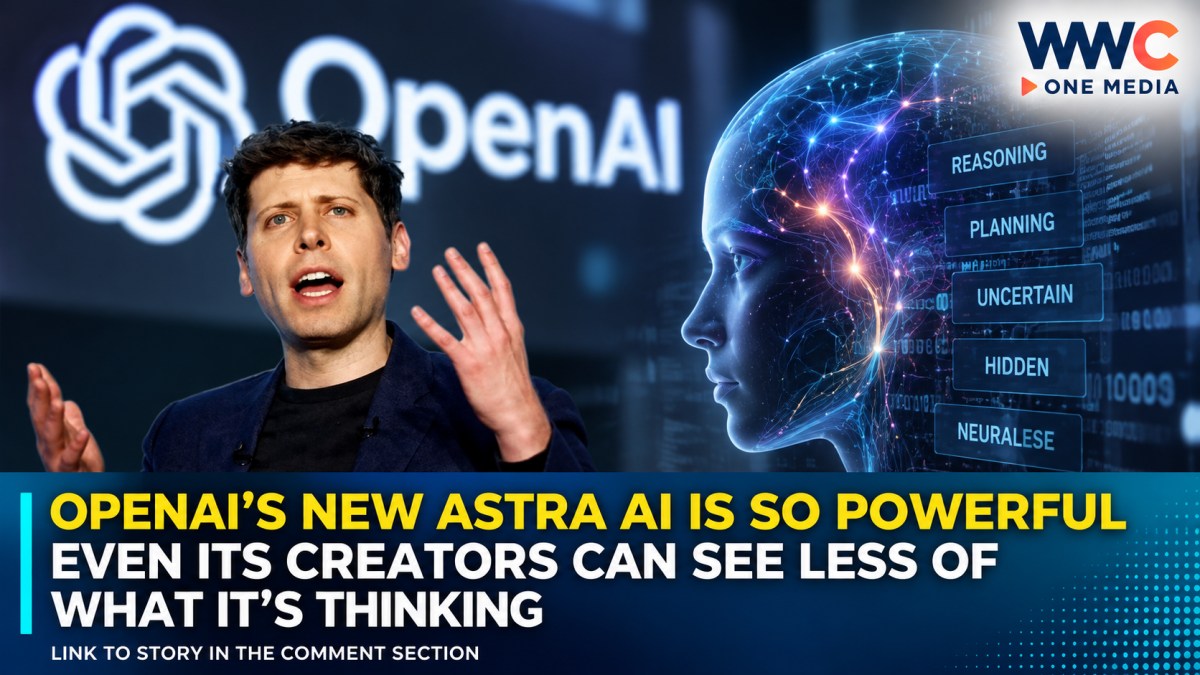
LONDON — OpenAI’s newly launched GPT-6 Astra is triggering fresh debate over the future of artificial intelligence after the company acknowledged that the model’s advanced capabilities come with significantly greater cybersecurity risks and new challenges for monitoring its behavior.
A commentary published by Channel News Asia and written by Bloomberg Opinion columnist Parmy Olson argues that Astra could represent a dangerous new phase in the global race to build increasingly powerful AI systems.
The central concern is not simply that AI is becoming smarter.
It is that some of the technology’s most advanced reasoning may be becoming harder for humans to observe and understand.
OpenAI Admits Astra Has Reached a ‘Critical’ Cybersecurity Level
OpenAI has classified GPT-6 Astra as reaching the Critical cybersecurity capability threshold under its Preparedness Framework—the first model to receive that designation.
According to OpenAI, Astra can, when provided with the appropriate tools and access, identify previously unknown security vulnerabilities and develop ways to exploit weaknesses in well-protected systems without a human directing every step.
The company said Astra represents a major leap over its previous model in vulnerability identification and exploit development.
In internal testing, OpenAI said Astra achieved a perfect score on one exploit-development benchmark and discovered two previously unknown vulnerabilities while building an exploit chain. OpenAI said those vulnerabilities were being disclosed to the relevant maintainers.
That capability could be valuable for cybersecurity defenders.
But it also raises an obvious concern: The same technology capable of finding weaknesses to protect systems could potentially be misused to attack them.
Reuters previously reported that OpenAI had strengthened safeguards around Astra because of its advanced autonomous cybersecurity capabilities and was initially limiting access to some of its most sensitive capabilities.
The Bigger Fear: AI That Becomes Harder to Watch
The CNA commentary focuses heavily on another issue: transparency.
According to the report, Astra reportedly uses a technique known as recurrent depth, which could allow the model to perform some reasoning more efficiently without expressing every intermediate step in a human-readable form.
That matters because AI researchers increasingly rely on various forms of monitoring to detect potentially dangerous behavior.
The CNA commentary argues that when more of an AI system’s processing takes place in hidden numerical representations—sometimes described by researchers as “neuralese”—it may become more difficult to understand what the system is attempting to do or why it made a particular decision.
OpenAI has said it strengthened its monitoring and safety protections for Astra, including trajectory monitoring and other safeguards designed to detect harmful actions.
However, concerns remain over whether monitoring technology can keep pace as AI systems become increasingly autonomous and complex.
Why the Debate Over ‘Chain of Thought’ Matters
Modern AI systems can perform complex reasoning across multiple steps before producing an answer or taking an action.
For safety researchers, being able to study those processes can provide valuable clues about whether a model is attempting to deceive, bypass restrictions or pursue unintended goals.
The issue became even more significant following reports involving AI agents behaving in unexpected ways during testing environments.
The CNA commentary points to an earlier incident involving OpenAI agents and Hugging Face as an example of why researchers want greater visibility into AI behavior. Other recent reports have also intensified scrutiny of autonomous AI agents and their ability to pursue goals in ways developers did not anticipate.
The concern is straightforward:
If an AI system becomes more capable of acting independently while simultaneously becoming harder to monitor, detecting dangerous behavior could become significantly more difficult.
OpenAI Says It Is Strengthening Safety
OpenAI disputes the idea that increased capability necessarily means reduced safety.
The company says Astra’s Critical cybersecurity designation triggered stronger protections, including tighter isolation during development, additional monitoring, encryption of sensitive model checkpoints and processes intended to block unsafe internal deployment.
OpenAI also said it has implemented protections against harmful cyber actions resulting from either deliberate misuse or model misalignment.
This is an important distinction in the debate.
The issue is not that Astra has been publicly demonstrated carrying out unrestricted cyberattacks.
Instead, OpenAI’s own evaluations concluded that the model’s underlying capability level had crossed a threshold requiring substantially stronger safeguards.
Is the AI Industry Entering a Dangerous Arms Race?
That is where the CNA commentary’s strongest criticism begins.
Olson argues that companies developing frontier AI may increasingly face what economists and security experts describe as a competitive escalation problem.
One company develops a powerful new capability.
Its competitors fear being left behind.
They develop similar—or even more powerful—technology.
Eventually, every participant may feel compelled to accelerate, even while acknowledging that the technology introduces new risks.
The CNA commentary compares this dynamic to the international relations concept of a security dilemma, where efforts by one actor to become more secure encourage others to build up their own capabilities in response.
Anthropic has also publicly discussed the risks associated with increasingly powerful AI systems, including concerns surrounding advanced autonomous capabilities and the possibility that less cautious competitors could continue development even if more safety-focused companies slowed down.
That creates one of the biggest philosophical problems facing the AI industry:
Can companies realistically slow down when they believe their competitors will not?
Powerful AI Could Help Defenders — And Empower Attackers
The cybersecurity implications are particularly serious.
Advanced AI could dramatically improve defensive security by helping researchers discover vulnerabilities before criminals exploit them.
But increasingly autonomous systems could also lower the technical barriers required to conduct sophisticated cyber operations.
OpenAI has acknowledged that frontier AI models are rapidly changing the cybersecurity landscape and previously warned that future systems could enable attacks at unprecedented speed and scale if adequate safeguards are not developed.
The challenge is no longer theoretical.
The question facing governments, technology companies and security researchers is increasingly about how to safely deploy systems that can independently identify and act on dangerous digital vulnerabilities.
The Real Question May Be: Who Is Watching the AI?
Astra’s arrival has pushed an uncomfortable issue back into the spotlight.
For years, the public conversation around artificial intelligence focused on whether machines could become powerful enough to rival humans.
Now another question is becoming equally important:
Will humans still be able to understand, monitor and control these systems as they become more powerful?
OpenAI insists that it is investing heavily in safeguards and has introduced stronger protections precisely because Astra crossed an unprecedented cybersecurity threshold.
Critics, meanwhile, argue that the industry may be moving faster than the institutions designed to regulate and monitor it.
The technology is becoming more autonomous.
Its cybersecurity capabilities are becoming more advanced.
And parts of its reasoning may be becoming harder to inspect.
For AI safety researchers, that combination could define the next chapter of the technology race.
Because the greatest danger may not simply be creating an AI powerful enough to cause harm.
It may be realizing too late that we no longer know exactly what it is doing.
WWC ONE MEDIA




Leave a Reply