
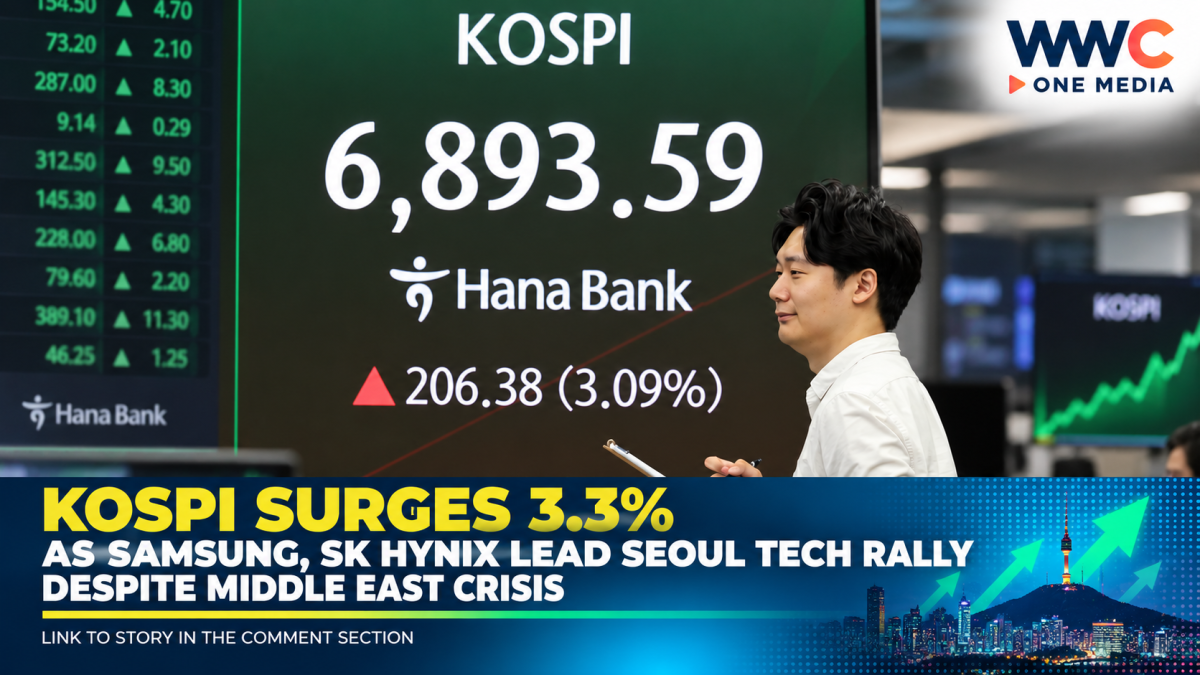
SEOUL, South Korea — South Korean stocks opened sharply higher Monday as semiconductor shares sparked a powerful rebound, pushing the KOSPI up more than 3% even as military tensions between the United States and Iran intensified in the Middle East.
The benchmark Korea Composite Stock Price Index (KOSPI) jumped 223.57 points, or 3.34%, to 6,910.78 at the opening bell, according to Yonhap. By 9:15 a.m., the index was still up 3.33% at 6,909.61.
The surge placed South Korea’s technology-heavy market in sharp contrast with the worsening geopolitical backdrop.
Samsung and SK hynix ignite the rally
The biggest driver was once again South Korea’s semiconductor sector.
Samsung Electronics jumped about 4.4%, while rival SK hynix surged 5.89% shortly after the opening.
Other technology-related companies also rallied. Semiconductor equipment maker Hanmi Semiconductor rose 5.22%, while LG Electronics gained 8.44%. Hyundai Motor advanced 1.96%, while defense contractor Hanwha Aerospace climbed 1.04%.
The gains show how strongly investors are continuing to position themselves around the global artificial-intelligence and semiconductor boom.
Why are chip stocks rising while war risks increase?
At first glance, the market’s reaction appears contradictory.
The Middle East situation deteriorated overnight, with military exchanges between the United States and Iran escalating. Tehran said it had targeted three oil tankers using what it described as an unauthorized route through the Strait of Hormuz, along with several U.S.-linked vessels, in retaliation for American attacks on Iranian tankers.
Ordinarily, such developments would be expected to trigger risk aversion.
Instead, investors focused heavily on the technology sector.
One major catalyst was the PHLX Semiconductor Index, which rose 3.38% after the release of OpenAI’s GPT-6 Astra, with expectations that increased AI computing demand could translate into stronger demand for memory chips.
That optimism appears to have spilled into Asian semiconductor stocks.
The AI boom is overpowering some geopolitical fears—for now
The latest move fits a broader pattern in the South Korean market.
Earlier this month, KOSPI stocks also recovered despite renewed U.S.-Iran tensions, with semiconductor companies helping reverse an early decline. Yonhap reported that strong chip demand and solid South Korean exports provided support for the market.
The semiconductor sector has become particularly important to South Korea because Samsung Electronics and SK hynix are among the world’s leading memory-chip producers.
The strength of AI-related demand has therefore become a major market theme, giving investors a reason to keep buying chip stocks even when geopolitical risks rise.
But oil is sending a very different signal
While technology shares are celebrating, the energy market is flashing a warning.
Oil prices rose again Monday after the latest U.S.-Iran attacks involving vessels around the Strait of Hormuz.
Reuters reported that Brent crude climbed to about $96.80 per barrel, while U.S. West Texas Intermediate reached around $92.14. The Strait of Hormuz carries roughly one-fifth of global oil transit, making prolonged disruption there a major threat to global energy supplies.
That creates a complicated backdrop for South Korean investors.
Higher oil prices can increase costs for businesses, put pressure on consumers and intensify inflation—potentially making monetary policy more difficult.
In other words, the same geopolitical crisis that is threatening the global economy is also being temporarily overshadowed by enthusiasm for AI-related technology.
The Korean won also strengthens
The currency market provided another positive signal.
The Korean won was trading at 1,344.8 won against the U.S. dollar at 9:15 a.m., strengthening by 5 won from the previous session’s close.
A stronger won can help ease pressure from imported costs, particularly when energy prices are rising.
But currency movements remain highly sensitive to developments in the Middle East, U.S. monetary policy and global investor risk appetite.
Wall Street wasn’t the source of the entire optimism
The rally also came despite a mixed finish on Wall Street Friday.
The Dow Jones Industrial Average fell 0.51%, while the Nasdaq Composite declined 0.29% after stronger U.S. employment data increased expectations that the Federal Reserve could face pressure to keep interest rates higher.
The contrast is notable.
U.S. stocks were weighed down by interest-rate concerns, yet South Korea’s semiconductor-heavy market opened dramatically higher.
That suggests the immediate focus in Seoul was less on broad global risk appetite and more on the outlook for AI-driven chip demand.
South Korea’s chip sector has already shown how volatile this trade can be
The latest rally follows a highly volatile period for Korean technology stocks.
In August, semiconductor shares experienced both dramatic rallies and steep sell-offs as investors reacted to U.S. Treasury yields, AI expectations and Middle East developments.
On August 20, for example, Samsung Electronics surged 9.49% and SK hynix jumped 12.73% after SK hynix announced a major shareholder-return program.
But just one day earlier, the same sector had suffered a brutal sell-off: Samsung plunged 7.82% and SK hynix dropped 9.75% as rising U.S. bond yields and renewed Middle East concerns hit investor sentiment.
The message is clear: South Korean semiconductor stocks remain powerful—but extremely sensitive to global developments.
The bigger question: Can the rally last?
Monday’s opening surge is impressive, but investors still have several risks to monitor.
The first is the Strait of Hormuz.
If military activity disrupts oil shipments for an extended period, higher energy prices could eventually overwhelm the optimism surrounding technology stocks.
The second is U.S. interest-rate policy.
Stronger U.S. employment data could keep inflation concerns alive and limit expectations for easier monetary policy.
The third is whether the AI boom can continue generating enough demand to justify elevated valuations across the semiconductor industry.
For now, investors appear willing to bet that AI demand remains the stronger force.
Seoul’s market is caught between two powerful forces
Monday’s opening captures the unusual state of global markets in September 2026.
On one side is the AI boom, pushing investors toward chipmakers such as Samsung Electronics and SK hynix.
On the other is a rapidly worsening geopolitical situation that threatens energy supplies and could reignite inflation.
South Korean stocks chose the first story at the opening bell.
But oil markets are telling investors not to ignore the second.
The KOSPI has surged, the chip giants are flying and AI optimism is back in control—but with the Strait of Hormuz becoming an increasingly dangerous flashpoint, the next headline from the Middle East could determine whether Seoul’s rally has legs or suddenly runs out of fuel.



Leave a Reply