
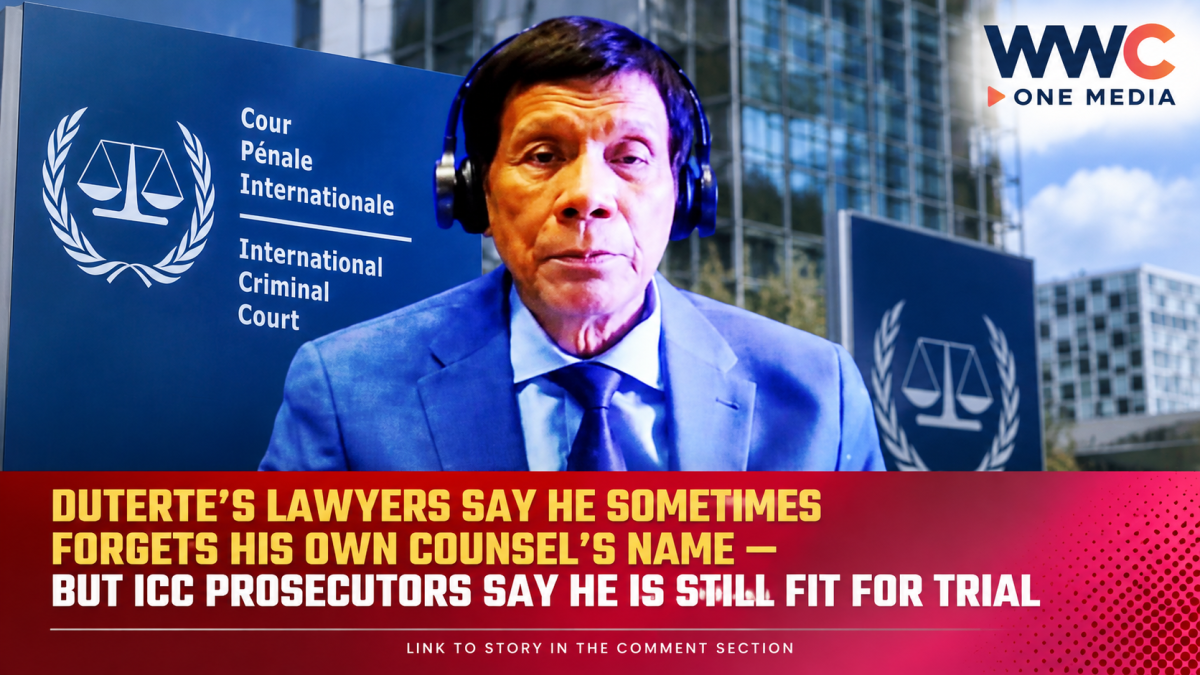
THE HAGUE — Former Philippine president Rodrigo Duterte’s lawyers say his memory has deteriorated so seriously that he sometimes cannot remember the name of the lawyer defending him.
International Criminal Court prosecutors say the evidence points to a very different legal conclusion:
Duterte can still understand the case, exercise his rights and stand trial.
That dispute has now become one of the most consequential questions in the ICC case against the 81-year-old former Philippine leader, whose trial on three counts of crimes against humanity is scheduled to begin on November 30, 2026.
Duterte’s defence told Trial Chamber III that he suffers from what it called “significant memory impairment” that prevents him from consistently retaining recent information and recalling past events.
Lead counsel Peter Haynes argued that the alleged impairment makes it difficult for Duterte to engage meaningfully with an enormous case file, discuss the alleged killings or reliably instruct his lawyers. According to the defence filing, Duterte sometimes cannot even remember Haynes’ name.
But prosecutors, relying on reports from a court-appointed panel of medical experts, have asked judges to find him fit for trial.
The prosecution says the expert assessment indicates that Duterte remains capable of meaningfully exercising his procedural and fair-trial rights.
The medical reports themselves remain largely confidential.
And that makes the dispute unusually difficult for the public to evaluate.
Both sides are pointing to the same assessment process.
They are drawing sharply different conclusions from it.
The dispute is not simply over whether Duterte has memory problems
That distinction is critical.
A criminal defendant does not necessarily have to be in perfect physical or cognitive health to stand trial.
The legal question is whether the accused can sufficiently understand the proceedings, appreciate the charges and evidence, communicate with counsel and meaningfully participate in the defence.
Earlier this year, the ICC’s Pre-Trial Chamber concluded that Duterte was fit to participate in the pre-trial proceedings.
On January 26, 2026, the chamber rejected a defence request for an indefinite adjournment after reviewing assessments from three independent medical experts and concluded that Duterte could effectively exercise his procedural rights.
That ruling allowed the case to resume.
The confirmation-of-charges hearing was then held from February 23 to 27, although Duterte was permitted to waive his right to attend.
The issue now before the trial judges is whether his condition permits him to participate in the trial itself.
So the new defence filing is not simply repeating a question that has never been considered.
It is asking Trial Chamber III to reconsider fitness in light of more recent medical assessments and what the defence says is continuing cognitive deterioration.
The defence says he cannot reliably remember recent events
Haynes’ September 14 filing paints a troubling picture — but the claims remain part of the defence case and have not been adopted as fact by the judges.
According to the defence’s description of medical interviews, Duterte showed difficulty with memory and orientation.
The lawyers say that during testing he believed the year was 2007 or 2008, gave an incorrect age for himself, had difficulty identifying some relatives and failed to remember some recent family visits.
CNA reported that the defence also said Duterte could not identify the current president of the United States and had difficulty recalling when he was last elected in the Philippines.
Haynes argues that such problems are especially serious in a complex international criminal case containing tens of thousands of disclosed items of evidence.
The defence’s point is straightforward:
If Duterte cannot reliably remember the people, events and decisions underlying the allegations, his lawyers say they cannot obtain meaningful instructions from him or prepare a full defence.
That is the argument.
The judges have not yet accepted it.
The experts apparently saw another problem: inconsistent effort
The medical assessment is more complicated than a simple diagnosis.
According to the defence’s own filing, the experts concluded that Duterte “may not have been fully applying himself” during parts of the testing.
That made some results difficult to interpret.
The defence says the experts could not conclusively determine whether poor test performance resulted from an underlying neurological problem, insufficient motivation or possible malingering — deliberately producing or exaggerating symptoms.
That uncertainty is precisely why Haynes wants additional medical work.
He has asked Trial Chamber III to order a neurologist to conduct further examinations and have the expert panel consider the new results.
If the judges refuse, the defence wants an opportunity to question the experts orally or in writing.
Haynes has described the existing assessment as “incomplete and inadequate” for deciding such a consequential issue.
Again, that is the defence position.
There has been no judicial finding that Duterte is malingering.
Nor has the court publicly concluded that his reported memory problems result from a neurological disorder.
Prosecutors say further testing is unnecessary
ICC prosecutors disagree.
Acting prosecutor Mame Mandiaye Niang told Trial Chamber III that the expert panel had complied with the judges’ instructions and that another fitness hearing was unnecessary.
The prosecution highlighted the experts’ observations concerning Duterte’s “reduced effort and unreliability during assessments” and said the reports nevertheless support the conclusion that he can participate meaningfully in his defence.
Much of the prosecution’s seven-page September 14 filing is redacted because it discusses confidential medical evidence.
That means the strongest underlying medical details are not publicly available.
What is public is the conclusion prosecutors are urging judges to adopt:
Duterte is fit for trial.
The prosecution says the experts also proposed practical measures that could help him participate effectively during proceedings.
Details of many of those measures have not been disclosed publicly.
This is not the first time Duterte’s fitness has become central to the case
The dispute has been building for months.
In late 2025, the same broad issue delayed the original confirmation-of-charges process.
Duterte’s lawyers argued that cognitive problems prevented him from participating.
Medical experts assessed him.
Prosecutors argued that those assessments showed that while Duterte was elderly and frail, he could understand the charges and evidence, comprehend the purpose and possible consequences of proceedings and instruct his lawyers.
The defence challenged the methodology and conclusions.
Then, in January, Pre-Trial Chamber I ruled him fit for the pre-trial stage.
The case proceeded.
That procedural history makes the new dispute particularly important.
Duterte’s lawyers now have to persuade a different chamber that the evidence at the trial stage justifies a different result — or at least further investigation.
Duterte’s trial is currently scheduled for November 30
That date remains on the ICC calendar.
After the February confirmation hearing, Pre-Trial Chamber I unanimously confirmed the charges on April 23 and committed Duterte to trial.
The ICC says Trial Chamber III — composed of judges Joanna Korner, Keebong Paek and Nicolas Guillou — is responsible for the trial proceedings.
The opening is scheduled for November 30, 2026, unless the chamber makes an order that changes the timetable.
That means the fitness dispute is no longer an abstract procedural issue.
The scheduled trial is only weeks away.
If judges find Duterte fit, preparations can continue toward November 30.
If they find him unable to participate meaningfully, the proceedings could be interrupted or adjusted.
Trial Chamber III has not yet announced that final determination.
He faces three confirmed counts of crimes against humanity
The case itself is broader than the immediate medical dispute.
The ICC confirmed three counts involving murder and attempted murder as crimes against humanity, covering alleged killings during Duterte’s years as Davao City mayor and later as Philippine president.
The first count concerns the alleged murder of 19 people in and around Davao City between 2013 and around June 2016.
Prosecutors attribute those killings to members of the alleged Davao Death Squad during Duterte’s mayoral period.
The second count concerns 14 alleged “high-value targets” killed in different parts of the Philippines between around July 2016 and July 2017, after Duterte became president.
The third involves 43 alleged murders and two attempted murders during barangay-level drug-clearing operations between around July 2016 and September 2018.
That means the confirmed charges involve 76 alleged killings and two attempted killings.
The ICC judges concluded in April that there were substantial grounds to believe the alleged crimes occurred as part of a widespread and systematic attack against a civilian population.
That is the threshold for sending the case to trial.
It is not a conviction.
At trial, prosecutors must prove Duterte’s criminal responsibility under the applicable legal standard, while the defence can challenge witnesses, evidence and the prosecution’s theory of the case.
Prosecutors say those 78 victims represent only part of the alleged campaign
The individual incidents in the charges do not represent the prosecution’s estimate of the entire death toll.
ICC prosecutors have said the broader anti-drug campaign may have resulted in as many as 30,000 deaths.
Philippine police have officially reported roughly 6,200 people killed in anti-drug operations.
Those numbers measure different things and have long been disputed.
The larger estimates include alleged extrajudicial killings and other deaths that critics and rights groups have linked to the campaign, while the police figure refers to officially recorded deaths during law-enforcement operations.
Duterte has consistently defended his anti-drug policy and maintained that he instructed police to kill only when necessary in self-defence.
His lawyers have also argued that many of his public statements about killing criminals were rhetoric intended to intimidate offenders rather than operational instructions to commit unlawful killings.
Those arguments will be among the issues ultimately tested at trial if the proceedings go ahead.
The confirmed charges reach back to Duterte’s time as Davao mayor
That is sometimes lost when the case is described simply as an investigation into his presidential drug war.
The ICC’s jurisdictional window in the Philippines covers alleged crimes committed from November 1, 2011 through March 16, 2019.
The Philippines withdrew from the Rome Statute, with the withdrawal taking effect in March 2019.
The ICC maintains that withdrawal did not eliminate jurisdiction over alleged crimes committed while the Philippines was still bound by the treaty.
Duterte’s legal team challenged the court’s jurisdiction.
That challenge ultimately failed, and the case proceeded to confirmation and trial.
Duterte was arrested in Manila in March 2025
His current detention began after Philippine authorities arrested him following an ICC warrant.
He was transferred to The Hague and surrendered to the court on March 12, 2025.
His first ICC appearance occurred two days later by video link.
Since then, many proceedings have taken place without him physically in the courtroom, often amid defence arguments about his health and ability to participate.
Reuters reported that judges have now sought his presence in court for the latest proceedings unless medical circumstances prevent it.
If he appears physically, it would mark his first in-person courtroom appearance at the ICC since his transfer.
The prosecution is also asking to keep him detained
Fitness is not the only issue before Trial Chamber III.
In a separate September filing, prosecutors asked the judges to continue Duterte’s detention.
They argued that a fixed trial date, additional incidents included within the charges and disclosure of witness identities increased the risks relevant to detention.
The prosecution said eight additional incidents had been incorporated into the case framework and argued that the larger number of alleged victims increased Duterte’s potential sentencing exposure.
It also argued that release could create risks involving witnesses.
The defence has indicated that if Duterte is ultimately found unfit and proceedings are adjourned, it may ask judges to review whether continued detention remains justified.
The chamber has yet to resolve those matters.
The Philippines government says it respects the ICC process
When the ICC confirmed the charges in April, President Ferdinand Marcos Jr.’s government said it respected the ruling and that the judicial process should determine the outcome.
The presidential office said justice could operate in either direction: vindication for Duterte if he is found innocent, or justice for victims if abuses are proven.
That position differs sharply from Duterte allies who have criticised the ICC process and questioned the legality of his arrest and transfer.
Those political disagreements continue in the Philippines.
But the question now before Trial Chamber III is narrower than the country’s broader political debate.
It is not whether Duterte was a popular or unpopular president.
It is not whether his anti-drug campaign was politically effective.
And it is not whether supporters or opponents believe the ICC should have become involved.
The immediate legal question is:
Can Rodrigo Duterte understand and participate in the criminal trial that is about to begin?
The public still has not seen the medical reports
That may be the most important limitation on the current coverage.
The court-appointed experts’ full assessments remain confidential.
The public instead sees selected passages and characterisations provided by the prosecution and defence.
The defence points to memory failures and says Duterte cannot reliably help prepare his case.
The prosecution points to the expert process and says he retains the abilities required for a fair trial.
That means headlines declaring that Duterte definitively “has dementia,” is definitively “faking” symptoms, or has already been definitively found “unfit” would go beyond the evidence currently available.
No such final public ruling has been made by Trial Chamber III.
The court — not commentators, political allies or opponents — will determine the legal question of fitness based on the evidence before it.
Age alone does not decide fitness
Duterte is 81.
Reuters describes him as elderly and reports that judges and experts have repeatedly considered his health.
But age itself is not the legal test.
A defendant can be elderly, physically frail or experience some memory difficulty and still be legally capable of standing trial.
Conversely, a defendant need not be unconscious or completely incapacitated to be unable to participate meaningfully.
The question is functional:
Can the accused understand what is happening?
Can he follow the evidence?
Can he communicate with lawyers?
Can he make decisions about his defence?
That is why the disagreement over Duterte’s memory is so important.
It goes directly to whether the court can conduct the trial fairly.
The defence’s strongest argument is about the scale of the case
International criminal trials are unusually demanding.
Duterte is not being asked to respond to one alleged act on one date.
The confirmed case spans years.
It includes allegations from his tenure as Davao mayor and his presidency.
It involves dozens of specific victims, numerous alleged operations, witnesses, police records, audiovisual material and other documentary evidence. The April confirmation decision says prosecutors relied on insider witnesses, crime-based witnesses, police reports, forensic records, audiovisual material and open-source evidence.
For the defence, that complexity magnifies the significance of any genuine memory impairment.
Haynes’ argument is essentially that a defendant unable to recall recent information reliably cannot meaningfully assist counsel in navigating a case of this scale.
Prosecutors answer that the expert evidence still shows sufficient functional capacity.
That conflict is now for the judges to resolve.
The prosecution’s strongest argument is the expert process itself
The prosecution is relying on a panel selected to evaluate precisely this question.
It says the experts followed the chamber’s instructions, agreed on assessment methods and produced findings sufficient to determine Duterte’s fitness.
The prosecution therefore says another round of examinations or questioning would unnecessarily delay proceedings.
That matters because victims participating in international criminal proceedings also have an interest in cases moving without unreasonable delay.
At the same time, a defendant’s right to participate meaningfully in his own defence is fundamental.
Those two interests can pull in different directions when health questions emerge late in a complex case.
A November trial is no longer guaranteed merely because it is scheduled
The ICC continues to list November 30 as the trial’s opening date.
But the schedule depends on pending trial-stage decisions.
Judges still have to rule on the defence request for further medical examination and on Duterte’s fitness.
They also have pre-trial procedural issues to resolve before opening statements can begin.
So November 30 should be described as the scheduled opening date — not an unconditional certainty.
That distinction is especially important in a case whose timetable has already been altered by earlier health litigation.
The same court process has now produced two opposite narratives
That may be the most striking feature of the latest filings.
According to Duterte’s lawyers, the assessments show a man struggling to retain recent information, remember dates, recognise some people and consistently instruct his own legal team.
According to prosecutors, those same assessments — including observations about reduced effort during testing — demonstrate that he still has the capacity required to exercise his rights and face trial.
Neither narrative is yet the court’s final conclusion.
That comes next.
And it could determine whether one of the most consequential international criminal cases ever involving a former Southeast Asian leader actually reaches opening statements on November 30.
Duterte has already been committed to trial.
The charges have already been confirmed.
The courtroom has already been assigned.
But before prosecutors can try to prove that he was criminally responsible for the killings charged in the case, the judges must first decide something even more fundamental: whether Rodrigo Duterte is capable of defending himself against them.


Leave a Reply