
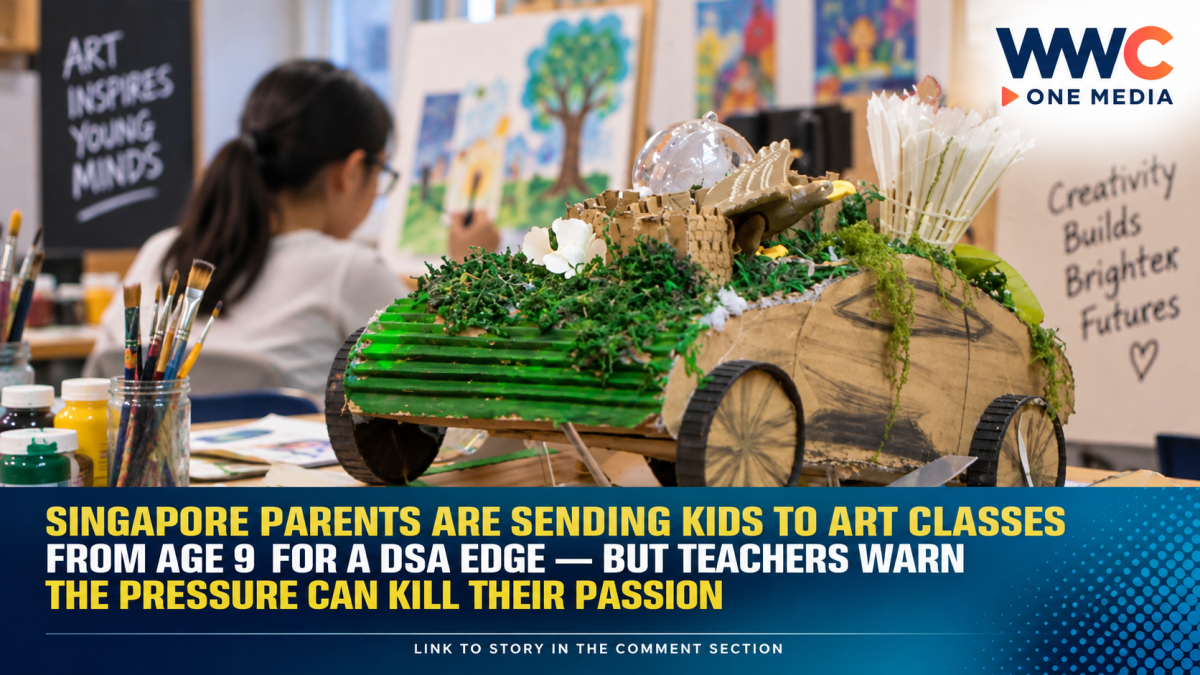
SINGAPORE — For generations of Singapore parents, enrichment usually meant mathematics worksheets, language tuition or science classes.
Now, some families are adding something very different to the schedule:
painting, digital illustration, animation, 3D printing — and increasingly, art classes designed specifically to prepare children for Direct School Admission.
Art enrichment providers say demand is rising as parents rethink what skills their children will need in an economy increasingly shaped by artificial intelligence and automation.
At the same time, another motivation is becoming impossible to ignore.
Some parents are starting DSA-focused art preparation when their children are as young as nine years old, several years before they actually apply to secondary school.
At ARTARY, demand for DSA-related programmes has risen by almost 50% over the past three years.
Tree Art says its DSA enrolment has increased about 30%.
And Tree Art’s overall art-enrichment enrolment has more than doubled since 2022.
The trend reveals a striking change in Singapore’s enrichment economy.
Parents are no longer asking only:
“Will this help my child score better?”
Increasingly, they are also asking:
“Will this help my child stand out?”
Art classes are no longer just about drawing
The traditional image of children’s art enrichment is simple.
A teacher places a still-life object on a table.
Students learn to sketch.
Then they paint.
But many art schools are deliberately moving beyond that model.
Tree Art now incorporates areas such as 3D printing and robotics into its programmes.
ARTARY offers digital-art classes and is exploring ways to incorporate artificial intelligence into portfolio management and exhibition preparation.
The Art People plans to introduce illustration, animation and 3D modelling into its curriculum from October after seeing parents increasingly ask for technology-related creative skills.
That reflects a larger concern among parents:
If AI can increasingly generate text, images, code and even videos, what skills will remain distinctly valuable?
Art-school operators believe one answer is not simply learning how to use technology.
It is learning how to form original ideas in the first place.
Tree Art chief financial officer Teh Chun Sem told CNA that parents are increasingly interested in qualities such as creativity, confidence and the ability to explain ideas rather than focusing exclusively on academic outcomes.
That makes art education relevant beyond children who eventually become artists.
An engineer still needs imagination.
A product designer needs visual thinking.
An entrepreneur needs to communicate an idea.
And someone working alongside AI may need to decide whether the machine’s first answer is actually good enough.
Singapore students are already unusually strong at creative thinking
There is an interesting contradiction here.
Singapore parents are spending more to develop creativity even though Singapore students already perform exceptionally well on international measures of creative thinking.
The OECD’s first PISA assessment of creative thinking found that Singapore scored significantly higher than every other participating education system.
Singapore students averaged 41 points, compared with an OECD average of 33.
Even more strikingly, 58% of Singapore’s 15-year-olds were classified as top performers in creative thinking, the highest proportion among the 64 participating countries and economies.
The OECD average was just 27%.
The assessment measured whether students could generate, evaluate and improve original ideas in areas including visual expression, writing and scientific or social problem-solving.
That suggests Singapore’s academically strong system has not prevented students from performing well creatively.
It also complicates a common assumption that creativity exists only outside conventional schooling.
Creativity and academics are not opposites
Another OECD finding may help explain why parents see value in developing both.
Students who excel at creativity are not necessarily the same students who dominate traditional subjects.
In Singapore, only about 59% of top creative-thinking performers were also top mathematics performers, while just 35% were also top performers in reading.
The OECD concluded more broadly that academic excellence is not a prerequisite for excellence in creative thinking.
That means the familiar debate — academics versus creativity — may itself be misleading.
A child can be strong at both.
Or strong at one and not the other.
That increasingly fits Singapore’s education policy as well.
MOE has been moving toward greater recognition of individual strengths and interests, including through Direct School Admission, Full Subject-Based Banding and expanded talent-development programmes.
Which brings the conversation back to DSA.
Art has become another pathway into secondary school
Direct School Admission allows students to seek places in secondary schools based on demonstrated strengths beyond their Primary School Leaving Examination results.
Those strengths can include sports, performing arts, leadership, specific academic areas — and visual arts.
For some parents, that has transformed art from an enrichment activity into an admissions strategy.
CNA found that DSA preparation at some art centres begins from around age nine.
Students may spend years building portfolios before applications take place in Primary 6.
They are trained not simply to produce polished work but also to:
discuss their artistic ideas,
explain how a piece developed,
assemble portfolios,
respond to interview questions,
and sometimes create artwork under observation.
That last skill matters because schools can design their own selection processes and may require applicants to demonstrate their ability rather than simply submit previously prepared work.
This changes what a DSA-preparation class looks like.
A beautiful portfolio alone may not be enough.
A child may need to prove that the work genuinely reflects his or her own thinking.
The commercial DSA industry has been growing beyond art
Art schools are part of a broader trend.
Earlier CNA reporting found private academies offering specialised DSA preparation in areas such as sports, speech and interviews.
Some programmes charged as much as S$750 for several days of coaching, reflecting parents’ willingness to pay for preparation outside conventional academic tuition.
Parents have also become much more knowledgeable about how DSA works.
The scheme has broadened significantly over the years, with opportunities extending far beyond traditional sports and music into increasingly diverse areas of talent.
That creates new pathways for children who may not be academically exceptional but have genuine strengths elsewhere.
It also creates a new enrichment market.
Where parents once hired tutors to improve examination scores, some now hire specialists to sharpen portfolios, interviews and talent demonstrations.
Some art centres claim very high DSA success rates
That market becomes particularly attractive when providers report strong results.
ARTARY told CNA that approximately nine in 10 of its DSA candidates have successfully secured places.
Tree Art similarly said its candidates achieve about a 90% success rate.
Those figures are impressive.
But they require context.
They are reported by the enrichment companies themselves.
They are not MOE-wide success statistics.
They may also reflect a selected group of students who already showed enough artistic interest or ability to enter intensive preparation in the first place.
A high success rate at one private school therefore does not mean that attending that school gives any child a 90% chance of entering a preferred secondary school.
DSA remains competitive.
Schools make their own selections.
And a strong portfolio does not guarantee an offer.
This creates an uncomfortable question about access
The rise of specialist DSA preparation creates the same concern that has long surrounded academic tuition.
If one family can afford several years of private portfolio coaching while another cannot, does an admissions system designed to recognise natural talent gradually become another competition in professional preparation?
That concern does not mean private coaching is inherently inappropriate.
Elite athletes use coaches.
Musicians take lessons.
Artists need technical instruction.
Talent develops through practice.
But the line between developing genuine ability and optimising a child specifically for an admissions process can become difficult to see.
That is especially true when preparation begins years before the application itself.
The danger is turning a passion into another examination
Art enrichment providers themselves are warning parents about this.
Tree Art regional supervisor Niesa Luib told CNA that some children are pushed into DSA because their parents want access to a particular secondary school rather than because the child genuinely wants to pursue art.
She said some children lose interest during the process even while their parents remain determined to continue.
ARTARY partner Louie Ong described seeing some students become so pressured that they eventually burn out and no longer want to paint.
That is perhaps the central paradox of DSA preparation.
The scheme is supposed to recognise passion.
But excessive preparation can destroy exactly that passion.
Art becomes very different when every picture has consequences
A child who draws because she enjoys it can experiment.
She can produce an ugly picture.
She can abandon an idea halfway through.
She can try something strange.
Those failures can be part of creative development.
But once every artwork may end up in a DSA portfolio, experimentation can become harder.
Parents may ask whether the work is “good enough”.
Teachers may need to optimise composition.
The child may compare every piece against what an interviewer might want to see.
Art then begins behaving less like exploration and more like examination preparation.
And that can undermine one of the reasons parents enrolled their children in the first place:
creativity.
AI is adding another complication
Art schools now face a second balancing act.
Children need enough familiarity with technology to function in a world filled with generative AI.
But if the machine generates too much of the creative work, what exactly is the student learning?
ARTARY says it is considering AI for tasks such as cataloguing work, helping organise portfolios and supporting artist statements, rather than simply allowing children to generate finished artworks with a prompt.
That distinction will become increasingly important.
If a child asks AI to produce an image instantly, the result may be visually impressive.
But the student may have skipped the difficult process of deciding:
what the idea is,
why it matters,
how to represent it,
what failed in the first version,
and how to improve it.
Those are precisely the creative-thinking processes that education experts increasingly value.
The OECD defines creative thinking not merely as producing something novel, but as the capacity to generate, evaluate and improve ideas.
AI can assist that process.
It can also short-circuit it.
Traditional art schools now feel pressure to become technology schools too
Not every provider is benefiting from the current boom.
The Art People told CNA its overall enrolment has fallen by as much as 30% compared with 2025.
Yet even there, management says parents increasingly want more technology incorporated into lessons.
That explains the planned introduction of animation, illustration and 3D-modelling programmes.
The competitive pressure is obvious.
An enrichment centre offering only pencils, brushes and canvases risks looking old-fashioned to parents who believe their children will grow up in an AI-driven economy.
Yet removing traditional skills entirely could be equally shortsighted.
Drawing teaches observation.
Painting teaches colour and composition.
Sculpture teaches form.
And all of them require patience — something an instant image generator does not.
The future of art education may therefore be hybrid rather than purely digital.
Parents are also buying confidence
The growing demand cannot be explained by DSA alone.
Providers repeatedly told CNA that parents increasingly want art classes to improve children’s ability to express and defend ideas.
That has value far beyond school admissions.
A child who creates a piece of work and then has to explain it learns something different from simply getting the correct answer on a worksheet.
Why did you choose this colour?
What were you trying to communicate?
Why did you change the design?
What did not work?
Those questions require reflection.
They can also build confidence because there may not be one predetermined correct answer.
That is one reason arts programmes are also used in community settings to help children build communication, self-expression and social resilience. Recent Singapore programmes for children from lower-income households have similarly used art as a way for participants to express themselves and develop confidence.
The enrichment race is changing, not disappearing
Singapore’s enrichment culture has long been associated with academic competition.
The new trend does not necessarily mean parents have become less competitive.
The competition may simply be expanding.
Math tuition can improve mathematics.
Speech coaching can prepare interviews.
Sports academies can improve DSA performance.
And now art studios can build portfolios years before Primary 6.
That is why the growth of art enrichment tells two stories at once.
The optimistic story is that parents increasingly appreciate creativity, visual literacy, confidence and original thinking.
The more complicated story is that once schools formally reward a talent, an industry inevitably emerges to help families optimise for it.
Both can be true.
A child who loves art may benefit enormously
None of this is an argument against art classes.
For a child genuinely interested in visual creation, structured instruction can open doors that casual drawing at home cannot.
A good teacher can introduce new materials.
Teach perspective.
Explain composition.
Expose children to artists and art history.
Encourage them to articulate ideas.
And help them move beyond copying images toward making work that is actually their own.
Those are meaningful developmental outcomes whether the student eventually becomes an architect, animator, engineer, doctor or accountant.
The OECD’s findings reinforce that creative thinking is increasingly relevant across disciplines rather than confined to traditionally “creative” professions.
The danger appears when the admissions outcome becomes more important than the experience itself.
The real question may be why the child is there
If a nine-year-old spends three years making art because she cannot wait for the next lesson, DSA preparation may simply provide structure around something she already loves.
If she spends three years doing it because her parents want access to a specific secondary school, the same programme can feel very different.
That distinction may matter more than whether the class uses paint, robotics or artificial intelligence.
Art enrichment is growing because Singapore parents increasingly understand that tomorrow’s children will need more than memorised answers.
They will need ideas.
Communication.
Confidence.
Adaptability.
And the ability to make something new.
The irony is that the harder parents push to turn those qualities into an admissions advantage, the easier it becomes to recreate the same high-pressure academic race they were trying to escape.




Leave a Reply