
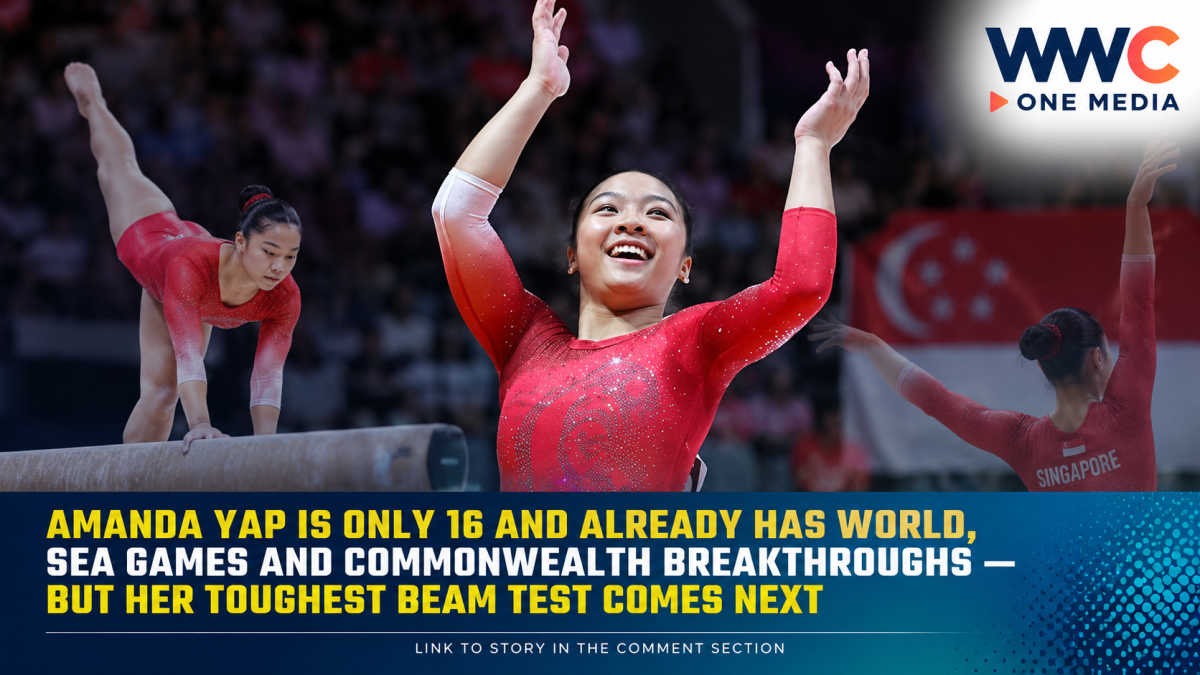
SINGAPORE — Amanda Yap is heading to her first Asian Games with the kind of résumé most gymnasts would be pleased to build over several seasons.
A World Championships final.
A SEA Games silver medal.
A Commonwealth Games silver.
And all of it before turning 17.
But when the Singapore artistic gymnast steps onto the balance beam in Japan this week, she will face something she cannot solve simply by adding another difficult skill to her routine.
She is still working her way back from a back injury.
Yap, 16, has set herself a deliberately measured goal for her Asian Games debut: qualify for the women’s balance beam final and see what happens from there. She told CNA that training has been modified because of the injury and that she is still leaving certain elements out of her routines to avoid aggravating it.
That caution is understandable.
The Aichi-Nagoya Asian Games officially run from September 19 to October 4, with artistic gymnastics scheduled from September 20 to 24 at Nagoya City General Gymnasium, also known as Rainbow Hall.
For Yap, those five days could determine whether the fastest rise in recent Singapore gymnastics history takes another step forward.
Eight months ago, an Asian Games final would have sounded ambitious
Today, it looks realistic.
Yap has already shown she can compete with some of Asia’s strongest gymnasts.
At the 2026 Asian Artistic Gymnastics Championships in China, she reached the balance beam final and finished sixth with 13.133 points. She also placed fifth in the floor final and 12th in the senior all-around.
That matters because the Asian Games field includes many of the same gymnastics powers that dominate continental competition.
At those Asian Championships, Chinese gymnasts Zhang Qingying and Ke Qinqin scored 15.266 and 15.100 respectively in the beam final, while South Korea’s Hwang Seohyun took bronze with 14.733.
Yap therefore knows exactly how high the standard can become.
She is not approaching Japan assuming her Commonwealth Games medal makes her a favorite.
Instead, she told CNA she is trying to focus on executing her own routines rather than worrying about what rivals do.
That may be the only sensible approach on balance beam.
A routine lasts barely more than a minute.
One missed landing can erase months of preparation.
Her Commonwealth silver changed expectations
Yap’s most recent major result came in Glasgow in July.
Competing at her first Commonwealth Games, she scored 13.233 in the balance beam final to win silver, finishing behind Australia’s Breanna Scott, who scored 13.933.
It was Singapore’s first Commonwealth Games gymnastics medal since 2014.
Yap also equalled the country’s best-ever Commonwealth Games result in women’s artistic gymnastics, matching Lim Heem Wei’s balance beam silver from 2010.
Singapore Gymnastics noted that Yap did more than medal in Glasgow.
She qualified for the individual all-around final and the floor exercise final as well, while Singapore’s women’s artistic team finished seventh.
So the silver was not an isolated good routine.
It came during a competition in which Yap was competitive across multiple events.
But she refuses to treat one medal as proof the next one is coming
That may be one of the more revealing things about her approach.
Speaking ahead of the Asian Games, Yap said the Commonwealth result was a major accomplishment but stressed that it was still just one competition and did not guarantee that everything afterward would go well.
That restraint matters because gymnastics results can change dramatically between meets.
Difficulty scores change.
Execution changes.
A small wobble becomes a large deduction.
And injuries can force an athlete to redesign a routine at exactly the wrong moment.
Yap is currently dealing with that last problem.
She said her coaches initially modified her programme after the back injury and that she is gradually returning toward normal training as the Asian Games approach. Some skills remain deliberately excluded for now.
So the teenager who has spent the past year raising expectations is now trying not to chase them too aggressively.
The breakthrough actually started at the 2025 World Championships
Before Glasgow, there was Jakarta.
At the 2025 Artistic Gymnastics World Championships, Yap became the first Singaporean gymnast to reach a World Championships apparatus final.
She qualified seventh for the balance beam final with 13.300, then improved to a personal-best 13.333 to finish sixth in the world.
That alone would have been an extraordinary week for a 15-year-old competing in her first senior season.
But Yap was simultaneously sitting for her GCE O-Level examinations.
She flew between Singapore and Jakarta during the championships, returning home to sit an examination paper before heading back to Indonesia for the final.
Singapore Gymnastics said she flew back specifically to sit her Mathematics paper between the qualification round and apparatus final.
That episode became almost as memorable as the result itself.
One day she was completing an exam.
Days later she was standing on a four-inch-wide beam at a world championship.
Then came another 20-year milestone
Less than two months later, Yap did it again.
At the 2025 SEA Games in Bangkok, she scored 12.733 to win balance beam silver, finishing behind Malaysia’s Yeap Kang Xian.
The medal ended Singapore’s 20-year wait for an individual SEA Games balance beam medal.
There was a family dimension too.
Her older sister Emma Yap won silver in the floor exercise at the same Games.
Amanda told CNA that achieving the result alongside her sister made the moment particularly special.
So within a matter of months, Yap went from a promising junior gymnast to an athlete repeatedly appearing in Singapore’s gymnastics record books.
Her 2026 results show the progress continued after the medals
The improvement did not stop after the SEA Games.
At the Singapore Championships in March, Yap won the senior all-around and balance beam titles while competing for Singapore Sports School.
At June’s Asian Championships, she recorded 13.700 on beam during the all-around competition, before later scoring 13.133 in the event final. She also reached the floor final.
Then came Glasgow and another silver.
Taken together, the sequence is striking:
October 2025: sixth at the World Championships on beam.
December 2025: SEA Games silver.
June 2026: Asian Championships beam final.
July 2026: Commonwealth Games silver.
September 2026: Asian Games debut.
That is an unusually steep progression for an athlete still only 16.
The Asian Games may actually be a tougher medal environment than Glasgow
This is where the Commonwealth silver needs context.
Winning in Glasgow was significant.
But artistic gymnastics in Asia contains several of the sport’s strongest countries, particularly China and Japan, along with accomplished programmes from South Korea and North Korea.
The 2026 Asian Championships demonstrated the gap Yap is still trying to close.
The winning beam score was 15.266.
Yap scored 13.133 in the final.
That is a substantial difference under gymnastics scoring.
It means reaching the Asian Games final would itself be a meaningful result, particularly while she is returning from injury.
A medal would require not only a strong Yap routine but potentially mistakes from athletes carrying substantially higher difficulty.
That is why her goal is a final, not a medal prediction
Yap’s target is deliberately specific.
She wants to reach the balance beam final.
Not promise gold.
Not declare that Commonwealth silver must become an Asian Games medal.
Just earn another routine.
That approach fits what she has said repeatedly about competition: focus on what she can control, hit the routine and allow the standings to take care of themselves.
Gymnastics rewards that mentality because competitors cannot respond tactically to an opponent in real time.
There is no defender to beat.
No race pace to follow.
No scoreboard strategy.
The athlete has the apparatus, the routine and the judges.
Balance beam has become her signature event
Yap competes as an all-around gymnast, but beam is where her biggest international breakthroughs have occurred.
The apparatus is just 10cm wide.
Routines combine leaps, turns, acrobatic series and dismounts while judges separately evaluate difficulty and execution.
That makes consistency unusually valuable.
Yap’s 2025 World Championships result showed she could produce that consistency under the biggest pressure of her career.
Her Commonwealth silver confirmed it was repeatable.
The Asian Games now asks whether she can do it again against a deeper Asian field — and with a body that is not yet fully back to normal.
She has been doing this since she was three
Yap first tried gymnastics at around the age of three, according to CNA.
More than a decade later, she says part of what still attracts her to the sport is the challenge of mastering difficult skills and the resilience required to survive repeated setbacks in training.
That resilience is being tested again now.
Gymnastics injuries create an awkward equation.
Athletes need repetitions to make skills automatic.
But repetitions can also aggravate the injury they are trying to protect.
Reducing difficulty may make a routine safer.
It can also lower its maximum score.
Yap and her coaches therefore have to arrive at a version of the routine difficult enough to qualify for a final but conservative enough not to jeopardize the rest of her season.
The long-term target is much bigger than Aichi-Nagoya
Yap has previously said her ultimate ambition is the Olympic Games.
The obvious target is Los Angeles 2028.
She would still be only 18.
But Olympic qualification in artistic gymnastics is extremely difficult, particularly for countries that do not qualify full teams.
That makes competitions such as the World Championships, Asian Championships and Asian Games important stepping stones.
They provide international experience.
They reveal where an athlete’s difficulty stands against world-class rivals.
And they show which routines can survive under pressure.
Yap has already proven she can make a World Championships apparatus final.
The next challenge is turning isolated historic breakthroughs into repeatable elite-level results.
Singapore is beginning to invest more heavily in her future
Singapore Gymnastics announced earlier this year that Yap had received a spexScholarship for the first time after her breakthrough 2025 season.
The programme provides enhanced support to high-performance athletes as they train and compete internationally.
For a teenage gymnast, that support can matter enormously.
Elite gymnastics involves coaching, physiotherapy, medical management, travel and large numbers of training hours.
And unlike athletes already competing professionally in lucrative leagues, young gymnasts often have limited commercial income while developing.
Yap’s results have now pushed her into a level where Singapore’s sporting system is treating her as a serious long-term prospect.
She is still not treating herself like a star
That may be the most interesting contrast in her rise.
Singapore gymnastics history has changed rapidly around her.
First Singaporean in a World Championships final.
First individual SEA Games beam medal in two decades.
First Commonwealth Games gymnastics medal for Singapore in 12 years.
Yet her language ahead of Japan remains cautious.
She speaks about consistency.
About managing the injury.
About enjoying the opportunity to compete alongside stronger gymnasts.
And about getting into the final first.
That mindset does not guarantee another medal.
But it may be one reason the medals have kept arriving.
Japan will show how far the rise has really gone
The Asian Games represent a different test from Glasgow.
The field is deeper.
The scores required at the top can be higher.
Yap is carrying an injury.
And unlike at last year’s World Championships, she is no longer arriving as an unknown Singapore teenager with little international expectation attached to her name.
Competitors and judges know who she is now.
Singapore fans do too.
That changes the pressure.
At 16, Amanda Yap has already reached a world final and stood on two major multi-sport podiums.
The Asian Games are the next test.
And this time, success may not need to mean another medal.
Simply earning the right to step onto the beam one more time in the final could be the clearest sign yet that Singapore’s teenage breakthrough gymnast is becoming a permanent fixture at Asia’s top table




Leave a Reply