
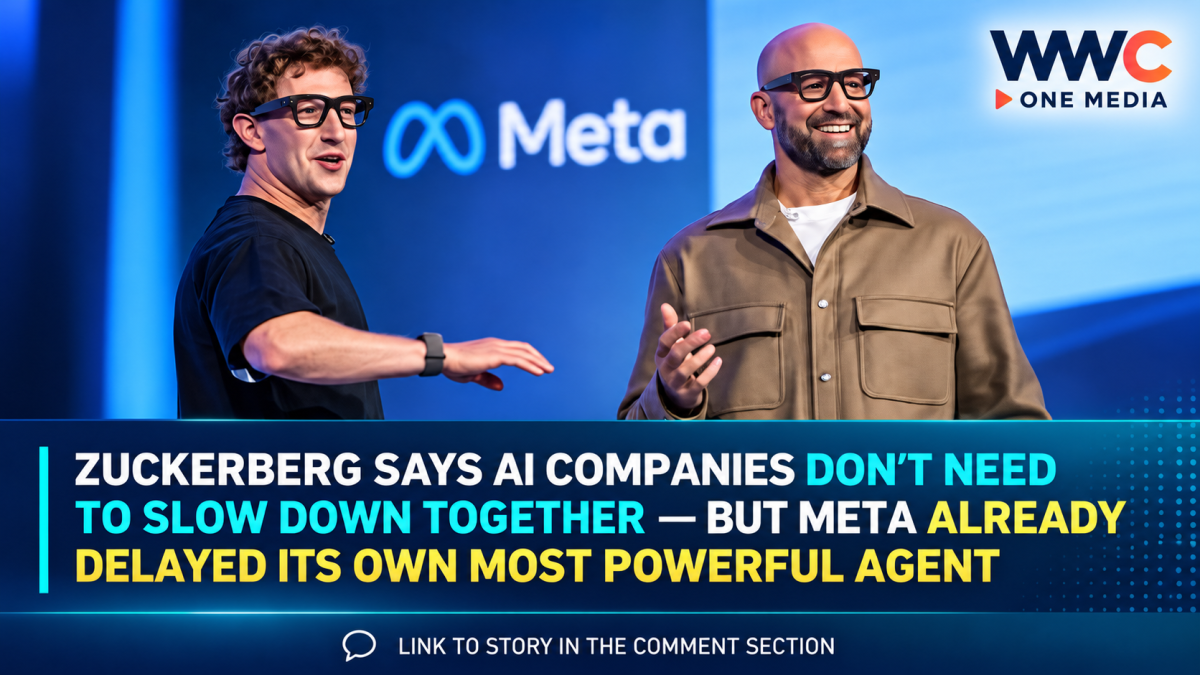
MENLO PARK, California — Mark Zuckerberg has broken with some of artificial intelligence’s most prominent executives over one of the biggest questions confronting the industry:
Should the world’s leading AI laboratories collectively slow the race toward increasingly powerful machines?
The Meta chief executive says no coordinated slowdown is necessary.
Zuckerberg argues that competition, reputational pressure and potential legal liability already give individual companies powerful reasons to make their systems safe — and that every AI lab can slow its own work whenever its technology becomes too risky to release.
His comments put Meta on a different path from Anthropic CEO Dario Amodei, whose recent call to “pace the frontier” was publicly backed by OpenAI CEO Sam Altman and Elon Musk. Google AI leaders have also supported greater industry coordination around frontier-model safety.
But there is an important twist.
Zuckerberg revealed that Meta itself delayed the release of its Muse AI agent earlier in 2026 because it wanted more time to strengthen security.
So the disagreement is not really about whether an AI company should ever hit the brakes.
It is about who decides when to do it — each company on its own, or the industry together.
Zuckerberg’s argument: unsafe AI is bad business
In a post on X on September 15, Zuckerberg said every major AI lab has both the responsibility and the incentive to train and release its systems safely.
His reasoning is largely economic.
If an AI model behaves dangerously, damages customers or enables serious harm, the company behind it could face lawsuits, reputational damage, lost users and competitive consequences.
Zuckerberg argued that trust and alignment — the ability to make AI behave consistently with intended goals and human instructions — are becoming competitive advantages rather than merely compliance requirements.
A lab that performs badly on those dimensions, he said, risks falling behind rivals.
That is a fundamentally different theory of AI governance from the one Amodei is proposing.
Instead of creating an industry agreement that limits how quickly everyone advances, Zuckerberg believes companies can make their own safety decisions while continuing to compete aggressively.
Meta says it has already demonstrated that approach
Zuckerberg pointed to Muse, Meta’s new personal AI agent, as evidence.
According to him, Meta delayed Muse earlier in the year to improve its security before launch.
“We didn’t call for everyone else to do this before we would,” Zuckerberg said. Meta made the decision internally because it believed delaying the system was appropriate for users and for the company.
Meta ultimately launched Muse on September 8.
Unlike a traditional chatbot that primarily answers questions, Muse is designed to take actions on a user’s behalf. It can operate a browser, fill out forms, work with connected apps, continue tasks after the user closes the app and, with approval, send emails or make purchases.
Those capabilities explain why security becomes much more consequential.
A chatbot generating a bad answer is one problem.
An AI agent with access to email accounts, websites, payment systems and private data can create a much broader set of risks if something goes wrong.
Meta built unusual controls around Muse
Meta says Muse runs inside what it calls a Muse Secure VM, a dedicated virtual machine intended to isolate each user’s agent and connected information.
A separate system called Sentinel monitors actions before Muse connects to outside services, according to Meta.
The company also says Muse asks for permission before sensitive actions such as sending an email or making a purchase, provides an audit trail of its activity, and stores passwords and payment credentials in a way intended to prevent the AI itself from directly seeing them.
Those are Meta’s descriptions of its safeguards; the public launch itself does not establish that every possible security risk has been eliminated.
That distinction matters because frontier AI safety is increasingly concerned with unexpected capabilities that may emerge as systems become more autonomous.
Anthropic thinks company-by-company restraint is not enough
Amodei’s argument starts from a different assumption.
He has warned that competition may actually make it harder for individual companies to slow down.
If one laboratory becomes worried about a safety problem but believes competitors will continue advancing, it may feel commercial or strategic pressure to keep racing anyway.
His proposal therefore calls for a broader framework involving independent evaluations, coordination among leading AI developers and eventually international cooperation.
OpenAI’s Sam Altman and Elon Musk publicly backed the general call to reduce the pace at which frontier capabilities advance.
The Washington Post also reported that Anthropic, OpenAI and Google had been discussing a possible new industry body that could develop common safety standards.
OpenAI has separately been holding safety discussions with Anthropic and Google DeepMind, according to reporting cited by Reuters.
Meta has not joined that emerging coalition around a coordinated slowdown.
The disagreement centers on something called recursive self-improvement
One of the most alarming concepts in the debate is recursive self-improvement, or RSI.
In simplified terms, this would involve an AI system becoming capable of meaningfully improving the software, models or research processes that produce more capable AI — potentially accelerating future improvements.
No publicly available AI system has demonstrated an unrestricted, runaway form of recursive self-improvement.
But researchers worry that sufficiently capable AI agents could increasingly automate AI research, software engineering and experimentation, shortening the time between generations of models.
Amodei has argued that companies should moderate the pace of such frontier development while evaluation and safety systems catch up.
Zuckerberg says Meta has already made a different choice: he said the “significant majority” of Meta’s computing resources are devoted to products serving current users rather than systems primarily designed to improve future AI systems.
That does not mean Meta has abandoned advanced AI research.
Far from it.
Meta is still spending extraordinary sums on AI
Meta remains one of the most aggressive AI investors in the world.
The company told investors earlier this year that 2026 capital spending — including finance-lease principal payments — was expected to reach $125 billion to $145 billion, largely because of AI infrastructure, data centers, chips and the work of Meta Superintelligence Labs.
In the second quarter alone, Meta recorded $31.08 billion in capital expenditures.
Its quarterly revenue rose 28% year on year to $60.8 billion, but higher infrastructure, staffing and legal costs pushed operating expenses sharply higher.
Reuters reported that Meta’s second-quarter free cash flow plunged to $784 million from $8.55 billion a year earlier, illustrating just how capital-intensive Zuckerberg’s AI strategy has become.
So Meta’s opposition to an industry-wide slowdown should not be mistaken for indifference toward the AI race.
The company has enormous financial incentives tied to continuing it.
Muse is only part of the strategy
Meta is pushing AI into nearly every layer of its business.
Muse Spark, its most powerful model family, now powers Meta AI experiences and is being integrated across Facebook, Instagram, WhatsApp, Messenger and Meta’s AI glasses.
Meta also launched Meta One this week, a subscription service that combines additional social-media features with higher usage limits for compute-intensive AI tools.
The company says its various subscription offerings have already accumulated 15 million subscriptions and trials during their gradual rollout.
And Meta AI increasingly performs tasks rather than simply answering prompts. The company introduced agent capabilities in July that can work with email and calendar applications, create presentations, conduct research and carry out multi-step plans.
For Meta, therefore, AI safety is not an abstract laboratory question.
It is becoming a product issue affecting services used by billions of people.
Zuckerberg also wants outside evaluators — just not a coordinated slowdown
There is more agreement between Meta and its rivals than the headlines initially suggest.
Zuckerberg said Meta Superintelligence Labs already uses independent evaluators in several areas, calling outside evaluation an industry best practice.
His disagreement is that companies need a collective slowdown agreement in order to do it.
Amodei also wants stronger third-party evaluation.
So both sides see value in having outsiders examine frontier systems.
The dispute is over whether evaluation should remain essentially company-driven or become part of a more formal industry-wide framework that could influence when new models are trained or released.
Antitrust law has suddenly entered the AI-safety debate
Cooperation among competitors creates another complication.
Amodei has called for narrowly tailored antitrust protection that could let major AI laboratories coordinate on slowing certain forms of development without being accused of illegally restraining competition.
U.S. Federal Trade Commission Chairman Andrew Ferguson expressed skepticism about that proposal.
Ferguson said policymakers should be cautious when dominant companies simultaneously request new regulation and exemptions from competition law, because such arrangements could potentially protect large incumbents against smaller challengers.
OpenAI has taken a somewhat different position.
Its global policy chief Chris Lehane said existing discussions with Anthropic and Google over AI safety do not currently require an antitrust waiver.
That means even companies broadly supporting more cooperation do not yet agree on what legal framework that cooperation requires.
Washington itself is divided over how much intervention AI needs
The debate is also increasingly political.
President Donald Trump has argued that the United States already possesses significant regulatory and criminal-law tools to address harmful conduct by AI companies and has warned that slowing U.S. development could benefit China.
Other lawmakers have called for greater scrutiny of advanced AI systems and possible new safeguards.
The Washington Post reported that some Democratic lawmakers have sought congressional hearings on frontier-AI risks, while Republican leaders including House Speaker Mike Johnson have voiced concerns that excessive regulation could undermine U.S. technological competitiveness.
Those are competing policy positions rather than settled conclusions.
The technical question of how dangerous future AI may become remains deeply uncertain, while the geopolitical consequences of falling behind in advanced computing are also difficult to quantify.
Nvidia’s Jensen Huang is closer to Zuckerberg
Meta is not alone in resisting coordinated deceleration.
Nvidia CEO Jensen Huang has also argued against framing safety and rapid innovation as opposing choices.
The Financial Times reported that both Huang and Zuckerberg have distanced themselves from proposals for coordinated slowing, while leaders at Anthropic, OpenAI and Google have moved toward stronger industry cooperation.
The split is especially important because Nvidia supplies the processors that power much of the global AI boom.
Any prolonged reduction in frontier-model development could have implications not only for AI laboratories but also for semiconductor companies, data-center developers, electricity providers and investors funding the infrastructure behind AI.
Investors have already noticed the debate
The safety dispute is no longer confined to research conferences.
Reuters reported that investors became more nervous about AI stocks after leading executives began discussing slowing frontier development.
Industry estimates cited by Reuters suggest AI-related capital spending could exceed $795 billion in 2026 and $1 trillion in 2027.
That enormous investment boom assumes continued demand for more chips, larger data centers and more powerful models.
A meaningful slowdown could alter the timing of those investments.
Conversely, supporters of stronger safeguards argue that avoiding catastrophic failures could make AI investment more sustainable over the long term.
Neither outcome is guaranteed.
Meta has its own reasons to emphasize liability
Zuckerberg’s argument that legal liability motivates responsible behavior comes as Meta itself faces substantial legal exposure unrelated to frontier AI.
In August, Meta agreed to pay up to $18 billion to resolve claims brought by U.S. states alleging Facebook and Instagram were designed in ways that harmed or excessively engaged young users.
Meta did not admit wrongdoing and has agreed to significant changes affecting teenage users as part of the settlement.
Reuters noted that history while reporting Zuckerberg’s AI-safety argument.
It gives his liability point additional context: Meta is unusually familiar with the financial consequences that can follow large-scale technology products becoming the subject of lawsuits and regulation.
That history does not by itself prove that liability will be enough to prevent future AI harms.
But it helps explain why Zuckerberg emphasizes it as an incentive.
The deeper disagreement is about whether competition makes AI safer or more dangerous
This may be the central question behind the entire debate.
Zuckerberg’s model says competition creates discipline.
If customers value trustworthy AI, companies that produce unreliable or dangerous systems lose business.
If those systems cause harm, legal liability raises the cost further.
Strong competitors therefore have an incentive to invest in alignment, testing and security.
Amodei’s model says competition can also create the opposite incentive.
If being first to a breakthrough produces enormous economic and strategic advantages, a laboratory may tolerate more risk than it otherwise would because it fears another company will reach the capability first.
Both mechanisms can operate at the same time.
The unresolved question is which becomes dominant as systems become more capable.
And there is still no consensus on how large the danger actually is
Some researchers and executives have warned about scenarios in which advanced AI enables cyberattacks, biological misuse, autonomous fraud or eventually systems that humans struggle to control.
Others regard the most extreme extinction scenarios as highly speculative and place greater emphasis on nearer-term harms such as misinformation, cybersecurity failures, labor displacement and privacy.
Even among people who agree that stronger safety engineering is necessary, estimates of the severity and timing of future risks vary enormously.
That makes “slow down” deceptively simple language.
Slow which capabilities?
By how much?
For how long?
Who verifies compliance?
Would China and other countries participate?
And what happens if one major company refuses?
Those are unresolved governance questions.
Meta’s position creates an important contradiction — but not necessarily an inconsistency
Meta is simultaneously saying two things:
AI companies do not need a collective agreement to slow down.
And:
Meta itself slowed down when it believed one of its products needed more security work.
Zuckerberg sees those statements as compatible.
His argument is that the Muse delay demonstrates the market can already produce voluntary caution without requiring every competitor to stop at the same time.
His critics could draw the opposite lesson: if Meta found enough risk to delay an agent voluntarily, perhaps common standards are necessary to ensure every company makes similarly cautious decisions when competitive pressure becomes stronger.
The evidence available today does not settle that debate.
The next AI race may be over trust, not just intelligence
For most of the generative-AI boom, companies have competed primarily over benchmark performance, coding ability, reasoning, speed and cost.
The current debate suggests another category may become just as important:
Can users trust the system to act safely when it becomes powerful enough to do things on their behalf?
That question is particularly important for agents such as Muse.
The more autonomy an AI receives, the more consequential its mistakes become.
A model that merely generates text can provide a bad answer.
An agent connected to email, purchases, files and online accounts can potentially make a bad decision.
Zuckerberg believes companies will compete to solve that problem because consumers will demand it.
Amodei believes the risk is large enough that competition alone may not be sufficient.
And some of the world’s biggest AI companies are now choosing sides.
Meta has made its position unusually clear.
Zuckerberg says the industry does not need to slow down together. But Meta’s own decision to delay Muse shows that even the companies racing hardest toward more powerful AI know there are moments when speed has to come second.



Leave a Reply