
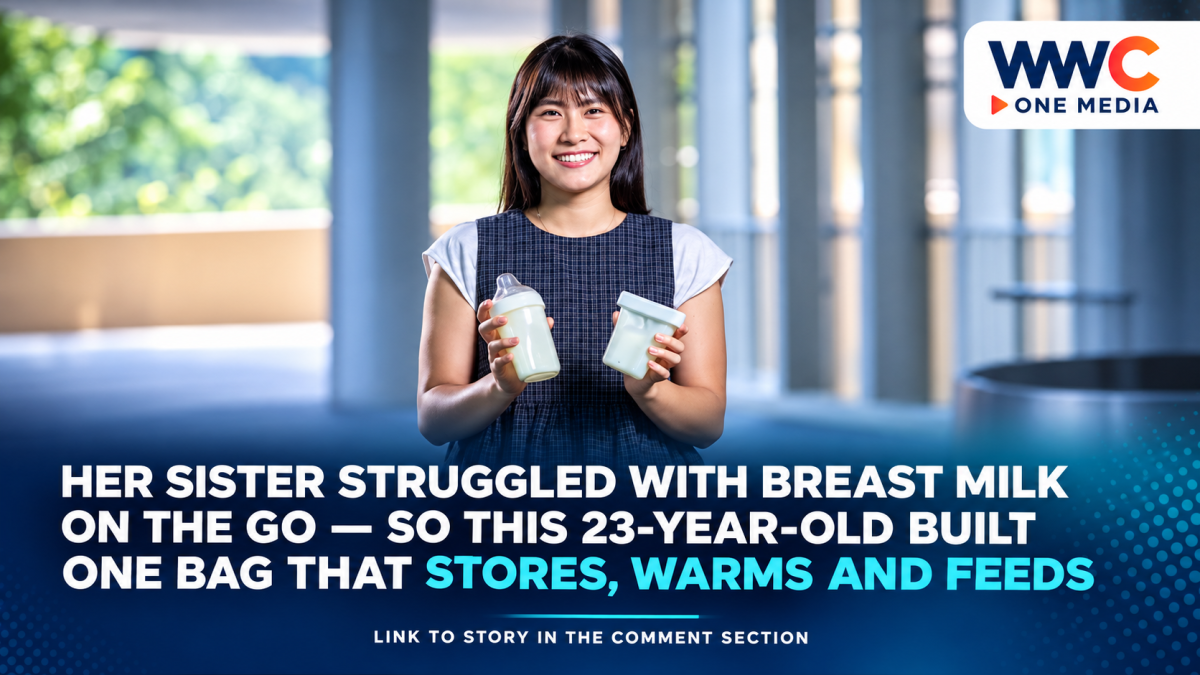
SINGAPORE — What began with a young woman watching her sister struggle through the logistics of breastfeeding has turned into one of Singapore’s newest award-winning design ideas.
Nicolette Wong, a 23-year-old National University of Singapore industrial design graduate, has been named Singapore’s national winner of the James Dyson Award 2026 for Momigo, a reusable system designed to let parents store, warm and feed expressed breast milk from the same silicone container.
The concept sounds deceptively simple.
Instead of carrying separate breast-milk storage bags, feeding bottles and warming equipment — and repeatedly pouring milk from one container into another — Momigo attempts to turn those separate steps into one continuous process.
But the award does not mean the product is ready for shop shelves yet.
Wong’s current system remains a prototype. It has not been tested with babies, and she says more work is required on materials, manufacturing, durability, thermal performance, regulatory requirements and extended user trials before commercialisation can be considered.
That makes the real story bigger than an award.
It is about whether a student project inspired by one family’s everyday frustration can eventually become a product used by parents far beyond Singapore.
It started with her sister
Wong chose breastfeeding as the subject of her final-year NUS thesis after watching her sister Stephanie navigate motherhood after giving birth to her first child.
She told CNA that she initially assumed breastfeeding would be relatively natural and straightforward.
Watching her sister changed that assumption.
Beyond breastfeeding itself, Wong saw the amount of planning involved in expressing milk, storing it safely, carrying it outside the home, warming it and eventually transferring it into something a baby could drink from.
Her attention increasingly shifted toward something that is rarely visible in discussions about infant feeding:
the logistics surrounding the milk.
The James Dyson Award project description similarly says Wong became interested in everything happening around feeding — pumping, storage, warming, washing and preparing for outings — rather than focusing only on the act of breastfeeding.
And her sister was not the only source of information.
Wong spoke with more than 15 parents as well as lactation consultants, gathering different experiences before settling on the final direction of her design.
Why not simply use a breast-milk bag and bottle?
That question became central to the project.
Disposable freezer bags are compact and convenient for storing milk, but they usually require milk to be transferred into another container for feeding.
Reusable systems reduce disposable waste, but Wong found many were bulkier to carry and store.
Her goal was therefore not simply to design another bottle or another storage bag.
It was to combine their functions.
Momigo’s central component is a reusable silicone container with a wide circular opening that narrows toward the bottom.
Once filled with expressed milk, it can be sealed into a relatively slim profile for refrigeration or freezing.
When feeding time arrives, the same container is attached to a warming system and placed inside an insulated flask containing warm water.
After warming, the silicone container can be moved into a supporting holder and fitted with a teat.
The milk therefore does not have to be poured into another bottle between storage and feeding.
Wong says warming takes about three minutes
For travel, parents would carry an insulated flask containing hot water.
At feeding time, Momigo’s silicone bag attaches to the flask’s warming component and is suspended in the water.
CNA reported that the warming process takes around three minutes in Wong’s prototype demonstrations.
The James Dyson Award description says a concave section in the container is intended to increase the surface area exposed to warm water and improve warming efficiency.
That is a key part of the design thinking.
Wong was not merely attempting to make the container reusable. She was trying to make one shape function effectively during freezing, warming and feeding, three stages that can place very different demands on a container.
It took 10 months to get there
Wong began the project in August 2025.
By around October, she had narrowed her focus toward the bottle-bag concept, with much of the detailed prototyping and refinement taking place during early 2026.
Altogether, she spent around 10 months developing Momigo.
Early concepts included collapsible and origami-inspired designs, according to the official project submission.
Those were ultimately abandoned because Wong felt they created more complexity rather than reducing it.
She also repeatedly revised the sealing geometry because the opening needed to be wide enough for feeding while still being capable of creating a secure, watertight seal for storage.
For the final prototype, Wong created a 3D-printed mould before casting the silicone container herself.
The holder and insulated-flask prototype were also 3D printed, although the intended commercial flask would eventually be metal.
She used an existing commercially available silicone teat rather than developing a new one, because the teat was not the central innovation.
But there is an important limitation
Despite the award, Momigo should not yet be described as a finished infant-feeding product.
Wong told CNA that she did not test the prototype with babies, because its current components remain prototypes.
That distinction matters for any product intended to store and deliver infant food.
The official James Dyson Award page says the next stage would include producing prototypes in food-grade silicone, assessing thermal performance and durability, refining capacities and conducting user trials.
Wong also hopes to work with industry partners to prepare the system for manufacturing and regulatory requirements.
So the national award validates the ingenuity of the concept and design process.
It does not constitute regulatory approval, safety certification or proof that a consumer version is ready for sale.
The prize gives her S$8,620 — and another shot at a much bigger award
As Singapore’s national winner, Wong receives S$8,620 to support further development.
Momigo now progresses to the international stage of the James Dyson Award.
Dyson engineers are scheduled to announce the international shortlist on October 14, followed by the International Winner and Sustainability Winner on November 4.
Each global winner receives S$51,700.
The international competition covers student and recent-graduate designers and engineers from 28 countries and regions, according to Dyson.
Wong said she intends to use her national prize money to help move Momigo closer to commercial reality, although she currently has no fixed commercialisation timeline.
Singapore has a surprisingly strong record in the competition
Wong’s victory comes as the James Dyson Award marks 20 years in Singapore.
The competition says it has supported more than 400 problem-solving inventions globally, while Singapore has already produced notable international winners.
In 2021, the NUS-developed HOPES wearable device for at-home intraocular-pressure monitoring became Singapore’s first Global Winner.
In 2024, Singapore University of Technology and Design students behind airXeed Radiosonde, a reusable weather-monitoring device inspired by the falling motion of maple seeds, won the global Sustainability Award.
That same year, Singapore national winner Mammosense, designed to determine more appropriate compression pressure during mammograms, advanced into the competition’s Global Top 20.
Momigo now gets the opportunity to follow them onto the international stage.
This is not Wong’s first healthcare-focused design
The breast-milk system also fits a pattern in Wong’s work.
Before Momigo, she was involved in a group project called Stomo, a wearable stoma-care training system developed with NUS Nursing.
Six wearable models were eventually handed to NUS Nursing for pilot use with students, giving trainees an opportunity to practise before working with actual patients.
Wong, who graduated in July, told CNA she hopes to pursue research and development work that combines consumer research with physical-product creation.
That helps explain why Momigo’s development involved extensive interviews rather than starting solely from an engineering specification.
The design began with users first.
The bigger innovation may be eliminating steps
Baby products already exist for virtually every individual function Momigo performs.
There are freezer bags.
Reusable milk containers.
Bottle warmers.
Travel flasks.
Bottle holders.
And systems allowing certain milk-storage bags to connect directly to feeding attachments.
So Momigo’s claim to novelty is not that nobody has ever designed something for storing or warming breast milk.
The idea is that parents should not necessarily need a different object for every step.
That is a subtle but potentially valuable design distinction.
Consumer products often become complicated because manufacturers solve individual problems separately.
One product solves storage.
Another solves warming.
Another solves feeding.
Another solves transportation.
The user is then responsible for turning all those solutions into a workable routine.
Momigo reverses that logic by designing around the entire routine first.
Sustainability is part of the pitch — but shouldn’t be overstated
Wong also sees reusability as an advantage over disposable breast-milk storage bags.
A reusable silicone system could potentially reduce repeated consumption of single-use bags if it proves durable enough for long-term use.
However, Wong herself acknowledges that no material is impact-free.
That is an important qualification.
Whether Momigo ultimately produces a lower environmental footprint would depend on factors such as how much material is used, how the silicone and other components are manufactured, how long each product lasts and how consumers clean and eventually dispose of it.
Those questions cannot be answered fully from the prototype alone.
For now, reusability is a design objective rather than a verified full-life-cycle environmental claim.
Momigo’s hardest test comes after the award
Winning a student design competition and launching an infant-feeding product are very different challenges.
The first requires an original idea, compelling design and evidence that the concept can work.
The second can require industrial tooling, food-contact materials, quality control, manufacturing partners, consumer testing, regulatory compliance and a price parents are actually willing to pay.
Wong appears aware of that gap.
Her next priorities include material validation, extended testing and conversations with potential industry partners.
And that restraint strengthens rather than weakens the story.
Momigo does not have to be presented as a finished revolutionary product to be interesting.
A 23-year-old designer saw her sister and other parents struggling with a process everyone had apparently accepted as normal.
She asked why storing, warming and feeding expressed milk required so many separate steps.
Then she spent 10 months trying to remove some of them.
That idea has now won Singapore’s James Dyson Award.
The next challenge is proving it can work just as well outside a design studio as it does inside one.


Leave a Reply