
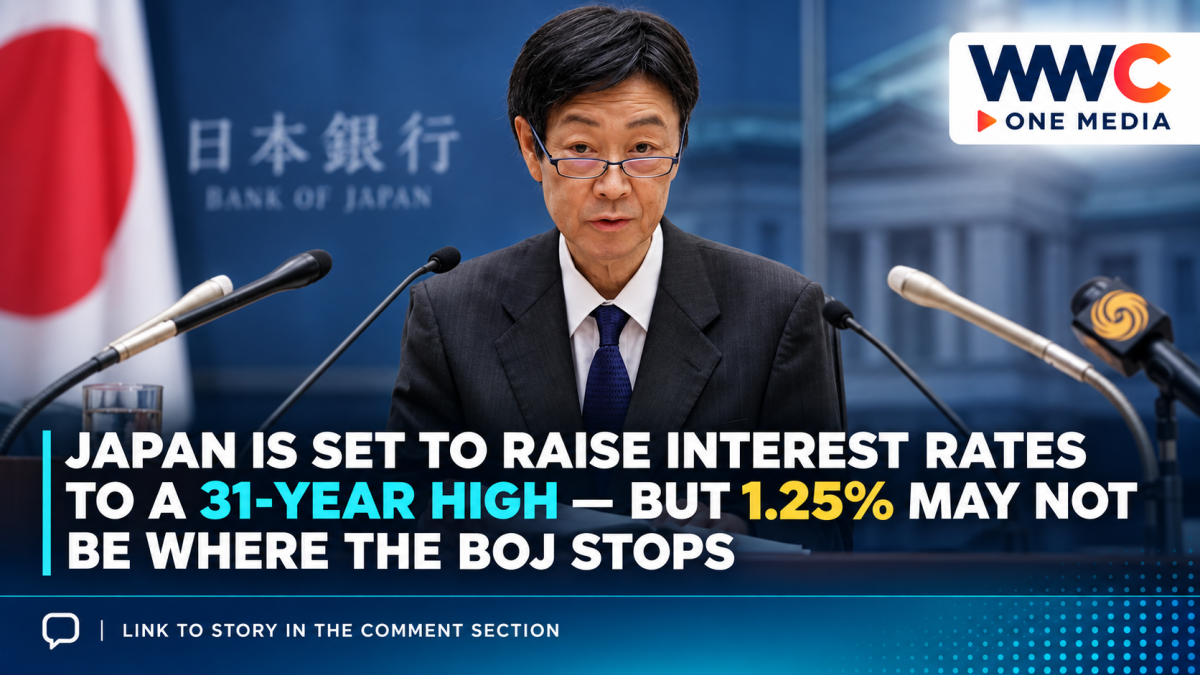
TOKYO — Japan is preparing to take another major step away from the ultra-cheap money that defined its economy for decades.
The Bank of Japan is widely expected to raise its short-term policy rate by 25 basis points to 1.25% on Friday, September 18, taking borrowing costs to their highest level in roughly 31 years as policymakers grow increasingly concerned that oil, imports, wages and a historically weak yen could keep inflation elevated.
On paper, 1.25% still looks tiny compared with interest rates in the United States and many other major economies.
For Japan, however, it represents something much bigger.
The country spent years with rates near or below zero, making the yen one of the cheapest currencies in the world to borrow. Now the BOJ is moving steadily in the opposite direction — and investors are increasingly asking not whether Japan will raise rates again, but how far and how fast it will go.
That question could affect the yen, Japanese mortgages, government bonds, bank profits and even global markets built around borrowing cheap Japanese money.
The BOJ is expected to raise rates only three months after its last hike
The central bank lifted its policy rate from 0.75% to 1.0% in June, voting 7-1 for the increase.
At the time, the BOJ said it expected financial conditions to remain accommodative and explicitly stated that it would continue raising interest rates if economic activity, prices and financial conditions developed as expected.
It left rates unchanged at its July meeting.
But that decision was not unanimous.
Board member Hajime Takata wanted an immediate increase to 1.25%, arguing that policymakers needed to respond more quickly to growing upside inflation risks. The proposal was rejected, and the board voted 8-1 to keep the rate at 1%.
Now, less than two months later, the argument for another hike appears to have gained substantially more support.
Reuters reported that officials increasingly see the conditions for higher rates falling into place as Japan’s economy continues to recover and price pressures broaden.
Why 1.25% matters so much
A quarter-percentage-point move would hardly look dramatic in most countries.
Japan is different.
The BOJ spent decades combating weak demand, falling prices and persistent deflation.
Its policy rate was effectively around zero as far back as the late 1990s. Later, it introduced massive quantitative easing, yield-curve control and eventually negative interest rates.
The BOJ finally ended negative rates in March 2024, beginning a historic normalization of monetary policy.
A move to 1.25% would put the policy rate at a level unseen for approximately 31 years, according to Reuters.
It would also bring rates into the bottom of the range the BOJ estimates could be roughly neutral for the Japanese economy.
Reuters reported that the central bank estimates Japan’s nominal neutral interest rate at roughly 1.1% to 2.5%.
A neutral rate is essentially the level economists believe neither stimulates nor meaningfully restrains economic activity.
And that raises a much bigger question.
If 1.25% is merely entering neutral territory, the BOJ may not be finished.
Economists now see 1.75% coming sooner
A Reuters poll released ahead of the meeting found economists overwhelmingly expect a September increase to 1.25%.
Their median forecast then sees the policy rate reaching:
1.50% by the end of March 2027, followed by 1.75% during the second quarter of 2027.
Most respondents placed the eventual terminal rate — the peak of the current tightening cycle — at at least 1.75%.
Some BOJ officials may be willing to go further.
Board member Naoki Tamura has indicated that he sees the neutral rate at around 2%, while Governor Kazuo Ueda has repeatedly avoided specifying exactly where the tightening cycle will end.
That ambiguity is intentional.
The BOJ does not want financial markets to interpret Friday’s expected hike as a promise that another increase will occur on a predetermined date.
But it also does not want investors to assume 1.25% is the finish line.
Oil has changed the inflation equation
One of the biggest reasons for the shift is energy.
Japan imports most of the fossil fuels it consumes, leaving its economy unusually sensitive to global oil and gas prices.
The renewed Middle East conflict has pushed crude prices sharply higher and increased the cost of shipping and securing energy supplies.
That pressure is now clearly appearing in Japan’s trade numbers.
Japanese imports surged 28% year on year in August, their largest increase in nearly four years, according to government data reported by Reuters.
The value of crude-oil imports jumped 58.7%, even though import volumes increased just 3.6%.
Japan consequently recorded a ¥1.106 trillion trade deficit, equivalent to roughly $7.1 billion.
That matters to the BOJ because expensive imported energy does not stop at the refinery.
It can eventually feed into electricity bills, transportation costs, manufacturing expenses, food production and the prices consumers pay throughout the economy.
Inflation looks moderate now — but the BOJ is worried about what comes next
Japan’s latest officially released national consumer-price data do not, by themselves, suggest an economy experiencing runaway inflation.
The Statistics Bureau reported that July headline inflation was 1.9% year on year, while the closely watched index excluding fresh food increased 1.8%.
Inflation excluding both fresh food and energy was also 1.9%.
A Reuters poll expects August core inflation to remain around 1.8% when the official figures are released.
So why raise rates?
Because central banks set policy based partly on what they expect inflation to do next, not simply where it was last month.
The BOJ is increasingly concerned that a combination of expensive energy, previous yen weakness, rising wages and firms’ greater willingness to pass higher costs to customers could cause inflation to become more persistent.
Governor Ueda recently said underlying inflation was “quite close” to the BOJ’s 2% target, increasing the need to monitor upside risks.
Japan finally has something it lacked for years: rising real wages
Wages are another reason the BOJ has more room to tighten than it once did.
Japan spent decades struggling to generate meaningful wage growth.
That picture has changed.
Real wages rose 2.4% year on year in July, their biggest increase since May 2021 and their seventh consecutive monthly gain, according to Japanese government data reported by Reuters.
That is important because the BOJ has long argued that sustainable inflation should be supported by a cycle in which wages rise, consumers maintain spending power and businesses can increase prices without destroying demand.
Higher pay also gives households more ability to absorb moderate inflation.
But it creates another risk.
If labor shortages keep pushing wages higher while companies continue raising prices, the BOJ could find itself dealing with an economy where inflation has become more durable than it expected.
Japan’s economy is holding up better than feared
Higher interest rates are easier to justify when the economy is still expanding.
Japan’s economy grew at an annualized 1.4% in the April-June quarter, according to revised government data, stronger than the initially reported 1.1% pace.
Quarter-on-quarter GDP expanded 0.4%.
Private consumption was flat, but external demand contributed to growth and business investment was somewhat stronger than first estimated.
The figures matter because one of the BOJ’s biggest historical fears has been tightening too early and pushing the economy back toward stagnation or deflation.
Japan has experienced exactly that problem before.
Today, policymakers increasingly appear to believe the larger danger may be waiting too long.
The yen may be the most important market reaction
The currency market will be watching Friday’s decision almost as closely as Japan’s bond market.
The yen has already staged a powerful recovery.
Reuters reported that it recently strengthened to around ¥152.89 per dollar, its strongest level in roughly seven months, after investors increased bets on additional BOJ tightening.
That followed extraordinary weakness earlier in the year, when the yen fell to levels not seen in roughly four decades and Tokyo intervened in currency markets.
Higher Japanese interest rates can make the yen more attractive because they narrow the enormous yield gap between Japan and countries such as the United States.
But simply delivering the expected 1.25% hike may not be enough to strengthen the currency further.
Much depends on what Ueda says next.
Ueda has a difficult communication problem
Markets have already largely priced in the rate increase.
That means the bigger market event could be Ueda’s press conference after the decision rather than the decision itself.
If he sounds too cautious, traders could conclude that another hike is months away.
That could weaken the yen again.
A weaker yen would raise the local-currency price of imported oil, food and other commodities — precisely the inflation pressure the BOJ is trying to contain.
But if Ueda sounds too aggressive, markets could rapidly increase estimates for Japan’s eventual interest-rate peak.
That could push government bond yields even higher.
Japan’s bond market is already under considerable pressure.
The benchmark 10-year Japanese government bond yield recently reached about 3%, around its highest level since the mid-1990s.
The BOJ therefore has to communicate something unusually delicate:
Rates probably need to rise further — but not necessarily quickly.
Japan’s enormous debt makes rising yields especially sensitive
There is another reason bond yields matter so much in Japan.
The Japanese government carries one of the largest public-debt burdens among developed economies.
For years, near-zero interest rates allowed Tokyo to finance that debt relatively cheaply.
As rates rise and older government bonds mature, new bonds may eventually have to be issued at higher yields.
That can gradually increase the government’s debt-servicing costs.
The issue has become especially sensitive because investors are simultaneously watching Prime Minister Sanae Takaichi’s expansionary fiscal policies.
Japan’s benchmark 10-year yield recently reached a 30-year high of around 3.025%, with concern over future borrowing contributing to the selloff.
The central bank’s challenge is therefore not limited to inflation.
It has to normalize monetary policy without destabilizing one of the world’s largest government bond markets.
The world’s famous yen carry trade is also being squeezed
For decades, investors around the world used Japan’s exceptionally low interest rates for something known as the yen carry trade.
The basic strategy is simple:
Borrow yen cheaply.
Convert the money into another currency.
Then invest it in bonds, stocks or other assets offering a higher return.
As long as the yen remains weak and Japanese borrowing costs remain tiny, the trade can be attractive.
But rising BOJ rates and a strengthening yen make that strategy more dangerous.
Reuters reported that the yen’s recent rally has already prompted investors to unwind some carry trades, with the currency gaining nearly 5% against several popular carry-trade currencies in early September.
The scale matters globally.
Reuters cited roughly ¥360 trillion in cross-border yen borrowing, illustrating how extensively cheap Japanese funding has been used internationally.
That is why a quarter-point BOJ move can matter far beyond Tokyo.
If investors suddenly rush to repay yen loans, they may have to sell assets elsewhere to raise the cash.
That mechanism contributed to global market volatility during previous sharp yen rallies.
Japan is no longer the only major central bank worried about inflation
The BOJ is also tightening into a very unusual global backdrop.
The European Central Bank has already raised rates amid renewed inflation concerns, while markets are pricing a strong chance of another U.S. Federal Reserve increase as energy costs push global inflation risks higher.
For years, the BOJ was an outlier.
The Federal Reserve, ECB and Bank of England raised rates aggressively while Japan maintained extremely loose policy.
Now those policy cycles are beginning to converge.
Japan is tightening.
The ECB is again concerned about inflation.
And U.S. markets are once more debating higher rates.
The common culprit increasingly is an external shock familiar to central bankers:
energy.
But 1.25% would still be extraordinarily low by global standards
The historical significance of Friday’s expected decision can obscure another fact.
Japanese monetary policy would still be relatively loose.
Reuters reported that BOJ officials believe financial conditions would remain accommodative even with the policy rate at 1.25%.
That is partly because the rate remains low relative to nominal economic growth and inflation.
And it is tiny compared with the levels historically required to fight serious inflation in other developed economies.
So the BOJ is not suddenly slamming on the monetary brakes.
It is slowly taking its foot off the accelerator.
The difference matters.
The central bank is trying to normalize an economy that spent decades conditioned to virtually free money without shocking borrowers, bond markets or consumers.
The biggest question isn’t Friday’s hike
At this point, a quarter-point increase is heavily anticipated by markets.
That means a move to 1.25% may generate less surprise than the headline suggests.
The real uncertainty starts afterward.
Does oil remain above $100?
Does wage growth continue?
Does the yen strengthen enough to reduce imported inflation?
Do businesses keep passing costs to consumers?
Can Japan’s economy absorb higher borrowing costs?
And does the BOJ eventually take its policy rate closer to 2%?
Those answers will determine whether Friday’s move is merely another small adjustment — or the beginning of a faster transformation of Japanese monetary policy.
For decades, Japan was the country where investors assumed interest rates would remain close to zero indefinitely.
That assumption is disappearing.
The BOJ may take rates to a 31-year high this week. The bigger story is that 1.25% increasingly looks less like the destination — and more like another stop on the way there.




Leave a Reply