
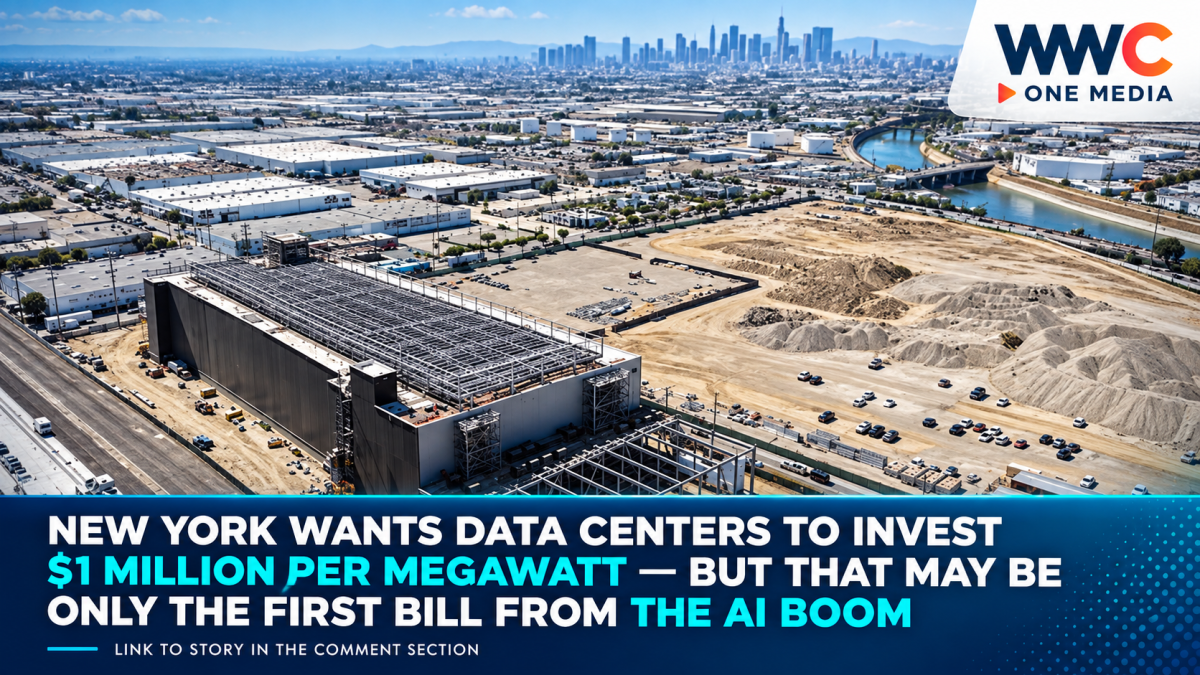
NEW YORK — The enormous data centers powering America’s artificial-intelligence boom could soon face a very different question when they come to New York:
Not simply how much electricity will you use?
But what will the community get in return?
New York Governor Kathy Hochul’s administration has released a statewide framework recommending that local governments seek at least $1 million in community investment for every megawatt of utility demand associated with a new data-center project.
The proposal is designed to give towns and cities a starting point when negotiating with some of the world’s largest technology companies over projects that can consume extraordinary amounts of electricity, water and land while supporting fewer permanent local jobs than many traditional factories.
But the $1 million figure is only one part of a much bigger policy shift.
New York has already temporarily paused state environmental permitting for new hyperscale data centers while regulators examine their effects on electricity demand, water, air quality and infrastructure.
And state officials are separately considering rules that could make data centers pay more of the cost of the grid expansion needed to serve them.
In other words, New York is no longer asking only whether it wants more AI infrastructure.
It is increasingly asking:
Who should pay for what that infrastructure requires?
The $1 million figure is a benchmark — not a mandatory tax
That distinction is crucial.
The newly released Host Community Investment Framework does not automatically charge every data center $1 million per megawatt.
Instead, it is voluntary guidance for local governments negotiating with developers. The state recommends community investment beginning at $1 million for each megawatt of utility demand associated with a project.
The idea is to give municipalities greater leverage when negotiating with companies proposing extremely large facilities.
New York says those investments could help pay for things such as:
- local infrastructure improvements
- child care
- workforce training and apprenticeships
- direct community support
- local hiring initiatives
- other benefits negotiated between developers and host communities.
The framework also encourages prevailing-wage standards and project labor agreements during construction, along with greater transparency and annual reporting once a facility begins operating.
Empire State Development President Hope Knight said New York wants the expanding innovation economy to operate under standards that allow host communities to share in the economic value created by the projects.
She also highlighted one of the fundamental differences between data centers and conventional industrial development: data centers typically do not create large numbers of permanent jobs relative to the enormous infrastructure and electricity capacity they can require.
Why one megawatt suddenly matters so much
For most consumers, a megawatt is an abstract measurement.
For data centers, it is becoming one of the most important numbers in economic development.
Modern AI facilities can require hundreds of megawatts of electricity, with the largest campuses potentially demanding amounts of power comparable to what is consumed by sizeable communities or industrial complexes.
That electricity has to come from somewhere.
Utilities may need new transmission lines.
Power plants may need to generate more electricity.
Substations may need upgrading.
And the grid may need billions of dollars in additional investment as more large-load customers connect.
New York’s concern is that those costs should not simply migrate onto the monthly bills of households and existing businesses.
Earlier this year, Hochul directed the state Department of Public Service to develop the Energize NY framework, under which major data-center loads could be required to pay more for electricity infrastructure or provide their own energy resources.
The New York Public Service Commission has likewise been examining tariff structures and cost-allocation rules for extremely large electricity users, including data centers. Commission discussions have focused on the principle that customers requiring major grid upgrades should bear the costs directly attributable to serving them rather than shifting those expenses to existing customers.
That may ultimately matter more financially than the community-benefit benchmark itself.
New York has already hit pause on hyperscale projects
The state’s tougher approach began before this week’s $1 million recommendation.
On July 14, 2026, Hochul signed an executive order establishing a temporary moratorium on new hyperscale data-center projects while New York develops a broader regulatory framework.
The state said the Department of Environmental Conservation would temporarily stop issuing discretionary permits that had not already been deemed complete while regulators prepare a Generic Environmental Impact Statement, or GEIS.
That study is expected to examine data centers’ effects on:
electricity demand, water consumption and water quality, air quality and other environmental resources.
The process may take up to a year.
Once the new standards are finalized, the state says the moratorium can be lifted and projects may proceed if they meet state requirements and obtain the necessary local zoning and other approvals.
That means the policy is a temporary planning and permitting pause rather than a permanent ban on data centers.
The AI boom is transforming America’s electricity system
New York is reacting to a trend extending far beyond its borders.
After roughly a decade and a half of relatively stagnant U.S. electricity consumption, power demand is growing again — and data centers are one of the main reasons.
The U.S. Energy Information Administration said electricity demand grew by about 1.7% annually between 2020 and 2025, compared with just 0.1% a year from 2005 through 2019.
The EIA specifically identified data centers as a major driver of the increase.
And the trend is expected to continue.
The agency projects that electricity consumed by servers will rise substantially over coming decades, with standalone data centers responsible for much of that growth. Depending on the scenario, U.S. server electricity consumption could reach between 446 billion and 818 billion kilowatt-hours in 2050.
Artificial intelligence makes the equation more demanding.
AI systems require enormous computing clusters filled with specialized processors, and those chips consume electricity not only while training models but also while responding to millions of users.
More computing also produces more heat.
That requires cooling.
Cooling can require significant electricity and, depending on the technology used, substantial quantities of water.
So the infrastructure behind a seemingly simple AI prompt can eventually reach far beyond a server rack.
It reaches into power plants, electrical grids, cooling systems, construction projects and local water supplies.
The problem is jobs don’t necessarily scale with electricity use
This creates an unusual political and economic challenge.
Traditional manufacturing projects may consume large amounts of energy, but they can also employ hundreds or thousands of people once the factories are operating.
A giant data center can employ large construction crews while it is being built.
Once operating, however, highly automated facilities often need relatively modest permanent workforces compared with their physical size and electricity consumption.
That is why New York says data centers have a different economic-development profile from traditional manufacturing.
It also helps explain the $1 million-per-megawatt proposal.
If local communities are being asked to host projects that consume scarce grid capacity but do not necessarily deliver factory-scale permanent employment, state officials want municipalities to negotiate other forms of long-term benefit.
Supporters of data-center development also point to broader economic effects, including construction work, tax revenue, technology investment and demand for suppliers.
Reuters reported this week that the AI infrastructure boom is already having ripple effects across the U.S. construction industry, including increased demand for workers and even equipment such as industrial workwear.
The argument is therefore not that data centers create no economic benefits.
The dispute is over whether those benefits justify their infrastructure demands — and how those benefits and costs should be divided.
New York is considering an even bigger grid fund
The host-community framework may not be the final bill for developers.
Hochul has also directed the Department of Public Service to consider creating a New York Grid Acceleration Fund.
Under the concept, data centers could be required to contribute toward upgrades to the state’s electricity system. Money could potentially support new clean-energy generation and mechanisms designed to protect utilities and customers from speculative projects that reserve large amounts of grid capacity but never actually get built.
Regulators are additionally considering whether large data centers should fund dedicated clean-electricity resources, potentially including on-site or distributed generation and battery storage.
The administration is also pursuing legislation to eliminate certain sales-tax exemptions for massive data-center projects.
Taken together, the measures suggest New York is trying to construct a system in which developers shoulder more of three separate categories of cost:
the host community, the electricity grid and the energy needed to operate the facility.
Public resistance is becoming a serious obstacle
The political pressure is not unique to New York.
A Reuters/Ipsos survey conducted earlier in 2026 found only 33% of Americans supported the rapid pace of AI-related data-center construction, while 64% opposed it.
About 57% said they would oppose a data center being built in their own community.
The survey included 4,531 U.S. adults.
Separate Ipsos polling released this week found 69% of Americans expressed concern about the growth of AI data-center construction.
Among those concerned, the most commonly cited issues were pressure on local water supplies, strain on the electrical grid and the possibility of higher household utility bills.
That opposition is increasingly shaping government policy.
Pennsylvania Governor Josh Shapiro issued an executive order in August establishing additional environmental, transparency and community requirements for AI data-center developers.
Texas Governor Greg Abbott has also directed regulators to address data-center water-use disclosure, according to Reuters.
Meanwhile, state legislatures around the country have introduced proposals dealing with utility costs, water use, environmental impacts and incentives tied to data-center development.
The debate is increasingly bipartisan because electricity bills and water supplies affect communities regardless of political affiliation.
Big Tech has enormous reasons to keep building
There is another side to the equation.
Technology companies need vastly more computing infrastructure if they are going to continue scaling artificial intelligence.
Microsoft, Amazon, Alphabet and Meta are among the companies spending heavily on servers, networking equipment, chips and data centers.
Reuters reported this week that overall AI-related capital spending could exceed $795 billion in 2026 and surpass $1 trillion in 2027, according to industry estimates cited in its market coverage.
That spending is supporting demand across an enormous ecosystem:
Nvidia and other chipmakers.
Electric utilities.
Construction companies.
Cooling-equipment manufacturers.
Power-generation developers.
Fiber networks.
Industrial real estate.
And increasingly nuclear and other energy projects.
The demand is so large that U.S. policymakers are simultaneously trying to accelerate new electricity generation while debating how much data centers should pay toward the infrastructure they require.
The challenge for states such as New York is attracting investment without allowing a handful of extremely large customers to dominate future grid planning.
What the tech giants are saying
As of Reuters’ September 15 report, spokespeople for Amazon, Meta and Google had not responded to requests for comment on New York’s new community-investment recommendation.
Microsoft declined to comment.
That leaves an important unanswered question:
How willing will hyperscale developers be to accept a system that could require significant community payments on top of construction expenses, energy costs and potentially new grid charges?
New York is a major market.
But data centers are unusually mobile compared with many other forms of infrastructure.
Companies can evaluate competing sites across multiple states based on electricity prices, tax treatment, permitting timelines, fiber connectivity and land availability.
If New York’s requirements become significantly more expensive than those elsewhere, developers could potentially choose another state.
Conversely, if public resistance spreads across the country, New York’s approach could become less exceptional over time.
This isn’t really about a $1 million payment
That may ultimately be the most important part of the story.
The headline number is memorable:
$1 million per megawatt.
But New York’s policy experiment goes much further.
It asks whether an AI data center should be treated like a conventional commercial building — or more like a major industrial facility whose effects on electricity, infrastructure, water and surrounding communities justify a different economic arrangement.
The answer could affect far more than New York.
America is building the physical infrastructure required for an AI economy at extraordinary speed.
Tech companies want computing power.
Utilities need more electricity.
Investors want growth.
Governments want tax revenue and economic development.
Communities want jobs — but they also want affordable power, reliable water and control over what gets built nearby.
New York’s new framework tries to put a dollar figure on part of that bargain.
But the $1 million-per-megawatt recommendation may only be the beginning.
The much bigger question is who ultimately pays the enormous infrastructure bill behind artificial intelligence.



Leave a Reply