
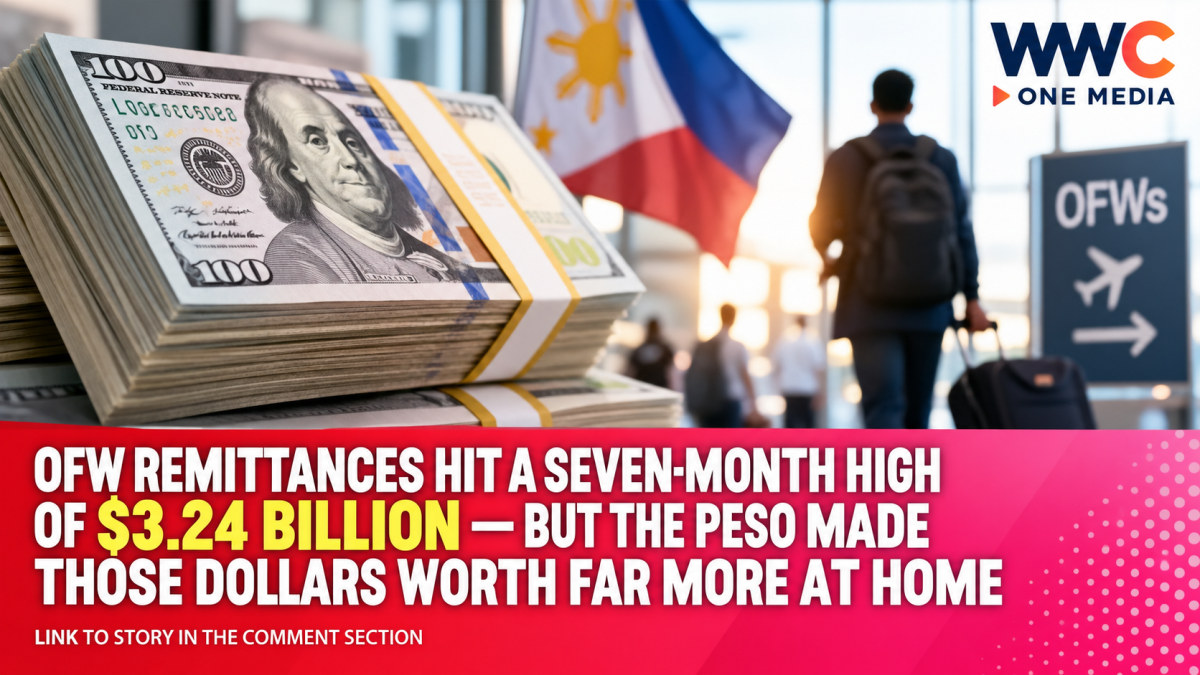
MANILA, Philippines — Overseas Filipinos sent $3.24 billion through Philippine banks in July, the highest monthly remittance total in seven months, providing another crucial cushion for households confronting high food, transport and energy costs.
Cash remittances reached $3.240 billion in July 2026, up 1.9% from $3.179 billion a year earlier and about 6.6% from $3.039 billion in June, according to data released by the Bangko Sentral ng Pilipinas.
It was the strongest monthly cash-remittance figure since December 2025, when Filipinos abroad sent a record $3.522 billion through the banking system.
The BSP’s broader measure of personal remittances—which includes cash sent through banks and informal channels as well as certain remittances in kind—also climbed to $3.603 billion, up 2% from $3.533 billion in July last year and from $3.388 billion in June.
Those numbers underscore something that has repeatedly distinguished Philippine remittances during global crises.
They may slow.
But they rarely collapse.
And in 2026, with the Philippine economy confronting weak growth, expensive energy and elevated inflation, that steady flow of dollars has become even more important.
July was strong — but this is not a remittance boom
The seven-month high sounds dramatic.
The underlying growth rate is less so.
Cash remittances increased only 1.9% year on year in July, while personal remittances rose 2%.
That means the record is being driven partly by the already enormous base of money Filipinos abroad send home.
Through the first seven months of 2026, cash remittances totaled $20.389 billion, up 2.3% from $19.932 billion during the same period in 2025.
Personal remittances reached about $22.73 billion, also up 2.3% from $22.21 billion.
So the pattern is best described as steady expansion rather than acceleration.
That distinction matters because the BSP is targeting full-year cash remittances of roughly $36.6 billion, about 2.7% to 3% above the record $35.6 billion received in 2025.
Seven-month growth of 2.3% leaves the Philippines within striking distance of that target, but the final months of the year will matter.
Historically, remittance inflows tend to strengthen during the “ber” months and peak around Christmas.
The peso makes those dollars feel much bigger
There is another reason July’s remittances matter more to Filipino families than the 1.9% dollar growth alone suggests.
The peso was much weaker.
BSP data show the Philippine currency averaged about ₱61.60 to the US dollar in July 2026.
A year earlier, July’s average was around ₱56.75 per dollar, according to BSP data cited by BusinessWorld.
Using those monthly averages purely as an illustration, July 2026’s $3.24 billion in cash remittances would be equivalent to roughly ₱199.6 billion.
The $3.179 billion sent in July 2025 would have been equivalent to around ₱180.4 billion at the average exchange rate then.
That is an illustrative increase of roughly 10.6% in peso terms, far larger than the 1.9% increase measured in dollars.
Actual households receive different exchange rates and do not necessarily convert every dollar immediately, so this should not be treated as an exact measure of money spent.
But it shows why a weak peso can partially magnify the local purchasing power of foreign-currency remittances.
There is a catch.
A weaker peso also makes imported fuel, food, machinery and other foreign goods more expensive.
So overseas families may receive more pesos per dollar just as those pesos are being asked to cover higher prices.
Remittances remain one of the Philippines’ biggest economic shock absorbers
The importance of remittances becomes clearer when compared with the size of the economy.
Cash remittances reached an all-time high of $35.63 billion in 2025, equivalent to about 7.3% of Philippine gross domestic product, according to the BSP.
The World Bank’s broader personal-remittance measure placed Philippine remittances at about 8.5% of GDP in 2025.
Few components of household income operate on that scale.
Remittance money pays for:
food,
tuition,
rent and mortgages,
medical expenses,
electricity,
small businesses,
construction,
consumer goods,
and debt payments.
This means money earned in hospitals, hotels, construction sites, ships, households and offices overseas is eventually spent across Philippine supermarkets, schools, banks, pharmacies and shopping centers.
The BSP said the July inflows continued to support household consumption and domestic economic activity, describing remittances as a resilient source of both household income and foreign financing.
That support matters more because the economy has weakened
The timing is particularly important in 2026.
The Philippine economy expanded by only 2.6% in the first half, and economists have repeatedly warned that high energy prices and inflation are hurting household spending.
The Asian Development Bank cut its 2026 Philippine growth forecast to 3.8%, citing delayed investment, weaker private consumption, high commodity prices and climate-related risks.
ADB has specifically identified remittances as one of the supports helping Filipino households withstand the slowdown, although it has also warned that overseas income itself could face pressure if geopolitical disruptions worsen.
That makes remittances a kind of automatic stabilizer.
When domestic economic conditions weaken, money sent by Filipinos earning abroad continues arriving independently of Philippine employers.
It does not solve every economic problem.
But it helps prevent weaker domestic income growth from translating immediately into equally large drops in household consumption.
The United States remains No. 1 — with an important warning
The United States accounted for 39.7% of recorded cash remittances during the first seven months of 2026, according to BSP data.
The next largest reported sources were:
Singapore — 7.1%
Saudi Arabia — 6.3%
Japan — 5.0%
United Kingdom — 4.7%.
But the nearly 40% US share does not mean four out of every ten remittance dollars were necessarily earned by Filipinos working physically in the United States.
The BSP repeatedly warns that country-of-origin figures are distorted by the international financial system.
Many global remittance companies and correspondent banks process payments through headquarters or banking partners located in the United States.
When the ultimate source country cannot be separately identified, the transaction can be recorded as originating in the US.
That means the ranking is useful—but not a perfect map of where overseas Filipinos actually work.
Singapore remains unusually important
Singapore’s position as the second-largest recorded source is also notable.
At 7.1% of total cash remittances, it remains ahead of major traditional destinations such as Saudi Arabia and Japan.
Part of that may similarly reflect remittance-processing structures.
But Singapore also hosts a significant Filipino workforce across professional services, health care, domestic work, finance, information technology, hospitality and other sectors.
Its role illustrates how the geography of overseas Filipino employment has diversified.
The Philippine remittance story is no longer only about workers in the Gulf states and North America.
Asia has become increasingly important.
Land-based workers still send most of the money
During the January-to-July period, land-based workers accounted for about 80.2% of cash remittances, while sea-based Filipinos contributed the remaining 19.8%.
That roughly four-to-one split highlights the enormous range of jobs behind remittance flows.
Land-based overseas Filipinos include nurses, caregivers, engineers, construction workers, hotel employees, domestic workers, teachers, technicians and professionals.
Sea-based remittances largely come from Filipino seafarers, who remain a major source of foreign income for the country.
In July alone, reporting based on BSP data placed land-based workers’ remittances at around $2.65 billion, with sea-based workers contributing roughly $590 million.
The seafarer share is especially significant because a comparatively small occupational group generates almost one-fifth of formal remittances.
Seafarers also expose remittances to geopolitical risk
That dependence carries risk.
Shipping routes have been heavily affected by Middle East tensions in 2026.
Filipino seafarers working aboard commercial vessels can be exposed not only to weaker global trade but to security risks, rerouting and disruptions around major maritime chokepoints.
Land-based workers face their own vulnerabilities.
Around 16% to 17% of Philippine remittance inflows have historically been associated with the Middle East, where millions of Filipinos live and work.
ADB warned earlier this year that a prolonged Middle East conflict could affect Filipino workers and remittance inflows, particularly from Gulf economies.
So far, however, the July data suggest the overall remittance system has remained resilient.
June had raised concerns
July’s rebound is more meaningful because it followed a softer June.
Cash remittances grew only modestly in the first half of the year, reaching around $17.15 billion, up approximately 2.4% from the comparable 2025 period.
Analysts cited several possible headwinds:
high living costs in countries where Filipinos work,
slower economic activity in some host economies,
geopolitical uncertainty,
Middle East deployment disruptions,
and base effects from previous strong remittance periods.
July therefore provides evidence that those pressures have not broken the underlying trend.
But it does not prove they have disappeared.
The Christmas season is the next major test
Remittances almost always become more closely watched during the final months of the year.
December 2025 produced a record $3.522 billion in cash remittances, helping push the annual total to $35.634 billion.
The pattern is easy to understand.
Overseas Filipinos often send additional money for:
Christmas celebrations,
gifts,
school expenses,
home repairs,
family travel,
and year-end obligations.
Bonuses and additional work hours in host countries can also increase the amount available to remit.
If 2026 follows the usual seasonal pattern, July’s $3.24 billion could still be surpassed during the final quarter.
But analysts are cautious.
UA&P recently said it expects only low single-digit remittance growth through the remainder of 2026, warning that high inflation in host countries and continuing Middle East disruptions could put the BSP’s full-year forecast at risk.
Digital remittances are changing how the money arrives
Another structural reason remittances remain resilient is the continuing shift toward digital channels.
Money that once required visits to remittance centers can increasingly be transferred through online banks, e-wallets and mobile platforms.
That can reduce processing time and make smaller, more frequent transfers practical.
It also means the boundary between traditional remittance companies, banks and fintech platforms is becoming less clear.
The dollar amount in BSP’s cash-remittance statistics still represents funds coursed through formal banking channels, but the consumer experience behind those transfers is changing rapidly.
For households, speed can matter almost as much as cost.
A Filipino abroad can now send money for an emergency medical expense or overdue bill within minutes rather than waiting several days.
Why economists watch remittances alongside exports and BPO revenue
Remittances perform another important function for the economy: they bring in foreign currency.
The Philippines imports large quantities of fuel, machinery, electronics, food and industrial inputs.
Those imports require dollars.
Remittances provide a consistent source of foreign exchange that helps offset money flowing out to pay for imports.
S&P Global Ratings has cited the country’s large and resilient remittance base as one of the factors supporting the Philippines’ external financial position even during periods of global stress.
That places remittances alongside exports and business-process outsourcing as major sources of foreign currency.
Finance Secretary Frederick Go recently highlighted the same combination, noting that 2025 remittances reached $35.6 billion while BPO revenues approached $40 billion.
But remittance dependence has another side
The durability of overseas income is economically valuable.
It also reflects a long-standing structural reality: millions of Filipinos continue to seek better-paying work abroad.
A country can celebrate record remittances while still asking why so many workers must leave their families to generate them.
Remittances can raise household living standards, fund education and provide capital for small businesses.
But they also come with social costs, including long family separations and exposure of workers to foreign labor laws and economic conditions Manila cannot fully control.
That is why higher remittance figures should not automatically be interpreted as an unqualified measure of domestic economic success.
The money is valuable.
The circumstances that produce it are more complicated.
July delivered exactly what the economy needed: stability
The latest numbers do not show an explosion in overseas income.
They show something arguably more valuable during an uncertain year:
consistency.
Cash remittances rose to $3.24 billion.
Personal remittances reached $3.60 billion.
Year-to-date inflows remain at record levels.
A weak peso increased the approximate local-currency value of those dollars.
And overseas Filipinos continued sending money home despite geopolitical tension, inflation and uneven economic conditions abroad.
That is why July’s seven-month high matters.
Not because remittances suddenly began growing at extraordinary rates.
But because while several parts of the Philippine economy are struggling, one of its most dependable sources of household income is still holding up.
The bigger question comes next.
Can overseas Filipinos sustain that pace through the year-end holidays and deliver the roughly $36.6 billion the BSP expects for 2026?
If they do, another annual record is within reach.
But after July’s numbers, the story is already clear:
the Philippines is still leaning heavily on money earned far beyond its shores to keep spending strong at home.


Leave a Reply