
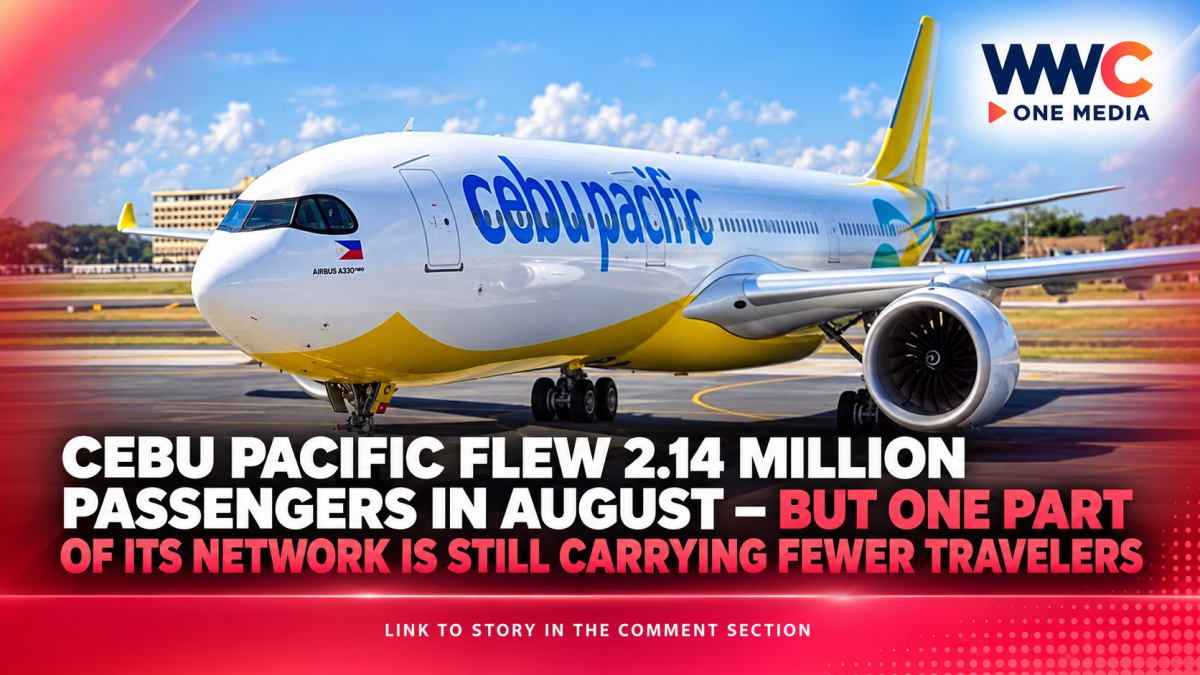
MANILA, Philippines — Cebu Pacific carried more passengers in August than it did a year ago, but the modest 1.9% increase tells only half the story.
The Philippines’ largest budget airline flew approximately 2.14 million passengers in August 2026, up from about 2.10 million in the same month last year, as resilient domestic travel offset another decline in international traffic.
More importantly for Cebu Pacific, its aircraft were fuller.
The carrier’s overall seat load factor climbed to 84.8% from 83.7%, even though available seat capacity increased only 0.7% year on year.
That suggests Cebu Pacific is entering the final months of 2026 with a more selective strategy: expand where demand remains strong, pull seats out of weaker international markets, and wait for the peak Christmas travel period before accelerating capacity again.
The strategy may be helping aircraft utilization.
But it also reveals how much the airline is still adjusting after a first half battered by soaring jet-fuel prices, foreign-exchange losses and a nearly ₱5.9-billion net loss.
Domestic flights are still doing most of the work
Domestic passenger traffic increased 3.8% year on year to roughly 1.62 million passengers in August.
Cebu Pacific increased domestic seat capacity by a slightly faster 4.7%, producing a domestic load factor of 86.9%.
The figure reinforces the strength of Cebu Pacific’s home market.
Domestic traffic represented roughly three-fourths of all passengers carried during the month, continuing the pattern seen in July, when local passenger volume jumped 9.1% to around 1.73 million.
The August domestic load factor, however, was slightly below the 87.6% recorded a year earlier, when the carrier had approximately 1.56 million domestic passengers.
So the domestic picture is positive, but not entirely straightforward.
Cebu Pacific is putting more seats into the local market and carrying more passengers, although capacity grew slightly faster than passenger demand during August.
International passengers fell 3.3% — yet that may be partly intentional
International traffic moved in the opposite direction.
Cebu Pacific carried approximately 523,000 international passengers in August, down 3.3% from a year earlier.
But the airline reduced international seat capacity by an even larger 9.1%.
As a result, its international load factor jumped 4.8 percentage points to 79%.
That means Cebu Pacific carried fewer international passengers but filled a much greater proportion of the international seats it chose to operate.
CEO Mike Szucs said the airline continued to see improving demand in selected markets including Korea and Bali, although overall international traffic remained below previous levels because of the capacity reductions Cebu Pacific had implemented.
That distinction matters.
A drop in passenger volume can signal weakening demand.
But when an airline deliberately removes even more capacity, improving load factors can also signal tighter network management.
July showed the same strategy even more clearly
August was not an isolated case.
In July, Cebu Pacific carried 2.216 million passengers, up 4.7% year on year.
Domestic passengers jumped 9.1%, but international traffic fell 8.6%.
The airline cut international seat capacity by nearly 17% in July, which pushed its international load factor to 83.8%, up 7.6 percentage points from the previous year.
Together, July and August show an airline willing to shrink parts of its international schedule instead of flying aircraft with too many empty seats during the weaker travel season.
That is particularly important when fuel is expensive.
Every additional flight adds costs for fuel, crew, maintenance, airport services and aircraft utilization whether the plane is full or not.
Cebu Pacific has still carried nearly 18.9 million passengers this year
Despite the international slowdown, Cebu Pacific remains ahead of last year’s passenger count.
From January through August, the airline flew nearly 18.9 million passengers, up 4.1% from 18.1 million during the same eight months of 2025.
Domestic passengers increased 5.3% to 14.2 million.
International passenger volume was nearly flat, increasing only 0.5% to approximately 4.6 million.
That means almost all of Cebu Pacific’s meaningful passenger growth so far in 2026 has come from its Philippine network.
And there is another number investors may watch closely.
Capacity grew twice as fast as passengers
During the first eight months, Cebu Pacific expanded total seat capacity by 8.2% to about 23 million seats.
Passenger numbers, however, increased only 4.1%.
That pushed the airline’s year-to-date average load factor to 81.9%.
A year earlier, Cebu Pacific had carried 18.1 million passengers on about 21.3 million seats, producing an average load factor of roughly 85.2%.
So even though August itself showed better aircraft utilization, the full-year-to-date figures tell a more complicated story:
Cebu Pacific has added capacity faster than passenger traffic has grown.
That is one reason the carrier is now emphasizing “disciplined” capacity management.
Airlines typically want growth, but growth is far more valuable when seats are filled at economically sustainable fares.
Why Cebu Pacific pulled back internationally
The capacity cuts are closely connected to one of the airline industry’s biggest problems in 2026: fuel.
Cebu Pacific began making temporary international network adjustments earlier this year after the Middle East crisis sent jet-fuel prices sharply higher.
The airline said fuel prices had at one stage risen to more than twice their 2025 averages, forcing it to suspend several routes and reduce frequencies on others.
Among the services temporarily suspended were:
Davao-Bangkok,
Iloilo-Bangkok,
Iloilo-Singapore,
Clark-Hanoi,
and Davao-Hong Kong.
Cebu Pacific also reduced frequencies on routes including Cebu-Singapore, Manila-Jakarta and Manila-Kuala Lumpur.
Those decisions help explain why 2026 international passenger numbers have not grown at the same pace as the airline’s domestic business.
Fuel turned a growing airline into a loss-making one
The financial impact has been dramatic.
Cebu Air Inc., Cebu Pacific’s listed parent, reported ₱68.56 billion in revenue during the first half of 2026, up from ₱63.33 billion a year earlier.
Yet the company recorded a ₱5.87-billion consolidated net loss, compared with almost ₱8.97 billion in profit in the first half of 2025.
Total expenses climbed about 23%.
Flying-operation costs rose sharply to approximately ₱30.88 billion, with Cebu Pacific attributing much of the increase to elevated jet-fuel prices.
The airline also recorded about ₱2.46 billion in foreign-exchange losses and faced higher financing costs related to aircraft and engine investments.
That creates an unusual situation.
Passenger demand has remained relatively resilient.
Revenue is growing.
But the cost of flying those passengers has increased even faster.
Fuel can represent nearly 40% of a low-cost airline’s expenses
S&P Global Ratings estimated in August that fuel can account for almost 40% of operating costs at Asia-Pacific low-cost carriers, compared with roughly one-third for traditional full-service airlines.
Cebu Pacific is especially exposed because much of its revenue is earned in Philippine pesos while fuel, aircraft leases, maintenance and other major expenses can be linked to the U.S. dollar.
That means a weak peso and expensive oil can hit the airline at the same time.
S&P said Cebu Pacific had increased fuel hedging compared with many regional peers, providing some protection, but not enough to eliminate the impact of a prolonged energy shock.
Against that backdrop, cutting weak flights becomes much easier to understand.
An airline paying unusually high fuel prices has less room to tolerate lightly occupied aircraft.
The strategy changes again when Christmas approaches
Cebu Pacific does not intend to keep its international network suppressed indefinitely.
The airline is preparing to restore and launch multiple international routes beginning in the fourth quarter, traditionally one of the strongest periods for Philippine travel.
From October 26, Cebu Pacific will resume Cebu-Ho Chi Minh City flights three times weekly.
It will launch:
Cebu-Shanghai on November 17,
Cebu-Nagoya on November 19,
resume Clark-Hanoi on November 19,
and restart Manila-Xiamen on November 23.
Cebu Pacific is also restoring international flights from Davao.
Davao-Hong Kong returns October 25, followed by Davao-Bangkok on October 26.
That makes the August capacity reduction look less like a permanent retreat and more like a seasonal and cost-driven repositioning ahead of year-end demand.
Cebu is becoming a bigger international hub
Another noticeable part of the expansion is where the new routes are being placed.
Three of the major fourth-quarter additions involve Mactan-Cebu International Airport rather than Manila.
Cebu Pacific will connect Cebu directly with Ho Chi Minh City, Shanghai and Nagoya.
The airline says it will be the only carrier offering a direct Cebu-Nagoya service and is expanding Cebu’s role as an international gateway for travelers who would otherwise have to connect through Manila.
This fits a wider trend in Philippine aviation.
Airlines and airport operators are increasingly trying to develop Cebu, Clark, Davao and Iloilo as international gateways rather than channeling almost every overseas passenger through Metro Manila.
For Cebu Pacific, that also means better utilization of aircraft and passenger demand across multiple hubs.
Iloilo and Davao are also getting routes back
Cebu Pacific’s regional rebuild extends beyond Cebu.
The carrier plans to restore Iloilo-Singapore and Iloilo-Bangkok service during the Northern winter schedule, with current timetables showing international operations returning in November.
From Davao, Hong Kong service will restart four times weekly while Bangkok will operate three times a week.
That suggests the airline’s fourth-quarter strategy is not simply to put more seats back into Manila.
It is rebuilding international capacity from regional Philippine airports as fuel conditions and seasonal demand allow.
Cebu Pacific also has more aircraft to work with
The airline entered the second half with an industry-leading fleet of around 102 aircraft, according to August reporting, supporting the widest domestic network among Philippine carriers.
Cebu Pacific has also committed to one of the largest aircraft orders in Philippine aviation history.
Its Airbus agreement covers up to 152 A321neo aircraft, reflecting expectations that passenger demand will continue growing well beyond the short-term fuel disruption.
Those aircraft represent long-term growth capacity.
But they also create financing obligations and make network planning more important.
Aircraft earn money when deployed productively.
If capacity grows much faster than passengers, load factors and fares can come under pressure.
August’s 1.9% growth is therefore more important than it looks
At first glance, an increase from about 2.10 million to 2.14 million passengers appears uneventful.
But several important changes are hidden behind that modest headline number.
Domestic demand continues to grow.
International traffic remains weaker year on year.
Cebu Pacific is removing international seats faster than passengers are declining.
That is lifting international load factors.
Year-to-date capacity, however, has still grown faster than passenger traffic.
And the airline is preparing to reverse some of its temporary reductions when holiday travel begins.
This makes August less a story about spectacular passenger growth than about how an airline manages supply when demand, fuel prices and route economics are moving in different directions.
The real test comes in the fourth quarter
Cebu Pacific CEO Mike Szucs says the airline will continue balancing growth opportunities with the changing fuel-cost environment as the year-end travel period approaches.
That makes October through December especially important.
The airline will bring suspended international services back.
It will add new routes.
Christmas and holiday travel should increase demand.
And Cebu Pacific will have an opportunity to put more of its aircraft back into productive service.
But the airline still has to solve the same equation that shaped August:
How many seats can it add without allowing capacity to outrun passengers—and can it fill those aircraft at fares high enough to offset unusually expensive fuel?
August provided one encouraging sign.
Cebu Pacific filled 84.8% of its seats, its passenger count moved higher, and international utilization improved despite fewer overseas travelers.
The next question is whether that discipline can survive when the airline starts adding international capacity back.




Leave a Reply