
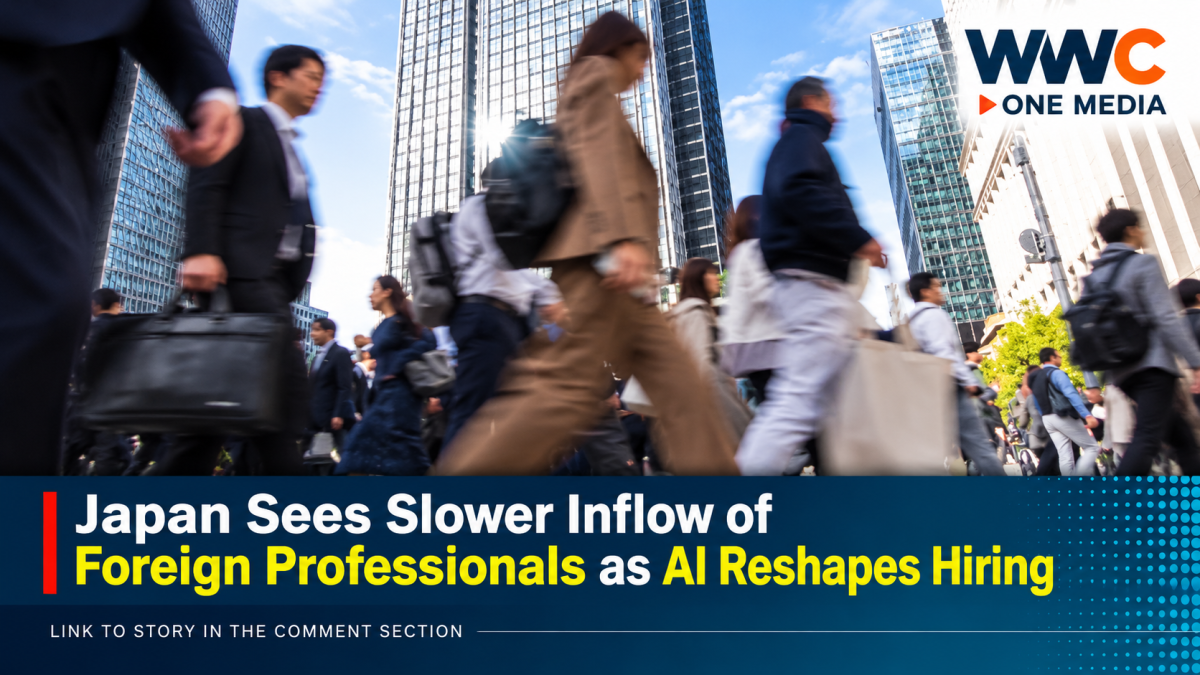
AI IS CHANGING JAPAN’S FOREIGN-TALENT BOOM
Japan’s effort to attract more foreign professionals is entering a new phase as artificial intelligence begins reshaping corporate hiring, according to a recent Nikkei Asia report.
The development comes as Japanese companies increasingly adopt AI and automation while the country continues to grapple with an aging population and persistent labor shortages.
Nikkei Asia reported on September 14 that the inflow of foreign professionals has slowed as AI affects hiring demand for some types of skilled work.
The shift does not mean Japan has stopped recruiting foreign talent. Instead, it points to a changing labor market in which companies are becoming more selective about which skills they need and where human workers provide the most value.
JAPAN STILL NEEDS WORKERS
Japan’s demographic situation remains a major reason the country has opened more pathways to foreign workers.
The country’s labor market continues to show more job openings than available workers. Recent labor-market data cited in employment reporting put Japan’s active job vacancies at roughly 800,000 in January 2026, with a jobs-to-applicants ratio of about 1.19.
That means the AI-driven change in professional hiring should not be interpreted as a broad collapse in demand for foreign workers.
Japan still needs people in sectors where shortages are difficult to solve through software alone, including healthcare, caregiving, manufacturing, construction, hospitality and other essential services.
FROM “MORE WORKERS” TO “THE RIGHT SKILLS”
The bigger change may be in what Japanese employers expect from foreign professionals.
AI can automate or accelerate certain tasks involving software, data processing, research, administration and other knowledge-intensive work.
That could reduce the need for some entry-level or routine professional positions while increasing demand for workers who can combine technical expertise with AI tools, industry knowledge and problem-solving skills.
Japan’s technology sector itself continues to seek specialists in areas such as AI, data science and software development, illustrating the contradictory effect of the technology boom: AI can eliminate some tasks while creating demand for new skills.
FOREIGN TALENT IS STILL PART OF JAPAN’S ECONOMIC STRATEGY
Japan has spent years trying to make itself more attractive to highly skilled international workers.
The country has expanded systems designed to attract professionals in fields such as technology, research, management and other specialized occupations.
That strategy is increasingly important as Japan’s working-age population shrinks.
But attracting foreign professionals is not simply a numbers game. Pay, career opportunities, workplace conditions, the yen’s value and immigration policies can all influence whether skilled workers choose Japan over competing destinations.
Recent reporting has highlighted concerns about Japan’s attractiveness to foreign workers, including relatively low wages and the impact of the weak yen.
AI COULD MAKE THE COMPETITION FOR TALENT EVEN TOUGHER
The rise of AI could ultimately force Japanese companies to rethink the traditional model of hiring additional workers whenever workloads increase.
Instead of simply adding headcount, businesses may increasingly ask whether a task can be automated, assisted by AI or redesigned around smaller teams.
That could make competition tougher for foreign professionals seeking conventional office-based positions.
At the same time, workers who can use AI effectively rather than compete directly against it could become more valuable.
The result could be a more specialized foreign workforce, with companies looking for people who bring skills that technology cannot easily replicate.
JAPAN FACES A DELICATE BALANCE
Japan now faces two seemingly contradictory realities.
On one hand, AI is reducing or reshaping demand for certain professional roles.
On the other, demographic decline means the country still cannot easily solve its workforce shortage without technology, higher productivity and continued participation from foreign workers.
The challenge for policymakers and businesses will be finding the right balance between automation and international talent.
Japan’s labor market may therefore be moving away from the question of how many foreign workers it can attract toward a more complicated question:
Which workers will Japan still need when AI can perform more of the work?
That question could become increasingly important as Japanese companies accelerate their adoption of artificial intelligence.




Leave a Reply