
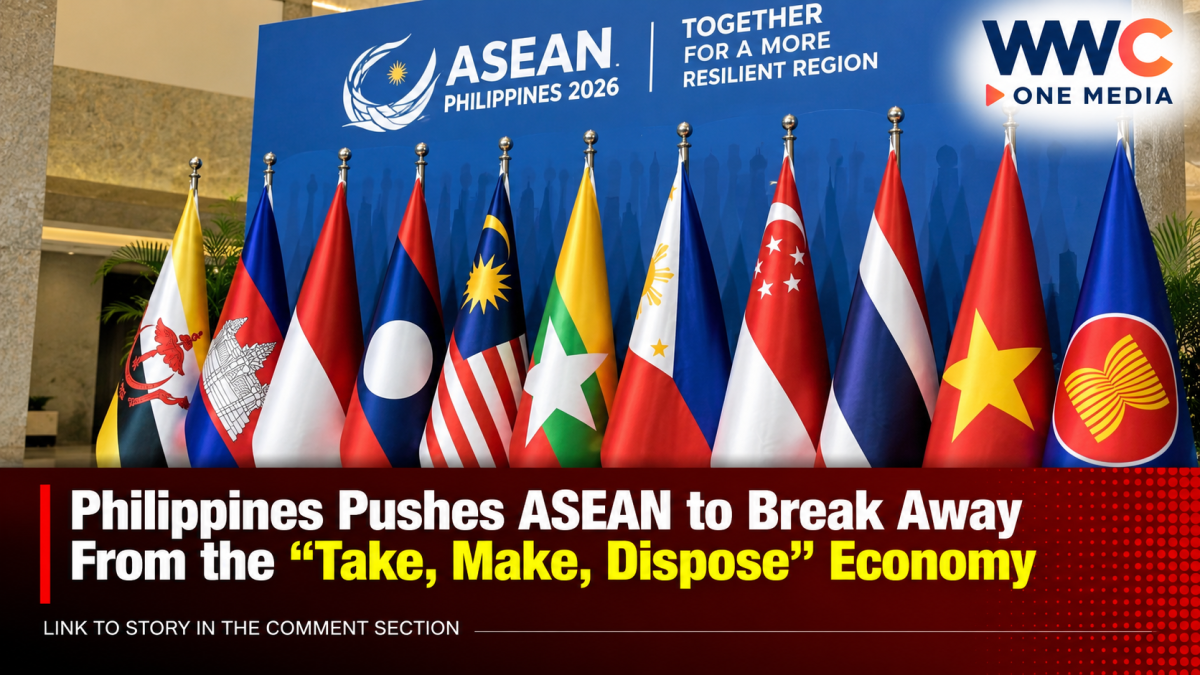
PHILIPPINES PUTS CIRCULAR ECONOMY ON ASEAN AGENDA
The Philippines is pushing for a major shift in how Southeast Asia produces, consumes and manages resources, calling for stronger regional cooperation to move ASEAN toward a circular economy.
Instead of following the traditional “take, make, use and dispose” model, the circular approach seeks to keep products and materials in use for as long as possible through reuse, repair, recycling and resource recovery.
The initiative is being advanced under the Philippines’ 2026 ASEAN Chairship, with Manila preparing to host the ASEAN Regional Dialogue on Circular Economy on September 22–23 in Makati.
FROM WASTE PROBLEM TO ECONOMIC OPPORTUNITY
The Philippine government wants the circular-economy discussion to go beyond environmental protection.
The regional dialogue will examine how ASEAN governments can create policies and financing mechanisms that encourage businesses and communities to reuse materials, expand recycling and improve resource efficiency.
Officials also see opportunities to create new livelihoods and businesses around recycling, repair, reuse and resource recovery.
That could be particularly important for Southeast Asia, where rapid economic growth, urbanization and rising consumption are increasing pressure on waste-management systems.
WHAT ASEAN COUNTRIES ARE BEING ASKED TO CHANGE
The discussions will cover several policy areas, including:
- National circular-economy strategies
- Extended Producer Responsibility (EPR)
- Local-government participation
- Financing mechanisms for circular businesses
- Recycling and resource recovery
- More efficient use of materials
- Support for micro, small and medium enterprises
- Inclusion of informal waste workers
The emphasis on EPR is particularly significant. Under such systems, producers can be given greater responsibility for the products and packaging they place on the market, including their management after consumers are finished with them.
WHY THE PHILIPPINES WANTS A REGIONAL APPROACH
Waste does not stop at national borders.
Plastic pollution, marine debris, resource consumption and supply chains affect multiple Southeast Asian countries simultaneously. A coordinated approach can therefore make it easier for governments and companies to develop compatible policies and markets for recycled and recovered materials.
The ASEAN Framework for Circular Economy already identifies resource efficiency, economic resilience and sustainable growth as important goals of the region’s transition. The Philippines’ latest push is aimed at turning those principles into more practical cooperation and implementation.
MSMEs AND WASTE WORKERS ARE PART OF THE PLAN
The transition is also being framed as an economic issue for smaller businesses and workers.
The September dialogue will include discussions on micro, small and medium enterprises and informal waste workers, with policymakers examining how these groups can benefit as waste-recovery systems become more formalized.
That matters because circular economies depend not only on major corporations and government programs. Collection, sorting, repair, reuse and recycling often involve thousands of smaller businesses and workers.
A successful transition would therefore need to make circular practices economically viable rather than simply imposing new environmental requirements.
THE PHILIPPINES IS ALSO BUILDING ITS OWN CIRCULAR-ECONOMY POLICY
The ASEAN push comes as the Philippines works on strengthening its domestic circular-economy framework.
The Department of Environment and Natural Resources convened government agencies in May for a high-level interagency roundtable aimed at shaping a national circular-economy policy.
The Philippine Institute for Development Studies has likewise examined circular-economy pathways as part of the country’s response to growing waste-management challenges. Its policy work highlights the potential of circular approaches to reduce waste while improving resource efficiency.
This means the ASEAN initiative is not happening in isolation. Manila is attempting to connect regional commitments with its own domestic policy development.
THE BIGGEST CHALLENGE: TURNING POLICY INTO PRACTICE
The idea of a circular economy is straightforward, but implementing it across an entire region is much harder.
Businesses need incentives to redesign products and packaging. Consumers need convenient ways to reuse and recycle. Governments need effective collection and processing systems. Investors need confidence that circular businesses can become financially sustainable.
There are also major differences among ASEAN economies in infrastructure, regulations and waste-management capacity.
The Philippines’ regional dialogue therefore represents an early step rather than a finished solution.
ASEAN’S NEXT ECONOMIC SHIFT?
If the initiative succeeds, the impact could extend well beyond cleaner streets and less waste.
A stronger circular economy could create new industries around recycling, repair, remanufacturing, sustainable packaging and resource recovery, while helping businesses reduce dependence on newly extracted raw materials.
ASEAN’s existing circular-economy framework already links the transition to economic resilience and sustainable growth.
For the Philippines, the challenge now is to turn its ASEAN Chairship into concrete regional cooperation—and eventually into changes that people and businesses can see in everyday life.
The Philippines is asking ASEAN to rethink what happens after a product is bought, used and discarded. The bigger question is whether Southeast Asia can turn that waste into its next economic opportunity.


Leave a Reply