
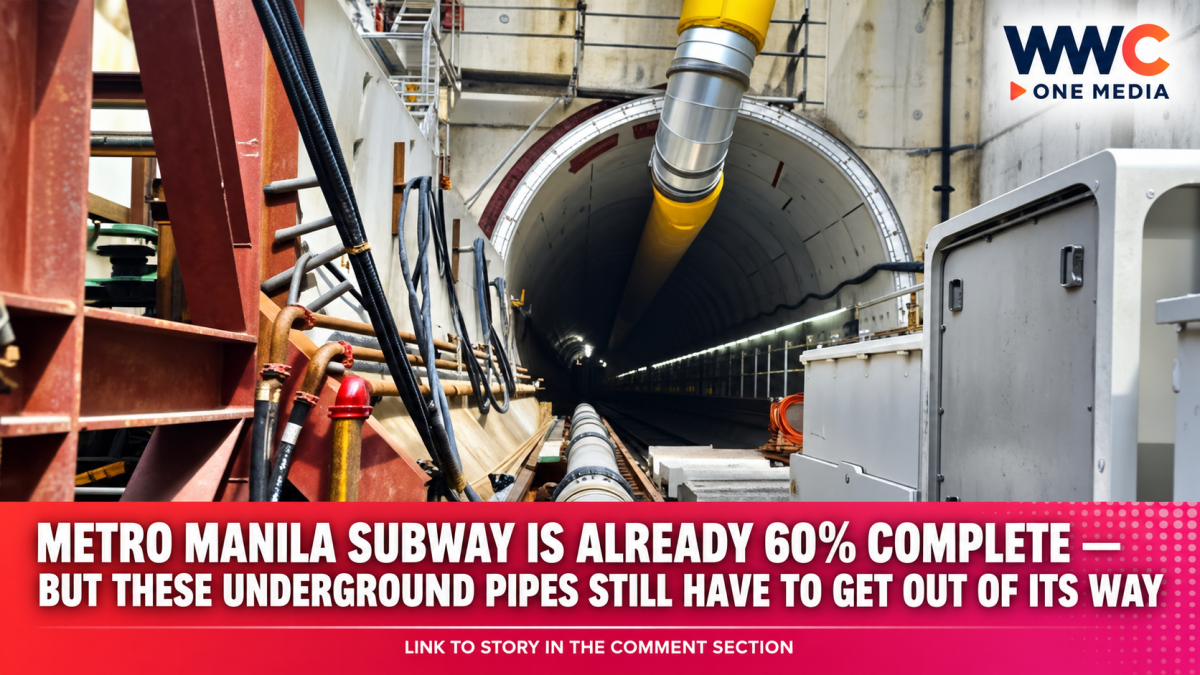
MANILA, Philippines — Beneath some of Metro Manila’s busiest roads, another infrastructure operation is unfolding alongside construction of the country’s first underground railway: Manila Water is moving major pipelines, sewer lines and water facilities that stand directly in the path of the Metro Manila Subway.
The East Zone concessionaire is advancing four utility-relocation projects around the future Shaw Boulevard, Ortigas Avenue, East Avenue and Anonas stations, with several works scheduled for completion by the end of September or October 2026.
The objective sounds simple—move the pipes so the trains can eventually pass underneath.
In practice, it is a delicate engineering operation.
Manila Water has to clear underground infrastructure from subway construction zones without disrupting water and wastewater services to surrounding communities, while contractors for the Department of Transportation’s massive rail project continue excavation and station works above and below ground.
A major water pipe has to move at Shaw Boulevard
One of the most critical relocations is taking place at the intersection of Meralco Avenue and Shaw Boulevard in Pasig City, where construction of the subway’s Shaw Boulevard Station conflicts with an existing 600-millimeter-diameter water pipeline.
Manila Water is permanently relocating that line and installing a new 600-mm steel pipeline outside the affected construction footprint.
The project was about 67% complete as of the first week of August 2026.
Earlier reporting by the Philippine Daily Inquirer provides an idea of the scale of the operation.
When the project began, the Shaw-Meralco pipeline relocation was valued at more than ₱49 million and involved open-trench excavation, pipe laying, interconnections, looping into existing water lines and road-restoration works.
Construction began during the second quarter of 2025, with Manila Water scheduling work around traffic conditions—including overnight operations on portions of the route—to limit disruption.
Moving the pipe is therefore not merely a matter of digging another trench.
The new line has to be installed, tested and integrated into the existing distribution network before the affected infrastructure can safely give way to subway construction.
East Avenue requires both water and sewer relocation
The challenge is even more complicated near East Avenue Station in Quezon City.
Along V. Luna Road in Barangay Pinyahan, Manila Water is relocating both water and sewer facilities affected by the subway alignment.
The work includes pipe laying, new manholes, valve boxes, the transfer of customer service connections and modifications to the surrounding water network.
Completion is targeted for October 2026.
The operation has actually been unfolding in phases.
In February, the Inquirer reported that Manila Water had already relocated 410 meters of sewer pipeline, with another 67 meters remaining under the original design.
Those sewer works passed through several streets in Barangay Pinyahan, while relocation of water lines along V. Luna Road was scheduled to follow.
That earlier work helps explain why utility relocation can precede major station construction by months—or even years.
Before contractors can freely excavate a station box or launch underground works, existing utilities crossing the site must either be protected or moved.
Anonas sewer line targeted for September completion
Another underground conflict is being addressed around the future Anonas Station.
Manila Water is relocating a sewer line covering sections of A. Luna Street near F. Castillo Street and J. Bugallon Street through E. Evangelista Street in Barangay Bagumbayan, Quezon City.
The project is scheduled for completion by the end of September 2026.
The goal is to remove sewer infrastructure from areas required for subway construction while maintaining the integrity of the wastewater network.
Ortigas gets its own utility shuffle
In Pasig City, Manila Water is also moving two meter-set assemblies at the corner of Ortigas Avenue and Meralco Avenue.
Those facilities conflict with the planned Ortigas Avenue Station footprint.
The relocation is targeted for completion by the end of October 2026.
Together, the four projects illustrate a less visible side of building a subway in a dense, already-developed metropolis.
The tunnels may attract the attention, but engineers first have to negotiate an underground maze of water mains, sewers, telecommunications infrastructure, electrical systems and other existing utilities.
Any one of them can become a construction constraint if it sits where a station, tunnel, access shaft or other subway facility needs to go.
Why moving utilities matters to the subway’s timetable
Manila Water Corporate Communications Group Head Dittie Galang said the adjustments are necessary both to accommodate the national transport project and to preserve reliable water and wastewater services during construction.
The company said it is coordinating with the DOTr, contractors and other stakeholders to reduce interruptions while the relocations are underway.
That coordination matters because the Metro Manila Subway is now well beyond its early construction phase.
Transportation Secretary Giovanni Lopez said in July that the project was approximately 60% complete.
The government also reported that tunneling between Valenzuela and Quirino Highway Station, as well as between North Avenue and Tandang Sora, had reached 100% completion.
A demonstration run covering an initial section is targeted for 2028, while full operations are expected around 2031 to 2032, depending on the construction package and final commissioning schedule.
That makes the current utility work more than routine maintenance.
As civil works accelerate farther south through Quezon City, Pasig, Taguig and toward the airport, unresolved underground conflicts could constrain station excavation and other construction activities.
The subway is one of the Philippines’ biggest transport projects
The Metro Manila Subway is designed as the country’s first full-scale underground urban railway.
Official project descriptions call for roughly 33 kilometers of railway infrastructure, 17 stations, a depot and the Philippine Railways Institute, connecting northern Metro Manila to areas farther south and including a spur toward Ninoy Aquino International Airport Terminal 3.
The system is designed to carry hundreds of thousands of passengers daily once fully operational.
Government projections have put eventual ridership at approximately 519,000 passengers per day, while officials expect the line to dramatically shorten trips between northern Metro Manila and the airport.
The project is heavily backed by Japan.
In March 2026, the Japan International Cooperation Agency and Philippine government signed a ¥220-billion fourth financing tranche for the subway.
That financing covers civil works, railway systems, rolling stock and consulting services. The planned rolling-stock fleet consists of 240 train cars, equivalent to 30 eight-car train sets.
Earlier government estimates placed the project’s total cost at about ₱488.48 billion.
Manila Water has more at stake than just the subway
The utility relocation comes at a time when Manila Water’s network itself is becoming larger.
As of July 2026, the company’s water distribution system had reached approximately 5,738 kilometers of pipelines.
It serves more than 7.9 million customers across the East Zone of Metro Manila and parts of Rizal.
That scale explains why relocating even one major transmission line must be carefully managed.
Cutting or moving the wrong pipe without sufficient network preparation could affect households, businesses and institutions well beyond the immediate construction site.
The subway project therefore creates an unusual engineering balancing act: infrastructure built to serve today’s metropolis must be moved so infrastructure designed for tomorrow’s metropolis can take its place.
What commuters may notice first
For motorists and residents, the immediate effects are unlikely to feel transformative.
Utility relocation can mean narrowed roads, excavation, construction barriers, nighttime work and temporary traffic arrangements.
At Shaw Boulevard, Manila Water previously said some construction activities were scheduled during off-peak hours, with temporary lane closures and stop-and-go traffic management.
But those disruptions are occurring because the project is entering stages where construction interfaces more directly with existing neighborhoods and infrastructure.
In that sense, the pipes being moved beneath Pasig and Quezon City are a sign of progress—but also a reminder of how complicated finishing the subway will be.
The bigger story
Building the Metro Manila Subway was never going to be just about digging tunnels.
It requires reorganizing parts of the underground city that already exists.
Water mains have to move. Sewer connections have to be rebuilt. Roads must be excavated and restored. Existing services need to keep functioning while heavy construction proceeds around them.
Manila Water’s four current relocation projects represent only one piece of that enormous coordination challenge.
The good news is that major parts of the railway are already taking shape, with government officials putting overall completion at roughly 60% by mid-2026.
But the work at Shaw, Ortigas, East Avenue and Anonas shows why a megaproject can still face difficult bottlenecks even after tunnels have been bored and stations have begun to rise.
For Metro Manila commuters waiting for the country’s first subway, the next milestone may not come from another tunnel breakthrough. It may depend on something far less glamorous: getting the pipes out of the way.




Leave a Reply