
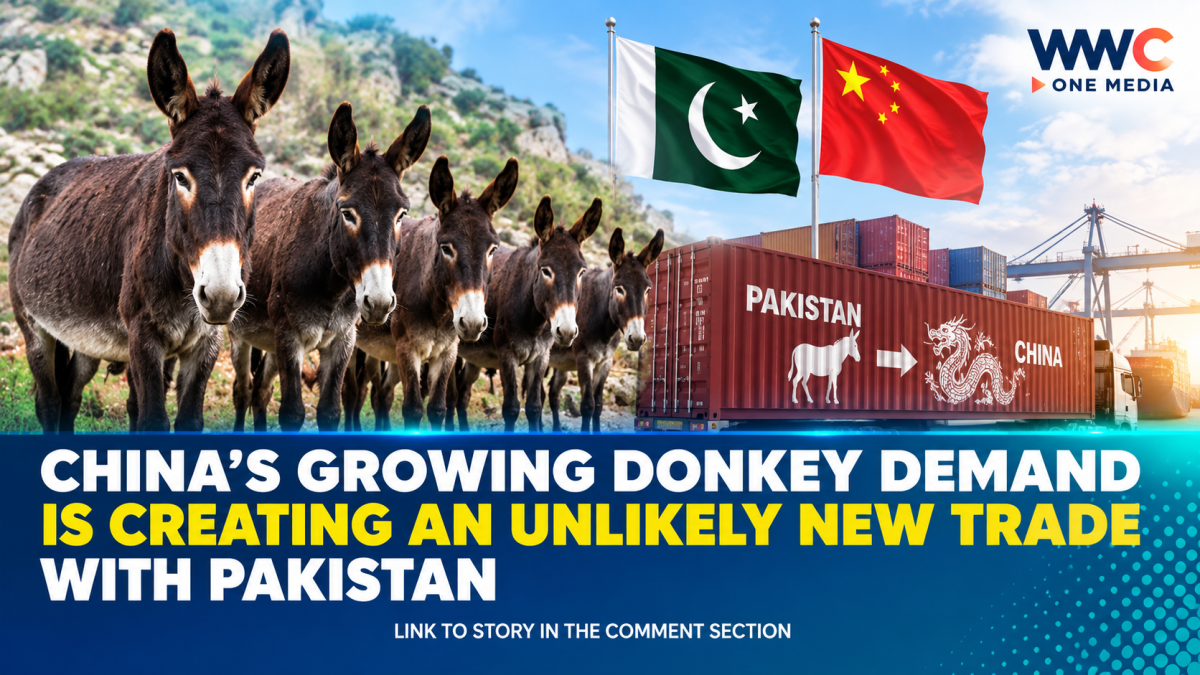
ISLAMABAD — A surprising new business is taking shape between China and Pakistan, driven by demand for an animal that has traditionally been associated with farm work and transportation rather than international trade.
In Pakistan’s southwestern Balochistan province, a slaughterhouse near Gwadar is processing donkeys for export, targeting the Chinese market for both meat and hides.
The unusual trade is being fueled by two different forms of demand: donkey meat, which is eaten in parts of China, and donkey hides, which are particularly valuable because they are used to produce ejiao, a gelatin made from donkey skin and widely used in traditional Chinese medicine.
Why China wants Pakistani donkeys
China has traditionally been one of the world’s major markets for donkey products, but its domestic donkey population has fallen substantially over the years.
That decline has encouraged Chinese buyers to look overseas for supplies.
Donkey hides are especially important because they are used to make ejiao. According to reporting citing a 2023 U.S. Congressional Research Service report, an estimated 2.3 million to 4.8 million donkeys are slaughtered globally each year for their hides, while China’s ejiao market was estimated at about US$7.8 billion in 2021.
The growing demand has turned donkey hides into a surprisingly valuable commodity.
Pakistan sees an unexpected export opportunity
Pakistan is now positioning itself as a new supplier.
The country’s donkey population has been growing, creating an opportunity for businesses seeking animals and hides for export.
In September, Pakistan’s Economic Coordination Committee approved the export of donkey meat and hides from the Gwadar Free Zone, subject to regulatory and food-safety requirements. The decision removed a major administrative obstacle for companies seeking to operate in the sector.
The move is also significant because Gwadar is a major component of the China-Pakistan Economic Corridor (CPEC), giving the emerging trade a direct connection to the broader economic relationship between the two countries.
A Chinese-linked company wants to scale up
Hangeng Group, which operates the slaughterhouse and processing facilities near Gwadar, is betting that China’s demand will continue to grow.
Company chief executive Andy Liao told reporters that the operation currently processes hundreds of donkeys and plans to increase daily slaughter capacity to 800 animals within months.
The company estimates that the business could generate around US$5 million in monthly foreign-exchange earnings within six months, potentially rising to US$7 million per month within two years if expansion plans proceed.
Those figures are company projections rather than guaranteed future earnings.
The business is about more than meat
Although headlines often focus on donkey meat, the hides may be the more important part of the commercial equation.
Ejiao is made by processing collagen extracted from donkey skin. It has a long history in traditional Chinese medicine and is marketed for a range of uses.
That demand has created intense competition for donkey hides around the world.
The supply problem has become more serious as donkey populations decline in some producing countries and several African nations have introduced restrictions on the commercial trade in donkey skins.
Pakistan therefore sees an opportunity to fill part of the supply gap.
From working animal to export commodity
For many Pakistani communities, donkeys have historically been working animals, carrying goods and pulling carts.
Their growing commercial value changes that equation.
Pakistan’s 2025-26 Economic Survey identified donkey meat, hides and related products as a potential niche export opportunity, particularly because of Chinese demand for donkey meat, milk and ejiao.
The government has consequently been exploring ways to expand the sector and make exports more commercially viable.
Gwadar gives the trade a strategic advantage
The location of the processing operation is also important.
Gwadar sits on Pakistan’s Arabian Sea coast and has been developed as a major component of the China-Pakistan Economic Corridor.
Using the Gwadar Free Zone for processing and exports could help connect Pakistani livestock products directly with international markets while adding another commercial activity to the China-linked economic zone.
The trade therefore represents something larger than an unusual food story.
It demonstrates how demand for a niche product can create a new commercial link between two countries already connected by major infrastructure and investment projects.
But expansion also raises questions
The rapid growth of the donkey trade could bring foreign exchange and new business opportunities to Pakistan.
At the same time, expansion of commercial slaughter raises questions about animal welfare, sustainable sourcing and whether growing demand could eventually put pressure on local donkey populations.
Those concerns will become more important if Pakistan’s export industry moves from a relatively small operation to large-scale production.
For now, however, an unlikely trade is taking shape.
China’s appetite for donkey products is turning Pakistan’s humble working animal into a new export commodity—and Gwadar could become one of the key gateways for that unusual business.


Leave a Reply