
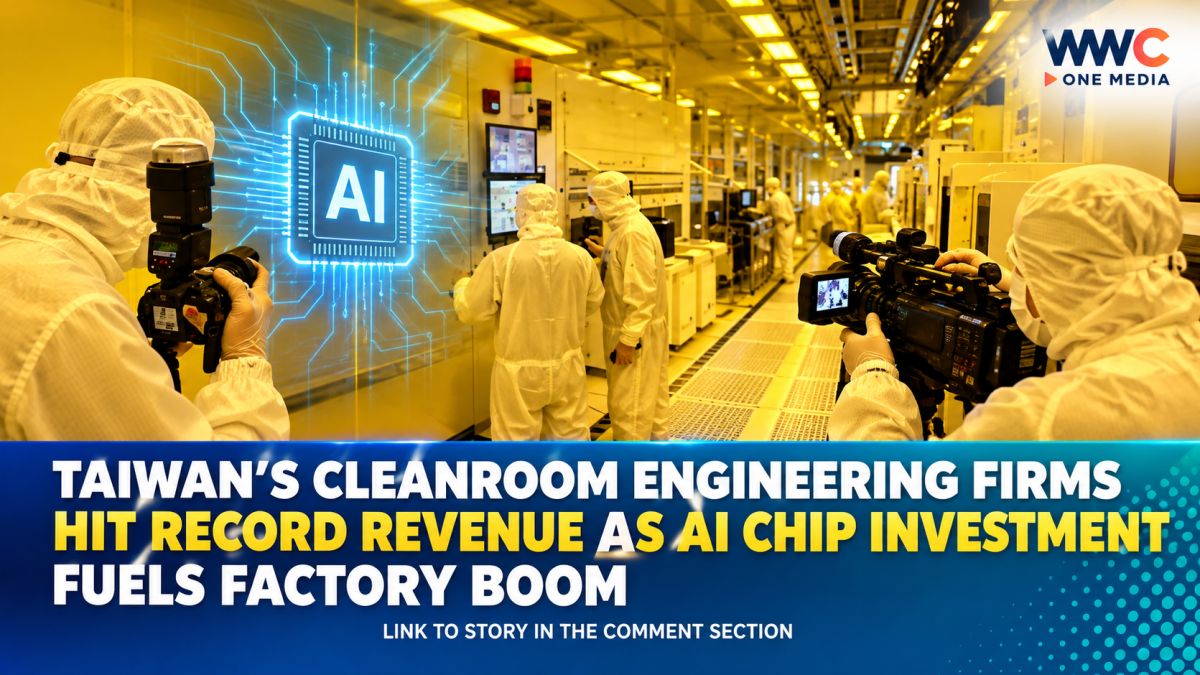
TAIPEI, Taiwan — Taiwan’s semiconductor expansion is creating a major windfall for a group of companies that rarely get the same attention as chipmakers: cleanroom and fab-facility engineering firms.
As chipmakers accelerate investments in advanced manufacturing, AI processors, memory and packaging capacity, companies responsible for designing and building the highly controlled environments required for semiconductor production are seeing orders and revenue surge.
Several Taiwanese engineering companies have recently reported record or sharply higher revenue, underscoring how the global AI boom is spreading well beyond the headline names in the semiconductor industry.
Cleanroom specialists are riding the semiconductor investment wave
Companies including L&K Engineering, United Integrated Services (UIS) and Yankey Engineering are benefiting from continued expansion across Taiwan’s semiconductor manufacturing ecosystem and related downstream operations.
Cleanrooms are essential to advanced chip production because even tiny amounts of dust or other airborne particles can compromise semiconductor manufacturing processes.
As chipmakers move toward increasingly advanced process technologies, fabs require sophisticated environmental-control systems covering temperature, humidity, air filtration, power and other tightly controlled conditions.
That means every new advanced semiconductor facility creates demand not only for expensive chipmaking equipment, but also for the specialized engineering work required to make the factory operational.
AI is making the factory-building boom bigger
The surge is closely tied to the explosive demand for AI computing.
Advanced AI processors require leading-edge manufacturing and increasingly sophisticated packaging. That is encouraging major semiconductor companies to expand capacity across wafer fabrication, advanced packaging and related facilities.
The result is a wider investment cycle extending through the semiconductor supply chain.
Taiwan’s semiconductor industry is expected to remain a major beneficiary. Industry officials recently projected that Taiwan’s semiconductor output could grow strongly in 2026 as demand for AI-related chips continues to rise.
The expansion is also visible at major industry events. At SEMICON Taiwan 2026, companies involved in semiconductor equipment, materials and manufacturing infrastructure showcased technologies designed to support the next generation of chip production.
Revenue records reveal the scale of the boom
The latest financial figures provide a clearer picture of how quickly the construction side of the semiconductor industry is growing.
Taiwanese cleanroom engineering company L&K Engineering has benefited from the expansion of semiconductor facilities, while UIS and Yankey have also seen strong demand from customers expanding manufacturing and related operations.
Other companies in Taiwan’s facility-engineering sector have posted similarly strong numbers.
Marketech International? The broader semiconductor-facility ecosystem includes contractors and engineering suppliers serving fab construction, equipment installation and factory infrastructure, meaning the investment cycle is generating business opportunities across multiple layers of the supply chain.
Recent reports also showed Scientech (聖暉)* posting August consolidated revenue of approximately NT$4.88 billion, up 26% from July and 45% from a year earlier, according to Taiwanese financial media.
L&K Engineering (亞翔) has also reported exceptionally strong monthly performance, with August revenue exceeding NT$10 billion for a second consecutive month, according to Taiwanese reports.
These figures illustrate the scale of construction and facility spending now flowing through Taiwan’s semiconductor ecosystem.
TSMC expansion is a major catalyst
At the center of Taiwan’s semiconductor investment boom is TSMC, the world’s leading contract chipmaker.
The company’s continued expansion of advanced manufacturing capacity in Taiwan and overseas is creating opportunities for Taiwanese suppliers and engineering contractors.
The expansion is not limited to Taiwan. TSMC’s growing manufacturing footprint in the United States is also encouraging Taiwanese semiconductor suppliers to follow their customers abroad and establish operations closer to new fabs.
That could give experienced Taiwanese cleanroom and facility-engineering companies another source of long-term growth.
The boom extends beyond wafer fabs
One important change in the semiconductor industry is that investment is increasingly spreading beyond traditional wafer fabrication.
Advanced packaging has become critical to AI chips because modern computing systems increasingly combine multiple high-performance components in sophisticated packages.
Taiwanese chip-testing and packaging companies have also recently reported strong August revenue, reflecting the broader expansion across the semiconductor production chain.
That creates additional work for engineering companies involved in cleanrooms, utilities, process piping and other specialized factory infrastructure.
Why cleanrooms matter so much
The semiconductor industry cannot simply build a factory and install chipmaking machines.
Advanced fabs require extremely controlled environments, specialized ventilation and filtration systems, stable utilities and tightly managed contamination levels.
As manufacturing processes become more advanced, those requirements become increasingly demanding.
That gives established engineering firms with semiconductor experience a potentially valuable position in the supply chain.
The current boom therefore highlights an often-overlooked reality of the AI revolution:
Before an advanced AI chip can be manufactured, someone has to build the highly controlled factory where it is made.
And right now, Taiwan’s cleanroom engineering companies are benefiting from that massive construction cycle.
A new phase of Taiwan’s semiconductor boom
The latest revenue records suggest that Taiwan’s semiconductor investment boom is no longer benefiting only chip designers, foundries and equipment manufacturers.
It is spreading to the companies building the infrastructure behind them.
With AI demand continuing to drive investment in advanced chips, memory, packaging and data-center hardware, Taiwan’s semiconductor facility-engineering sector could remain an important beneficiary of the industry’s expansion.
But the companies face the same risk as the broader chip industry: if semiconductor capital spending eventually slows, the extraordinary flow of new construction orders could weaken.
For now, however, the direction is clear.
Taiwan isn’t just making the world’s most advanced chips—it is also building the factories needed to make the next generation of AI possible.




Leave a Reply