
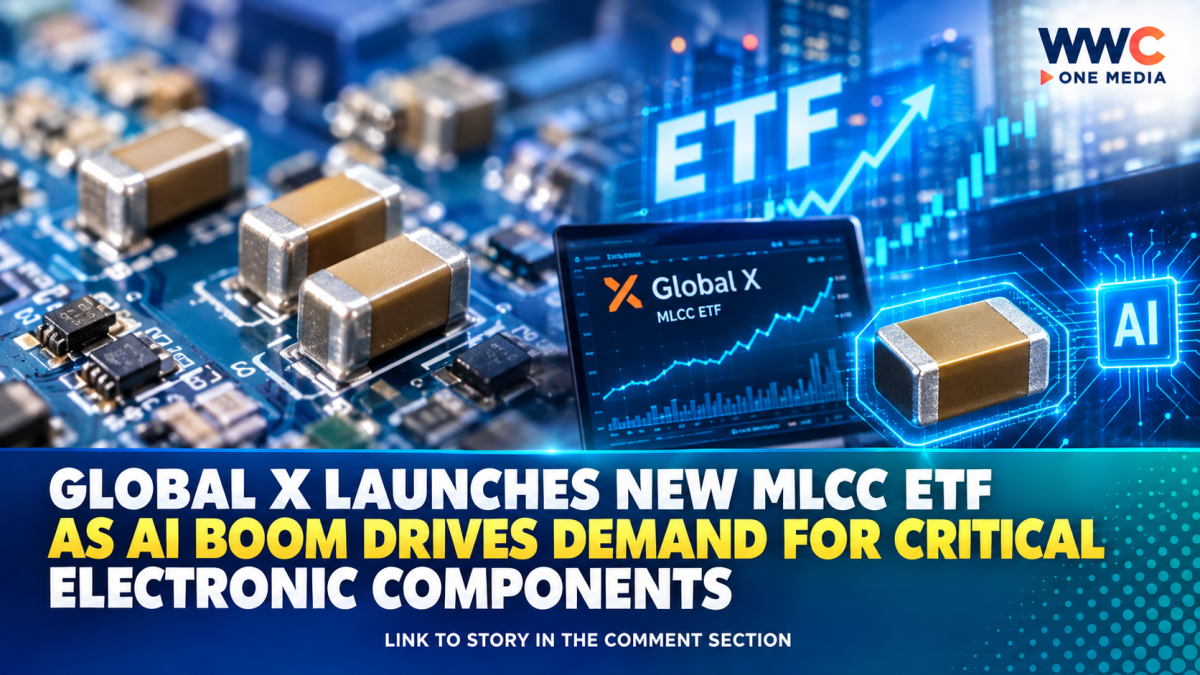
NEW YORK — The artificial intelligence boom is creating a new investment battleground beyond GPUs and memory chips, as Global X has launched an exchange-traded fund targeting manufacturers of multilayer ceramic capacitors (MLCCs) and related electronic components.
The new Global X MLCC & Electronic Components ETF, trading under the ticker MLCC, began trading on the Cboe BZX Exchange on Sept. 11. The actively managed fund is designed to give investors concentrated exposure to companies supplying one of the small but essential components required to keep increasingly power-hungry electronics operating reliably.
Why MLCCs are suddenly important in the AI race
MLCCs may be tiny, but their role is enormous.
These multilayer ceramic capacitors store and rapidly release electrical charge, helping stabilize voltage and filter electrical noise inside electronic circuits. They are used throughout smartphones, electric vehicles, industrial equipment and—more recently attracting attention—AI servers.
As AI data centers deploy increasingly powerful processors, the demand for stable and efficient power delivery is rising.
Global X says AI servers can use more than 10 times as many MLCCs as conventional servers, while demand for MLCCs specifically tied to AI servers could increase about 4.3 times between 2025 and 2030, based on research cited by the fund manager.
That makes MLCCs an increasingly important part of the AI infrastructure story.
Global X targets Asia’s MLCC giants
The new ETF focuses heavily on companies based in Japan, South Korea and Taiwan, where much of the global MLCC industry is concentrated.
According to Global X’s latest published holdings, the fund’s largest positions include:
- Murata Manufacturing — Japan
- Samsung Electro-Mechanics — South Korea
- Yageo — Taiwan
- TDK — Japan
- Taiyo Yuden — Japan
- Walsin Technology — Taiwan
As of Sept. 10, Murata accounted for about 20.56% of the portfolio, Samsung Electro-Mechanics about 19.98%, and Yageo about 14.79%. Holdings can change over time.
Korea JoongAng Daily similarly reported that Murata, Samsung Electro-Mechanics and Yageo were the three largest holdings when the ETF launched, highlighting the importance of Asian manufacturers to the strategy.
AI servers could become a major demand engine
The shift toward AI computing is changing the requirements for electronic components.
Modern AI servers consume enormous amounts of power, and the electrical systems supporting advanced processors must handle increasingly demanding conditions.
MLCCs help smooth fluctuations and maintain stable voltage close to sensitive components. As computing systems become more power-dense, manufacturers increasingly need MLCCs with higher capacitance, smaller footprints and greater tolerance for electrical and thermal stress.
This is why the AI hardware boom is spreading beyond the companies making processors.
The emerging investment thesis is that every layer of the AI infrastructure stack—from chips and memory to networking, power systems and passive components—could benefit from the buildout of AI data centers.
Supply is concentrated among a handful of manufacturers
Another factor attracting attention is the concentration of the MLCC industry.
Global X estimates that more than 85% of worldwide MLCC supply is controlled by five manufacturers based in Japan, South Korea and Taiwan.
That concentration could become strategically significant if AI-related demand grows faster than manufacturers can expand production.
Global X estimates MLCC supply capacity can increase by roughly 10% to 15% annually, creating the possibility of tighter supply conditions if demand grows substantially faster.
For manufacturers with the technology and production capacity to supply high-end components, that could translate into stronger utilization and potentially greater pricing power.
Global X isn’t the only ETF chasing the capacitor boom
The launch comes as financial firms increasingly look beyond the best-known AI chipmakers.
Another ETF focused on the sector, Defiance ETFs’ CAPA, launched in August with exposure to companies involved in MLCCs and other capacitor technologies used in AI servers, accelerators and data centers. Its index includes major names such as TDK, Samsung Electro-Mechanics, Murata, Kyocera and Yageo.
Roundhill Investments also launched a dedicated MLCC-focused ETF in September, showing how quickly the investment industry is turning its attention toward the component suppliers behind the AI infrastructure boom.
The growing number of funds suggests investors are looking for ways to participate in AI’s expansion without concentrating entirely on the most visible semiconductor companies.
Korea and Taiwan are in the spotlight
The MLCC boom is particularly relevant to Asia.
South Korea is home to Samsung Electro-Mechanics, one of the world’s major MLCC manufacturers, while Taiwan is home to major suppliers including Yageo and Walsin Technology.
Japan remains another dominant force, with companies such as Murata, TDK and Taiyo Yuden playing major roles in the global passive-components market.
This gives the region an important position in an AI supply chain that increasingly depends on sophisticated power-management components.
A small component with a much bigger AI story
The investment case for MLCCs ultimately reflects a broader change in the AI market.
The first stage of the AI investment boom focused heavily on GPUs, advanced processors and memory chips.
Now, investors are increasingly examining the infrastructure needed to make those processors function at scale.
That includes electricity generation, data centers, cooling systems, networking equipment, power-management technology and the passive components that help keep increasingly complex electronics stable.
Global X’s new MLCC ETF is essentially betting that some of the least visible components in the AI supply chain could become increasingly important as AI systems consume more power and become more sophisticated.
Still, the ETF is a concentrated thematic investment rather than a guarantee of gains. Global X itself notes that investment value can fluctuate and that past performance does not guarantee future results.
For the AI industry, however, the message is becoming clearer:
The next AI bottleneck may not be another processor. It could be one of the tiny components helping that processor stay powered.




Leave a Reply