
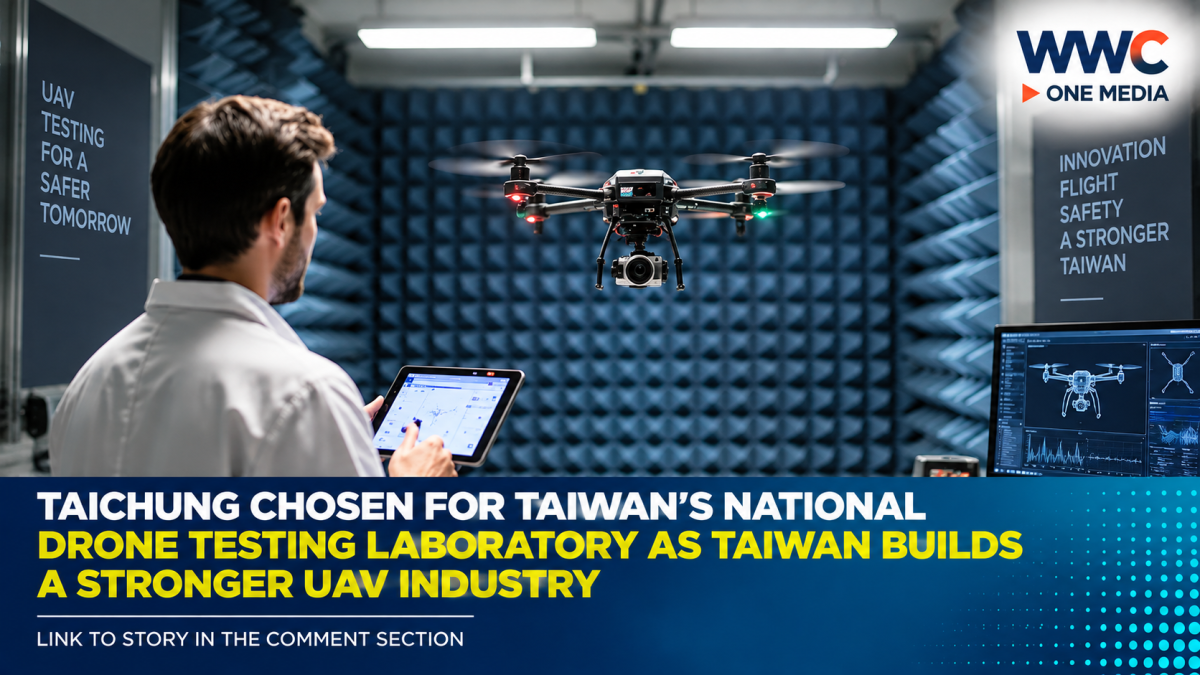
TAICHUNG, Taiwan — Taichung is set to become a major testing hub for Taiwan’s rapidly expanding drone industry after the central government selected the city to host a national-level drone technology testing laboratory.
The planned facility is designed to help Taiwan’s drone manufacturers conduct testing and verification closer to home, potentially cutting costs and shortening the time needed to bring new unmanned aerial vehicles to market.
The selection comes as Taiwan accelerates efforts to build a more resilient domestic drone supply chain and strengthen its unmanned-vehicle capabilities.
National drone laboratory coming to Taichung
Taiwan’s Bureau of Standards, Metrology and Inspection approved the Taichung site earlier this month. The initial project is expected to require about NT$30 million (US$944,000) and occupy approximately 1,197 square meters.
Planning and design are scheduled to be completed in 2027, construction is expected to begin in 2028, and the laboratory is targeted for completion in 2029.
The first phase will focus on testing drones weighing less than 25 kilograms. Plans also call for a roughly 200-meter runway and buffer zones for fixed-wing aircraft.
The facility is expected to include an electromagnetic chamber capable of testing individual drones or swarms of drones, adding an important capability for manufacturers developing increasingly sophisticated unmanned systems.
Why Taichung?
Taichung already has a significant concentration of companies involved in the drone sector.
According to Taichung officials, the city is home to around 50 drone companies involved in areas including research and development, manufacturing and testing. Companies such as Thunder Tiger and the Aerospace Industrial Development Corporation (AIDC) were among industry representatives involved in discussions surrounding the planned facility.
The central government said locating a testing facility in Taichung could address a practical problem facing local manufacturers: some companies currently need to transport their drones elsewhere for testing, adding both expenses and delays.
For an industry where rapid testing and verification can determine how quickly a product reaches customers, having a dedicated facility nearby could provide a significant competitive advantage.
Taiwan’s drone ambitions are growing
The Taichung project is part of a much broader push to establish Taiwan as a competitive center for unmanned systems.
Taiwan’s drone ecosystem has expanded rapidly, with industry groups working to connect manufacturers of airframes, sensors, communications equipment, control systems and other components.
The Taiwan Unmanned Vehicle Alliance, for example, says its network now connects more than 1,700 Taiwanese UAV and component companies, reflecting the breadth of the emerging domestic supply chain.
Taiwan is also attracting greater international attention. In July, American Institute in Taiwan Director Raymond Greene spoke at the Taichung Drone Industry Opportunities Forum, highlighting growing international interest in the city’s drone sector.
Testing could become a key bottleneck
For manufacturers, building a drone is only part of the challenge. Products also need to undergo testing, verification and certification before they can move toward wider commercial deployment.
Officials involved with the Taichung project emphasized that faster verification can translate into faster orders and shorter time-to-market.
The new laboratory could therefore become an important piece of Taiwan’s drone strategy by giving companies greater access to standardized testing infrastructure without having to repeatedly move equipment to distant locations.
Thunder Tiger has also urged authorities to keep listening to industry feedback as drone technology evolves, noting that regulations and technical standards need to keep pace with rapidly changing capabilities.
More than a local economic project
Taichung’s selection has significance beyond the city’s technology sector.
Taiwan is seeking to develop a complete domestic unmanned-systems ecosystem, from components and manufacturing to testing and certification. A national testing laboratory could help strengthen that chain and make it easier for smaller companies to develop and validate new products.
The government also plans to secure additional land for possible future expansion of the testing infrastructure.
That could become increasingly important as Taiwan’s drone industry moves beyond small commercial UAVs toward more sophisticated platforms and autonomous systems.
Taichung’s drone moment
With a growing concentration of manufacturers, aerospace expertise and technology companies, Taichung is positioning itself as one of Taiwan’s most important centers for unmanned technology.
The national laboratory is not expected to be completed until 2029, meaning its immediate impact will be limited. But once operational, it could remove a major testing bottleneck and help Taiwan’s drone manufacturers move from prototype to certified product faster.
Taichung’s selection sends a clear signal: Taiwan’s drone ambitions are moving from individual companies and prototypes toward a more organized national industrial ecosystem — and Taichung is being placed at the center of it.




Leave a Reply