
NEW DELHI/ISLAMABAD — For more than six decades, one agreement managed something almost nothing else could between India and Pakistan.
It survived wars.
It survived military crises.
It survived terrorism disputes, border confrontations and decades of mutual distrust.
Now the Indus Waters Treaty is facing a more fundamental question:
Can a treaty survive when one side says it has been put on hold — while the other side and an international arbitration court insist that legally, it never stopped operating?
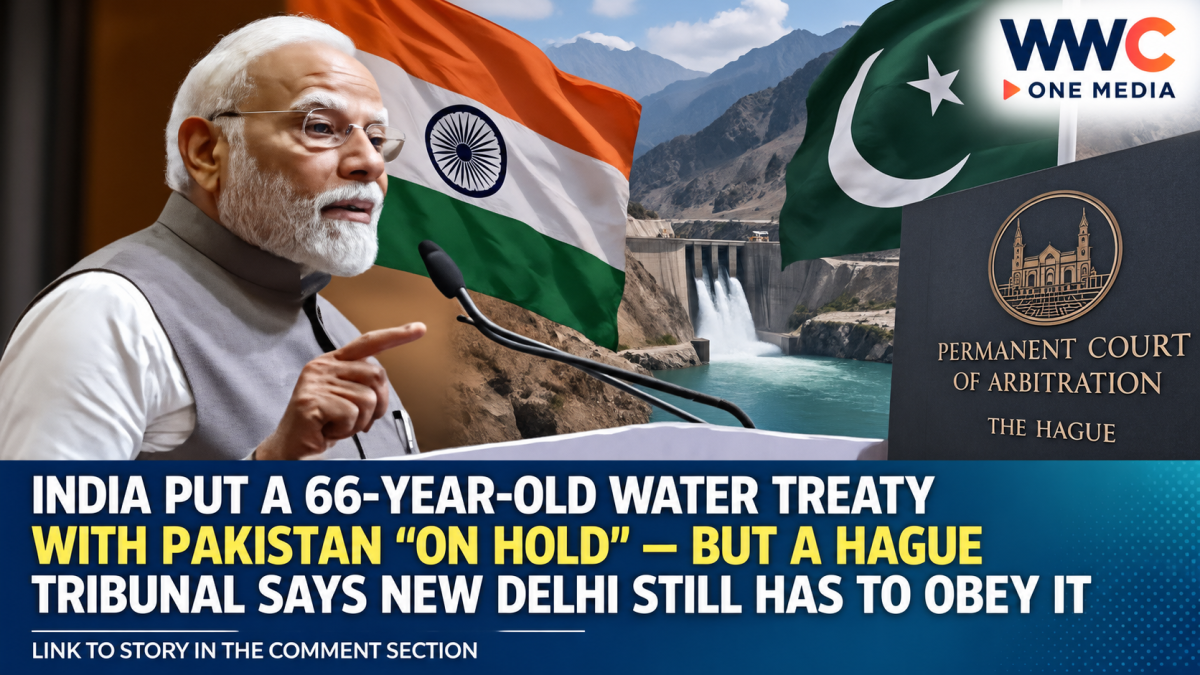
That conflict moved into sharper focus on August 31, when a Court of Arbitration constituted under the treaty ruled that India’s decision to place the pact in “abeyance” was not permissible under the treaty or applicable international law and said New Delhi remains bound by its obligations.
India rejected the ruling.
New Delhi maintains that the arbitration process itself is illegitimate and says the tribunal has no jurisdiction over what India considers sovereign decisions involving the treaty and national security.
Pakistan, meanwhile, says the ruling confirms what Islamabad has argued from the beginning: India cannot suspend the agreement unilaterally.
And underneath the legal battle sits something much more consequential than courtroom language.
Water.
A treaty signed in 1960 became one of the world’s most durable water agreements
The Indus Waters Treaty was signed on September 19, 1960, after years of negotiations facilitated by the World Bank.
Indian Prime Minister Jawaharlal Nehru, Pakistani President Ayub Khan and World Bank Vice President William Iliff signed the agreement in Karachi.
The basic bargain was unusually simple for such a complicated river system.
The three eastern rivers — Ravi, Beas and Sutlej — were allocated primarily to India.
The three western rivers — Indus, Jhelum and Chenab — were allocated primarily to Pakistan, although India retained specified rights including limited agricultural use, domestic use and hydroelectric-power generation subject to treaty constraints.
The agreement also created the Permanent Indus Commission, with one commissioner from each country, and established mechanisms for resolving disputes through bilateral discussion, a neutral technical expert and, in specified circumstances, a Court of Arbitration.
That architecture proved remarkably durable.
The World Bank has described the agreement as one of the most successful international treaties of its kind because it continued functioning through repeated periods of military and political confrontation.
Then came April 2025.
The Pahalgam attack changed the political equation
India placed its participation in the treaty in “abeyance” in April 2025 after 26 people were killed in an attack on tourists in Pahalgam in Indian-administered Kashmir.
India blamed Pakistan-linked militants and increasingly tied future water cooperation to what New Delhi describes as Islamabad’s support for cross-border terrorism.
Pakistan denied involvement in the attack.
The dispute quickly became part of the broader India-Pakistan confrontation that followed.
Even after the two nuclear-armed neighbours reached a ceasefire in May 2025 following their most serious military exchanges in decades, Reuters reported that India’s position on the treaty remained unchanged.
Then Indian Home Minister Amit Shah went much further.
In June 2025, Shah said the treaty would “never” be restored and argued that India should redirect water toward its own territory, including Rajasthan.
That statement dramatically narrowed expectations for a quick diplomatic repair.
But the tribunal says India never had the legal power to pause it
The arbitration court sees the situation very differently.
Its August 31 ruling said India’s purported abeyance did not suspend the treaty’s legal effect and did not end India’s obligations.
The court also ruled that the treaty’s dispute-resolution procedures remain operational.
That conclusion matters because the treaty itself establishes procedures for addressing disputes and specifically provides for arbitration under certain conditions.
Its awards in qualifying disputes are described in the treaty text as final and binding on the parties with respect to those disputes.
Pakistan therefore argues that India remains legally bound whether or not New Delhi chooses to participate.
India rejects that interpretation.
India’s objection to this arbitration actually predates the 2025 crisis
The disagreement is more complicated than “India dislikes the latest ruling.”
New Delhi has disputed the legitimacy of this particular arbitration process for years.
Pakistan sought a Court of Arbitration over aspects of India’s Kishanganga and Ratle hydroelectric projects, while India sought a Neutral Expert to examine technical differences over the same projects.
The World Bank ultimately facilitated appointments for both processes in 2022.
India objected to having both mechanisms operate in parallel.
In a formal 2023 statement, India’s Ministry of External Affairs described the Court of Arbitration as “illegally constituted” and argued that the Neutral Expert process was the mechanism consistent with the treaty at that stage.
So when India now rejects the arbitration court’s authority, it is repeating a position that existed before the Pahalgam attack and before the treaty was placed in abeyance.
Pakistan takes the opposite view and says the arbitration court was lawfully constituted under the treaty.
That disagreement over who has jurisdiction is now layered on top of the much bigger disagreement over whether the treaty itself can be suspended.
Ratle has become the immediate battlefield
The August ruling was not purely theoretical.
The tribunal also imposed interim restrictions involving India’s 850-megawatt Ratle Hydroelectric Plant on the Chenab River.
According to CNA’s summary of the ruling, work affecting part of the dam wall is restricted until after a World Bank-appointed Neutral Expert reaches a final decision on whether Ratle’s design complies with treaty requirements.
That Neutral Expert ruling is expected by July 2027, with the arbitration court’s interim measure continuing for 90 days afterward.
This produces an extraordinary situation.
India rejects the arbitration court.
India has nevertheless participated historically in the separate Neutral Expert mechanism.
And both processes are now touching the same strategically important hydroelectric project.
Why does Pakistan care so much about dam design?
Because the argument is not simply about whether India is allowed to build dams.
It generally is.
The treaty permits India to build hydroelectric projects on the western rivers allocated primarily to Pakistan, subject to detailed engineering restrictions intended to prevent India from obtaining excessive control over storage and downstream flows.
The dispute is therefore often about design features.
How much water can a reservoir store?
At what level are outlets positioned?
How quickly can operators hold or release water?
How much “pondage” is really required to operate a plant?
India argues that projects such as Ratle and Kishanganga are legitimate hydroelectric developments allowed by the treaty.
Pakistan has argued that certain design features could give upstream India too much ability to manipulate the timing of flows downstream.
That difference may sound technical.
For Pakistan, it is strategic.
The Indus system is essentially Pakistan’s agricultural bloodstream
Pakistan’s dependence on the Indus basin is extremely high.
Reuters has reported that the western-river system supplies water supporting roughly 80% of Pakistan’s irrigated agriculture.
The country’s vast Indus Basin Irrigation System is among the world’s largest interconnected irrigation networks.
The World Bank says it underpins agricultural production and national food security, while related groundwater replenished through the canal system is also essential for millions of rural residents.
Crops including wheat, rice, cotton and sugarcane depend heavily on reliable water availability.
That helps explain why Pakistani officials treat water as a national-security issue rather than an ordinary trade disagreement.
Even modest uncertainty over the timing of flows can complicate planting, reservoir management and irrigation.
But India cannot simply close a giant tap tomorrow
This is one of the most important corrections to some of the more dramatic versions of the dispute.
India sits upstream on major parts of the river system.
That gives it leverage.
But it does not currently possess enough storage capacity on the western rivers to simply stop Pakistan’s Indus water supply indefinitely. Reuters reported after the 2025 suspension that India lacked the infrastructure required to create an immediate, comprehensive cutoff.
Rivers continue flowing because of hydrology and physical infrastructure, not merely treaty language.
That does not mean the abeyance is meaningless.
Without treaty cooperation, India can potentially stop or reduce certain data exchanges, advance projects more aggressively and operate infrastructure without the same cooperative framework Pakistan previously relied upon.
Over time, new reservoirs and hydroelectric facilities could potentially give the upstream state greater influence over the timing of flows.
That is why the infrastructure race matters.
India has accelerated projects since putting the treaty in abeyance
CNA notes that India has advanced work involving several projects on the Chenab system, including Kiru, Kwar and Sawalkot, as New Delhi tries to make fuller use of water and hydropower rights it believes it possesses.
India has also constructed a rock check dam at Upshi on the Indus for local irrigation purposes, according to the commentary.
From New Delhi’s perspective, this is partly about correcting what Indian officials increasingly view as decades of underuse of their lawful share of basin resources.
Pakistan sees the buildup much more nervously.
The lower-riparian state fears that cumulative upstream infrastructure could give India greater ability to alter flows during sensitive periods even if India cannot permanently withhold entire rivers.
Those are competing strategic interpretations of infrastructure that, on paper, may also have ordinary power-generation and irrigation purposes.
The dispute is therefore about control, not merely total volume
Imagine Pakistan ultimately receives roughly the same annual quantity of river water.
That does not necessarily mean timing is irrelevant.
For agriculture, the difference between water arriving during a crucial planting window and arriving weeks later can be enormous.
Likewise, rapid releases during high-flow periods can present very different management problems from predictable flows coordinated through treaty mechanisms.
This is why dam outlet levels, reservoir capacity, operating rules and advance data sharing occupy so much space in Indus disputes.
Water politics is not simply about how much crosses the border.
It is also about when and under whose control.
The Court of Arbitration has no army to enforce its decision
Here lies the biggest practical weakness in the August ruling.
The tribunal can interpret the treaty.
It can issue awards.
It can order interim measures.
It cannot physically force India to comply.
CNA compares the dilemma with the 2016 South China Sea arbitration involving China and the Philippines: Beijing rejected the tribunal’s jurisdiction, refused to participate and has continued to reject the award, even though Manila has used the legal ruling diplomatically.
The analogy is not exact, but the enforcement problem is similar.
International adjudication depends heavily on states choosing to comply, facing diplomatic costs for refusing, or encountering pressure from other governments and institutions.
Pakistan can therefore use the August ruling to strengthen its legal and diplomatic argument.
Whether that changes Indian policy is another matter.
The World Bank cannot simply order both sides back to the table either
Because the World Bank helped broker the treaty and signed parts of it, it is frequently described as though it were the treaty’s global referee.
Its role is narrower.
The Bank helped negotiate the original agreement, performs specified procedural responsibilities and makes certain appointments when required.
It does not possess a general power to rewrite treaty obligations or dictate political settlements to India and Pakistan.
That matters because calls for the World Bank to “solve” the present crisis may overstate what the institution can legally do.
Ultimately, the two governments themselves must decide whether cooperation can be restored.
India had already wanted the treaty changed
Another important piece of context predates the current suspension.
India formally sought modifications to the treaty before April 2025.
Among New Delhi’s concerns was what it saw as an increasingly dysfunctional dispute-resolution mechanism, particularly Pakistan’s pursuit of arbitration while India sought a Neutral Expert on overlapping technical issues.
India therefore sees the current treaty not only through a terrorism and security lens but also as an agreement whose procedures need updating.
Pakistan fears that reopening the treaty could weaken protections it considers essential to its food and water security.
That creates an obvious negotiating trap.
India wants change.
Pakistan has strong incentives to preserve an agreement whose western-river allocation is highly favorable to it.
And then climate change entered the room
The treaty was negotiated in the 1950s.
Its basic structure reflects the hydrological and political assumptions of that era.
The basin of 2026 is very different.
Populations are far larger.
Electricity demand is much higher.
Cities and industries consume more water.
Groundwater is under pressure.
And climate change is destabilizing the mountain systems feeding South Asia’s great rivers.
ICIMOD warned this year that the Hindu Kush Himalaya is facing increasingly erratic monsoons, with longer dry periods interrupted by intense rain capable of triggering floods, landslides and glacier-related disasters.
A report covered by Reuters on September 14 warned that Himalayan glaciers are approaching critical thresholds and that parts of the region could eventually reach “peak water”, after which meltwater contributions begin declining.
For the Indus basin, that creates a dangerous paradox.
Climate change can initially produce greater melt and flood danger.
Later, declining ice reserves can contribute to reduced long-term water availability.
A treaty originally designed primarily to allocate river use between two states must now operate in an environment where the river itself is changing.
Pakistan has water problems India did not create
That point is essential to avoid oversimplifying the crisis.
Pakistan’s water insecurity cannot be explained entirely by Indian upstream activity.
The World Bank has documented serious domestic challenges including groundwater over-extraction, inefficient irrigation, waterlogging, salinity, pollution, aging infrastructure and rapid population growth.
Pakistan’s long-term water security therefore depends heavily on domestic reform regardless of what India does.
That does not reduce the importance of predictable cross-border river flows.
It simply means the treaty dispute is only one part of a much larger water problem.
India faces severe water pressure too.
The World Bank says India has about 18% of the world’s population but only 4% of global water resources, while hundreds of millions of people experience water stress.
Both countries therefore enter the dispute feeling increasingly water-constrained.
That makes compromise harder.
A modernized treaty could make sense — but negotiating one may be nearly impossible
Researchers writing in Water Security in August argued that the Indus agreement faces interconnected challenges from climate change, population growth, development pressures and geopolitics and suggested modernization could improve long-term resilience.
In theory, a modernized arrangement might improve glacier monitoring, flood-data exchange, drought planning, environmental flows and joint climate adaptation.
In practice, reopening the bargain could be extraordinarily dangerous.
Pakistan may fear losing rights it already possesses.
India may see little reason to return to an arrangement without major concessions.
And every technical issue can quickly become entangled with Kashmir, terrorism and broader national-security grievances.
Once water negotiations become proxies for every other dispute between the countries, engineering solutions become much harder to reach.
The treaty survived wars because both countries once kept water partially insulated from everything else
That may be the most important historical lesson.
India and Pakistan fought major wars and experienced repeated crises while the Indus framework continued operating.
The treaty worked partly because water cooperation remained insulated — imperfectly, but significantly — from disputes over territory, terrorism and military confrontation.
That barrier has now weakened.
India has explicitly connected treaty cooperation to security and cross-border terrorism.
Pakistan has increasingly framed Indian upstream action as a national-security threat.
Water is no longer simply a technical issue managed by commissioners and engineers.
It has become part of strategic coercion narratives on both sides.
Once that happens, every dam begins to look like a weapon to somebody.
So is the Indus Waters Treaty dead?
Legally, according to the August 31 Court of Arbitration ruling: no.
The tribunal says the agreement remains in force and India remains bound by it.
Politically and operationally, however, the picture is far less clear.
India continues to treat the pact as being in abeyance.
New Delhi rejects the arbitration court’s legitimacy.
Pakistan rejects India’s right to suspend the agreement.
Hydroelectric projects are advancing.
The Neutral Expert process is still unfolding.
And the Court of Arbitration cannot compel India physically to change course.
So the treaty occupies an extraordinary state:
alive in law, contested in practice and increasingly weakened by politics.
The next major date may be July 2027
The Neutral Expert is expected to issue a decision on the Ratle project by July 2027.
That ruling could matter because India recognizes the Neutral Expert mechanism as treaty-consistent, even though New Delhi disputes the parallel arbitration process.
If the expert’s conclusions substantially overlap with or reinforce the arbitration court’s position, India could face additional pressure over project design.
If the conclusions diverge, the already complicated jurisdictional fight could become even more contentious.
That makes Ratle something of a test case for the entire treaty system.
But the bigger deadline may be imposed by climate, not lawyers
Courts can take years.
Treaty negotiations can take even longer.
Glaciers, droughts, floods and population growth do not wait for legal clarity.
That is what makes the Indus crisis unusually dangerous.
India and Pakistan are arguing over a framework designed to manage a shared resource at the same time that the resource itself is becoming less predictable.
And unlike a trade agreement, a water treaty cannot simply be abandoned without consequences that flow downstream.
Literally.
India may have enough leverage to make cooperation much harder for Pakistan.
Pakistan may have enough international legal support to raise the political cost for India.
But neither government has the power to create another Indus River.
The treaty’s greatest achievement was never that India and Pakistan stopped disagreeing.
They did not.
It was that they found one critical area where disagreement did not automatically destroy cooperation.
After 66 years, that firewall is breaking.
And the biggest question is no longer whether the Indus Waters Treaty survived the wars of the past.
It is whether water itself has now become part of the conflict.



Leave a Reply