
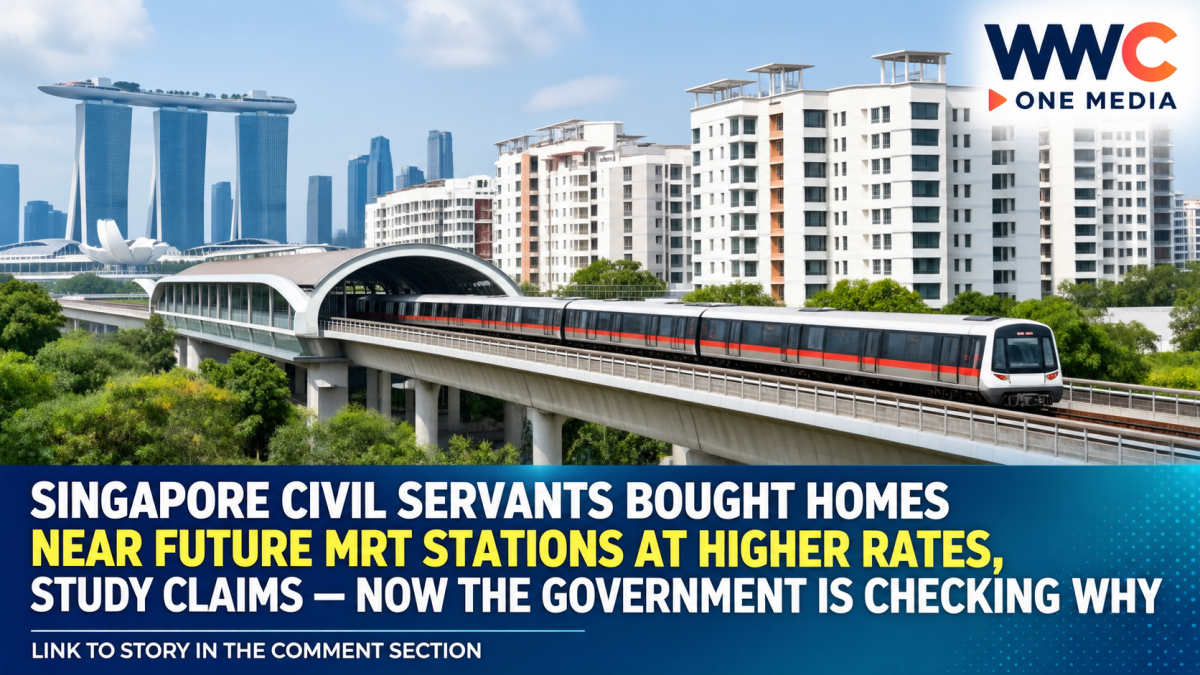
SINGAPORE — One of the most sensitive questions surrounding Singapore’s reputation for clean government has emerged from an unexpected place: the private-property market.
A new academic working paper claims that people identified by its researchers as Singapore civil servants purchased private homes near planned but not yet publicly announced MRT stations at disproportionately high rates, with the difference becoming most visible roughly one to two years before the station locations were officially announced.
The Public Service Division, or PSD, is now examining the study.
And its response was deliberately serious without prejudging the outcome.
PSD said it takes integrity concerns “extremely seriously”, is reviewing the paper’s data and methodology, and will refer the matter to the Corrupt Practices Investigation Bureau if its assessment finds a material basis for doing so.
That means Singapore is not currently announcing that civil servants have been caught abusing confidential MRT information.
It is investigating whether the academic claim is strong enough to justify taking the matter further.
That distinction should remain at the center of any responsible reporting on the story.
The study makes an unusually strong claim
The September 2026 paper is titled “Do Social Norms Substitute for Enforcement? Evidence from Public Officials’ Home Purchases in Singapore.”
It was written by Tomasz Piskorski of Columbia University, Jian Zhang of the University of Hong Kong, and Amit Seru and Chun Zhao of Stanford University and published as National Bureau of Economic Research Working Paper 35756.
The researchers describe Singapore as an especially useful place to examine whether a country with longstanding anti-corruption norms can rely primarily on those norms, or whether continued formal enforcement remains essential.
Their answer is provocative.
Using housing transactions, government-directory information and MRT expansion announcements, the authors say they detected what they call “informed home purchases” among civil servants before planned station locations became public.
According to the paper, purchases near future stations were disproportionately concentrated among civil servants compared with matched non-civil-servant buyers.
The increase was particularly pronounced one to two years before public announcements, then changed after the information entered the public domain.
That is a serious statistical allegation.
It is not, by itself, proof of an offence.
How did the researchers identify civil servants?
The methodology is part of what PSD is now reviewing.
The authors used private-property transaction information drawn from Singapore legal filings and linked buyer identities with information from the Singapore Government Directory Interactive, or SGDI, to classify buyers as civil servants and track their housing transactions.
They then identified properties close to MRT stations whose locations had been planned but had not yet been publicly announced.
Purchases around those locations were compared with purchases made by matched control groups.
The idea is straightforward:
If the public does not yet know precisely where an MRT station will be built, but one particular group begins buying homes close to those future locations more frequently than otherwise similar buyers, that pattern could suggest the group possesses information others do not.
But “could suggest” is doing important work in that sentence.
A statistical model can identify an abnormal pattern.
It generally cannot tell investigators what a particular buyer actually knew, where that knowledge came from, or why that person bought a particular condominium.
Those questions require evidence about individuals.
The authors say the pattern was strongest among mid-level officials
The working paper goes further.
Using a large language model to classify official job ranks, the researchers concluded that the alleged purchasing effect was concentrated among mid-level civil servants rather than the most senior or junior officials.
The authors theorize that mid-level officials may have had enough access and financial resources to act while facing less scrutiny than senior officials.
That is the researchers’ interpretation of the pattern — not a PSD finding about the conduct or motivations of actual officers.
The study also says the effect was more prevalent among people working in government agencies connected with rail-line planning, which the authors interpret as consistent with greater access to non-public information about future station locations.
This finding is potentially one of the most consequential parts of the research.
If the apparent purchases had been distributed randomly across every corner of the civil service, alternative explanations would be easier to imagine.
The authors argue that concentration in rail-related agencies strengthens their interpretation.
PSD is now effectively being asked to determine whether that inference survives closer examination of the underlying data.
The researchers tried another comparison — real-estate agents
There is an obvious alternative explanation.
Maybe civil servants were simply better at predicting where Singapore would build MRT stations.
After all, future rail corridors are frequently discussed by property investors, transport enthusiasts, developers and residents long before final station locations are formally announced.
Public planning documents, construction surveys, soil-testing activity and urban-development trends can all provide clues.
To test that possibility, the researchers compared civil-servant purchases with groups that might also be unusually sophisticated at interpreting public information, including real-estate agents and corporate board members.
They say neither group showed a comparable increase in buying near future MRT stations before official announcements.
The authors therefore argue that their results are more consistent with access to non-public information than merely superior interpretation of information already available to everyone.
Again, that conclusion is being asserted by the paper’s authors.
It has not been independently established by PSD.
Then the pattern appeared among people linked to civil servants
The NBER abstract adds another potentially significant finding.
The researchers say similar purchasing patterns appeared among relatives or people connected with civil servants, which they characterize as consistent with possible information leakage.
This does not establish that an official actually told a relative where an MRT station would be built.
It identifies another correlation the researchers say fits their hypothesis.
To establish misconduct involving any particular official, investigators would still need to answer much harder questions about identities, relationships, timing and actual communication of information.
That is one reason PSD’s methodological review matters so much.
Why knowing an MRT location early could potentially be valuable
The financial incentive is not difficult to understand.
Homes near MRT stations can become more desirable because they offer shorter commutes and easier access to jobs, schools, shopping and other parts of Singapore.
When Phase 2 of the Cross Island Line was officially announced in 2022, property analysts told CNA that some affected areas could receive an immediate price boost of up to around 3%, with additional gains possible as the stations approached completion. One analyst estimated that confirmed MRT access could materially improve long-term appreciation expectations in certain locations.
But proximity to an MRT station is not an automatic jackpot.
A 2026 Straits Times analysis of around 24,000 HDB resale transactions found that the effect of proximity varied substantially between towns. In some locations the premium was meaningful; in others it was much smaller.
So the economic logic behind the NBER paper is plausible without being universal:
If someone knew with high confidence that a station would be built beside a particular private development before everyone else knew, that information could potentially influence the attractiveness and future value of buying there.
But calling this “insider trading” can be legally misleading
The phrase “insider trading” is likely to spread rapidly online because the analogy is obvious.
Someone allegedly possesses valuable non-public information and uses it before the wider market receives it.
But traditional insider trading laws normally refer to transactions in securities.
Buying a condominium using confidential government information raises a different set of legal and disciplinary questions.
Singapore’s Public Service Code of Conduct requires officers to avoid conflicts between official duties and personal interests, remain fair and impartial, and uphold the integrity and reputation of the Public Service. PSD has also said public officers must safeguard confidential official information.
The government has previously told Parliament that public servants must declare interests in investments and properties and that existing safeguards are intended to prevent officers from using privileged access to information or data for personal gain.
Under the Public Sector (Governance) Act, unauthorized use of information controlled by a public-sector agency can constitute an offence in specified circumstances where an individual knowingly or recklessly uses the information without authorization and obtains a gain. The precise application of that law to any actual transaction would depend on the facts and, importantly, the timing because the legislation does not cover the entire historical period studied by the researchers.
The Official Secrets Act separately restricts unauthorized communication of official information obtained through government positions.
None of those provisions means the study has established a crime.
They explain why PSD is treating the allegation seriously.
Singapore has dealt with property-integrity questions before
There is also historical context.
Property transactions involving public officials have been politically sensitive in Singapore for decades.
During a 1996 parliamentary debate over private-property purchases involving political leaders, the government explicitly addressed the principle that ministers, MPs and civil servants should remain free to buy private property — but should not take advantage of official status, special treatment or inside information.
The government subsequently tightened property-declaration requirements for senior civil servants.
That history is notable because the principle behind today’s controversy is almost identical:
Public servants are entitled to invest. What they cannot do is exploit privileged public office for improper personal advantage.
The unresolved issue is whether that happened here at all.
One of the paper’s more interesting findings may actually be what happened later
The NBER researchers say the apparent purchasing pattern weakened substantially after formal enforcement became stronger.
Their abstract states that stronger enforcement reduced what they characterize as both direct and indirect misconduct.
That finding is central to the paper’s broader thesis.
The researchers are not simply trying to write a study about MRT condominiums.
They are attempting to answer a larger governance question:
Can a country with a powerful culture of integrity eventually rely on social norms alone, or does maintaining that culture still require credible rules and enforcement?
Their conclusion is that even in a society regarded internationally as highly resistant to corruption, informal norms can be “persistent but fragile”, meaning enforcement remains necessary to sustain them.
That is a much wider claim than the allegations surrounding individual housing purchases.
But the study has not gone through peer review
This point should not be buried.
NBER working papers are influential in economics and frequently written by prominent academics, but NBER itself explicitly states that its working papers are circulated for discussion and comment.
They have not undergone peer review or the review by NBER’s Board of Directors that accompanies official NBER publications.
That does not mean the paper is unreliable.
It means its methodology, assumptions and causal interpretation remain open to academic challenge.
And in this particular case, those methodological questions carry unusually high stakes because the paper is not merely estimating house prices.
It is making an inference about the behavior of public officials.
One methodological question is particularly important
The paper identifies a statistical pattern and then interprets it as evidence of access to privileged information.
Those are not identical things.
Possible alternative explanations that PSD may want to test include whether future MRT locations were already reasonably predictable from public planning information, whether individuals classified as civil servants were correctly identified at the time of each transaction, whether the matched comparison group is sufficiently comparable, and whether unrelated differences in income, job location or housing preferences could affect where public officers bought property.
The researchers say they ran robustness checks and placebo tests, including analysis of Singapore’s more tightly regulated subsidised public-housing market.
But the purpose of PSD’s review is precisely to determine whether those safeguards are convincing when tested against government data and institutional knowledge that outside researchers may not possess.
The HDB comparison was meant to strengthen the researchers’ case
The paper used the subsidised public-housing market as a type of placebo test.
Because HDB ownership, eligibility and resale conditions constrain speculative activity much more heavily than private-property transactions, the researchers argued that it provides a useful comparison.
They said the patterns seen in private housing did not appear in the same way in that regulated environment.
Again, that is evidence supporting their interpretation.
It is not proof of any individual transaction being improper.
Why PSD’s next step matters more than the viral allegation
It would be easy to turn this into an explosive headline:
“Singapore civil servants caught buying homes with secret MRT information.”
Based on the evidence currently available, that headline would be inaccurate.
No civil servant has been publicly identified by PSD as having committed such misconduct.
No CPIB investigation has been announced.
No court has ruled that confidential information was misused.
And the study itself works largely through statistical inference rather than evidence about the state of mind of individual buyers.
What has happened is still highly significant.
A group of established academics examined a large body of property data and reported a pattern they regard as difficult to explain without privileged information.
Singapore’s government believes the allegation is serious enough to examine.
PSD has publicly committed to escalating the matter to CPIB if its review finds a material basis.
Those are the confirmed facts.
The real question is now whether statistics can be turned into evidence
If PSD finds problems with the researchers’ matching, classification or station-announcement data, the paper’s most explosive conclusion could weaken considerably.
If government records independently reproduce the same pattern, however, the matter could become much more serious.
Investigators could potentially ask questions that academics cannot answer with transaction data alone.
Who actually had access to particular station plans?
When did each officer receive that information?
When was a property purchased?
Was the buyer working on a relevant project?
Was information shared with family members?
Did purchase decisions change immediately after confidential planning information became available?
Were any property interests declared internally?
And are there communications or documents connecting access to the eventual purchase?
That is where the line between an academic correlation and an actual misconduct case would have to be crossed.
Singapore’s reputation makes this story unusually sensitive
The working paper deliberately chose Singapore because the country is widely associated with strong state capacity and low levels of perceived public-sector corruption.
The authors argue that this makes Singapore an especially revealing test of whether a successful integrity culture can eventually substitute for formal enforcement.
That also raises the stakes for the government’s response.
A weak statistical paper can be rebutted with stronger evidence.
A valid warning sign can be investigated.
What would be most damaging is leaving the underlying question unanswered.
PSD has therefore chosen a potentially consequential formulation:
It is not dismissing the paper.
It is not accepting its conclusions.
It is checking the evidence.
And depending on what that review finds, Singapore could move from an academic debate about MRT stations and property transactions to a formal anti-corruption investigation.
For now, however, one distinction should remain impossible to lose in the headlines:
The study has identified a pattern. It has not yet proved who knew what — or whether anyone broke the rules.




Leave a Reply