
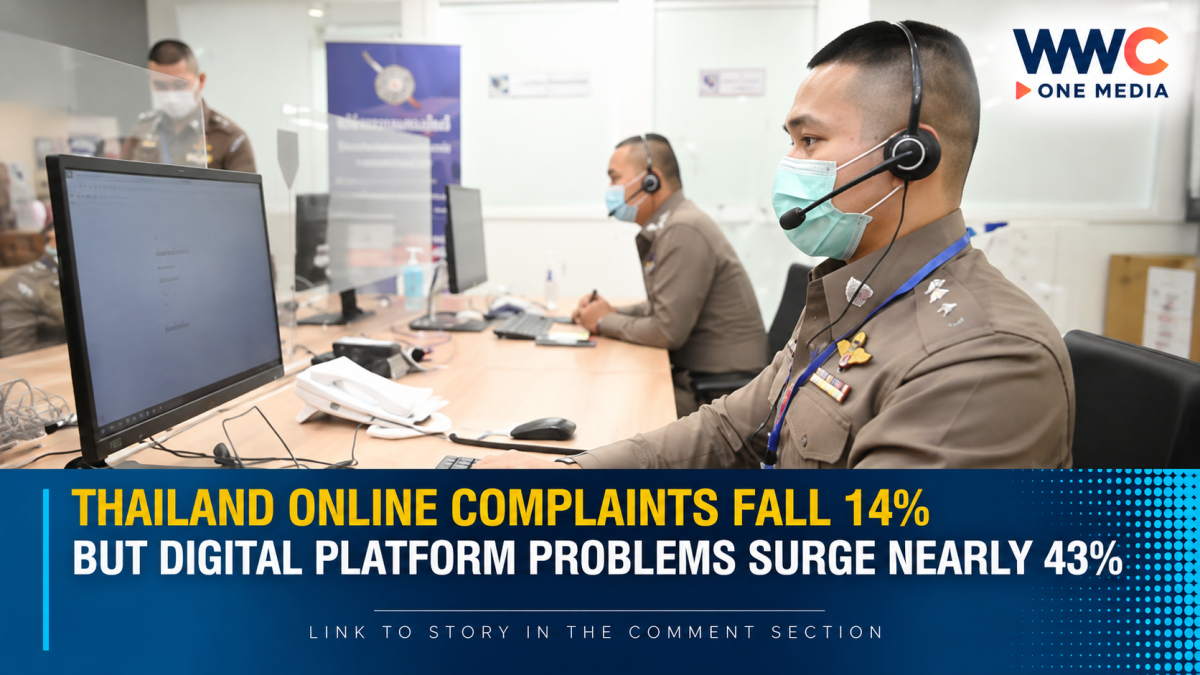
Thailand is seeing a striking shift in online consumer problems, with overall complaints falling sharply while complaints specifically involving digital platforms surged by nearly 43% during the first eight months of 2026.
The Electronic Transactions Development Agency recorded 23,525 online complaints between January and August, down 14.06% from the same period last year.
But complaints directly related to digital platform services moved in the opposite direction.
ETDA received 4,034 platform-related complaints during the first eight months of the year, an increase of 1,212 cases, or 42.95%, compared with the same period in 2025.
The figures suggest that while some traditional online problems may be declining, consumers are increasingly encountering more complicated disputes involving platforms, personal data, unfair business practices and digital services.
Illegal websites were the largest overall category, accounting for 8,309 complaints, or 35.32% of the total.
Online shopping and sales problems ranked second with 7,548 complaints, representing 32.09% of all cases.
Other complaints and enquiries accounted for 2,286 cases, followed by unfair business practices with 2,073 and personal data protection issues with 1,677.
Online shopping remains a persistent problem despite consumers becoming more familiar with digital commerce.
Complaints include customers paying for products that never arrive, receiving goods that do not match advertisements or discovering that products are significantly lower in quality than promised.
The rise of social commerce has also made scams more difficult to identify, as consumers increasingly purchase products through social media accounts, advertisements and informal online sellers.
Artificial intelligence is adding another layer to the problem.
Fraudsters can use AI-generated images, manipulated information and increasingly convincing promotional material to make fake products or sellers appear legitimate.
The technology can make online scams more persuasive while making it harder for consumers to determine whether an advertisement or product listing is genuine.
ETDA’s longer-term data also highlights the growing complexity of platform-related complaints.
From 2023 through 2026, the agency recorded 10,514 complaints specifically involving digital platform services. Of those, 10,488 had been resolved, representing 99.75%.
Personal data protection was the biggest category, accounting for 5,464 complaints, or 51.97%.
Unfair business practices followed with 4,593 cases, or 43.68%, while complaints involving ride-hailing applications accounted for 284 cases.
The figures show that digital-platform disputes are increasingly moving beyond straightforward online shopping scams.
Consumers are also concerned about how platforms collect and use personal information, how fees and terms are presented, and what happens when something goes wrong.
Working-age consumers appear to be particularly exposed.
Gen Y, covering people aged 29 to 44, accounted for 43.2% of complaints in the cumulative data, while Gen X, aged 45 to 60, represented 29.03%.
Together, the two groups accounted for more than 72% of complaints.
Their higher exposure is partly linked to their extensive use of online shopping, financial services, social media and other digital platforms.
However, younger and older consumers are also facing similar risks.
Online shopping problems remain one of the most common complaints across generations, showing that digital fraud and consumer disputes are not limited to a particular age group.
ETDA has warned that several types of online problems require particular attention this year.
One involves sellers advertising attractive agricultural products or seasonal goods online before customers receive products that are poor quality, spoiled or substantially different from the advertised images.
Loan applications are another growing concern.
Some victims have reported receiving money they never requested and subsequently being pressured to repay loans at excessive interest rates, while others face threats involving their personal information.
Illegal online gambling platforms remain another major source of complaints, with victims sometimes transferring money into gambling accounts only to discover that they cannot withdraw their funds.
The growing number of complaints involving digital platforms is also increasing pressure on Thailand’s regulators to make platforms more accountable.
The country has been strengthening its digital-platform regulatory framework, including requirements covering registration, transparency, user protection, complaint handling and risk management.
Authorities are also considering stronger legal measures that could make platforms more directly responsible when failures in screening or risk management contribute to harm.
The issue is becoming increasingly important as more aspects of everyday life move online.
Consumers now rely on platforms not only for shopping, but also for transportation, payments, communications, entertainment and financial services.
A failure on a major platform can therefore affect thousands or even millions of users at once.
For regulators, the challenge is shifting from simply responding to individual complaints to addressing systemic weaknesses in how digital services operate.
Thailand’s latest figures show that progress is being made in resolving complaints, but the sharp increase in platform-related cases suggests that the nature of online consumer risk is changing.
The internet is no longer simply a place where consumers encounter individual scammers.
Increasingly, disputes involve the systems, policies and responsibilities of the platforms themselves.
As Thailand’s digital economy expands, consumers will be looking for stronger protections, clearer rules and faster remedies when something goes wrong.
The message from the latest data is clear: fewer people may be filing online complaints overall, but the problems surrounding digital platforms are becoming more complex — and much harder for regulators to ignore.




Leave a Reply