
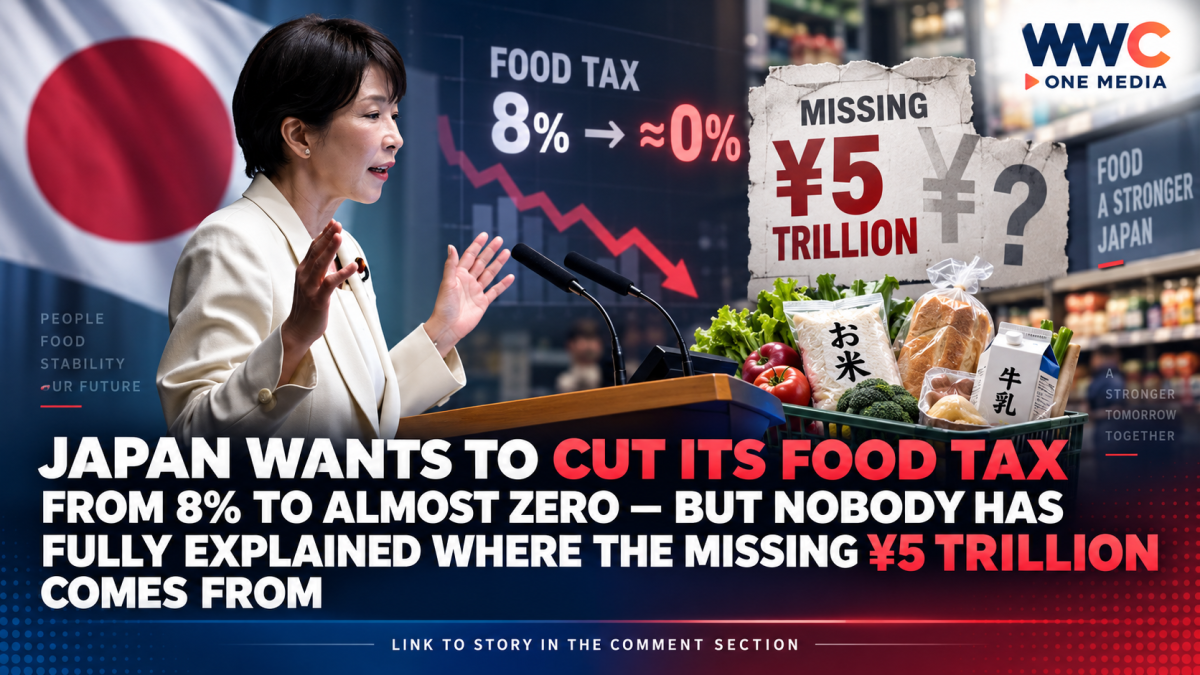
TOKYO — Japan is preparing to give households one of the biggest tax breaks in its modern fiscal history.
But investors are increasingly asking an uncomfortable question:
Where exactly will the money come from?
Prime Minister Sanae Takaichi’s government was expected Tuesday to finalize an outline that would cut the consumption tax on food from the current 8% to just 1% for two years beginning in April 2027. An accompanying payment program would offset the remaining 1% burden for eligible households, effectively bringing the food-tax burden toward zero during the transition.
For families facing higher grocery, energy and living costs, the political appeal is obvious.
For Japan’s bond market, the arithmetic is much less comforting.
The plan is expected to create a revenue shortfall of roughly ¥5 trillion a year — about US$32 billion at current exchange rates.
And while Takaichi has promised not to finance the tax cut through additional deficit-covering bonds, the policy outline does not yet provide a detailed list of spending reductions or new revenues large enough to cover that gap.
That omission is arriving at precisely the wrong moment.
Japan’s benchmark 10-year government-bond yield pushed above 3% on Tuesday, a level that would have been almost unimaginable during the country’s long era of near-zero interest rates.
For a country carrying the largest public-debt burden among major economies, higher borrowing costs turn a politically attractive tax cut into a much bigger fiscal gamble.
What exactly is Japan proposing?
Japan currently imposes a standard 10% consumption tax on most goods and services.
Food and non-alcoholic beverages generally receive a reduced rate of 8%.
Under the emerging Takaichi plan, that 8% food rate would fall to 1% for two years starting in fiscal 2027, which begins next April.
The government also plans a simplified, income-linked cash-benefit mechanism equivalent to the remaining 1%, with the intention of effectively reducing the burden on food purchases to zero during the transitional period.
The tax cut would be temporary.
A fuller income-linked benefits system is planned for fiscal 2029, allowing assistance to be targeted more precisely according to household income rather than permanently maintaining a near-zero food tax.
That design reflects a political compromise.
Tax cuts are immediately visible at checkout counters.
Targeted payments can direct more help toward lower-income households.
Takaichi’s government is trying to do both.
The ¥5 trillion question has not gone away
The problem is that cutting a tax does not eliminate the spending commitments that tax revenue previously supported.
Reuters says the food-tax reduction would leave an approximately ¥5 trillion annual revenue gap.
The government says it intends to cover the cost through a combination of:
- non-tax revenue;
- reviews of government subsidies;
- reductions or changes to special tax breaks; and
- broader spending and revenue reforms.
Japan’s Finance Minister has said the budget process will examine expenditures and revenues “from both sides,” including subsidies, tax expenditures and non-tax income, while trying to keep the debt-to-GDP ratio on a declining path.
That sounds fiscally cautious.
What markets have not yet received is the detailed ledger.
Which subsidies disappear?
Which tax breaks are abolished?
How much will each measure raise?
Will any savings be permanent?
And can lawmakers actually pass them?
Until those numbers exist, investors have little way to verify that the promise of “no new deficit-financing bonds” can survive contact with the final budget.
Local governments could lose another ¥1.6 trillion
There is another layer of complexity.
Japan Times reported that local governments could lose approximately ¥1.6 trillion in consumption-tax revenue because of the reduction. Tokyo is considering compensating them through special central-government grants.
But compensation does not make the fiscal cost disappear.
It largely shifts the problem from local balance sheets onto the national government’s.
That illustrates why the headline phrase “tax cut” understates what policymakers are attempting.
The government must simultaneously reduce the rate paid by consumers, support local authorities losing revenue and establish a new payment mechanism — all while insisting it will not significantly increase borrowing.
Japan’s debt makes the missing details unusually important
Most governments can cut taxes temporarily and finance the difference with additional borrowing.
Japan has much less room for investors to ignore that choice.
The IMF estimates Japan’s gross public debt at roughly 200% of GDP, even after a meaningful post-pandemic decline, and says the ratio remains the highest among major economies.
The IMF expects favorable nominal growth to help the debt ratio decline for several more years.
But it also warns that aging-related health and long-term-care spending, together with higher interest costs, could eventually push debt upward again.
That is why seemingly small changes in interest rates matter enormously.
For years, Japan could maintain extraordinary levels of government debt partly because interest rates were extraordinarily low.
That era is ending.
Japan’s interest bill is already climbing
The Finance Ministry’s fiscal 2026 figures show central-government debt-servicing costs at approximately ¥31.3 trillion, up more than ¥3 trillion from the previous year’s initial budget.
As older, low-yielding government bonds mature and are refinanced at higher rates, that bill can continue rising even if the government does not suddenly increase its debt stock.
This is the basic bond-market problem confronting Takaichi.
A government that wants to spend more on growth, defense and household relief is entering a period when servicing yesterday’s debt is becoming more expensive.
Now it wants to surrender another ¥5 trillion in annual tax revenue.
Investors therefore want more than a promise that the books will eventually balance.
They want to see how.
The 3% bond yield is a warning from a market that used to barely move
Japan’s government-bond market spent much of the last decade under the Bank of Japan’s massive monetary stimulus program.
The BOJ bought enormous quantities of debt and at times explicitly capped yields.
A 3% 10-year JGB yield would have seemed extraordinary only a few years ago.
Reuters noted last month that the benchmark had not reached that territory since the mid-1990s.
Now the threshold has been crossed as investors confront three forces at once:
higher inflation,
the Bank of Japan’s withdrawal from ultra-easy monetary policy,
and anxiety about government borrowing.
That makes fiscal credibility much more valuable than it was during the zero-rate era.
And the Bank of Japan could raise rates again this week
Fiscal policy is not operating in isolation.
A Reuters poll found that 97% of economists surveyed expected the Bank of Japan to raise its policy rate from 1% to 1.25% on September 18.
A majority now expects rates to climb further, with many seeing at least 1.5% by March 2027 and 1.75% by the second quarter.
The reason is persistent inflation and concern about the yen.
Higher rates can support the currency and restrain price pressures.
They also increase financing costs throughout the economy — including for the government.
That creates an awkward policy mix.
Takaichi wants fiscal policy to stimulate growth and protect households.
The BOJ is moving in the opposite direction, tightening monetary conditions to contain inflation.
Even Washington has been pushing Japan toward tighter policy
The pressure has become international.
U.S. Treasury Secretary Scott Bessent has publicly supported more decisive Japanese monetary tightening to stabilize the yen and contain inflation expectations.
Reuters has also reported that Takaichi’s expansionary fiscal approach has drawn criticism from Bessent as bond-market concerns intensified.
That is unusual.
Foreign governments generally avoid becoming deeply involved in another advanced economy’s domestic monetary and fiscal debates.
But the yen’s sharp decline earlier this year became serious enough for the United States and Japan to carry out a rare coordinated currency intervention.
Fiscal expansion that weakens confidence in Japanese assets could complicate that effort.
Takaichi has promised to keep new bond issuance near ¥40 trillion
The prime minister has attempted to reassure markets by promising to hold new government-bond issuance for fiscal 2027 to roughly ¥40 trillion, or around US$259 billion.
The problem is that spending demands are already large.
Budget requests for the coming fiscal year have reached ¥143.1 trillion, roughly comparable with pandemic-era levels.
Economists are uneasy.
In a Reuters poll, 28 of 38 economists who answered a question about the budget said the scale of the requests heightened concern about Japan’s fiscal discipline.
Senior bond strategist Keisuke Tsuruta of Mitsubishi UFJ Morgan Stanley Securities said markets may remain nervous until the final draft budget reveals the true level of debt issuance toward year-end.
In other words, the ¥40 trillion ceiling is a promise.
The December budget will show whether it is achievable.
Fitch is watching the same number investors are
Credit-rating agency Fitch has also said Japan’s fiscal direction will be judged through the final budget.
Senior director Jeremy Zook told Reuters that Fitch is particularly interested in the primary balance — whether government revenues can cover expenditures before interest costs are included.
Fitch currently expects Japan’s debt-to-GDP ratio to decline for several years because stronger nominal economic growth and tax revenues are helping the denominator.
But it says much depends on whether Takaichi’s huge industrial-investment strategy actually produces stronger long-term growth.
Fitch rates Japan A with a stable outlook, well below the top AAA grade.
That does not suggest an immediate fiscal crisis.
It does mean the government cannot assume markets will indefinitely finance every new commitment on favorable terms.
Takaichi is making a much bigger economic bet than one tax cut
The food-tax plan is only one component of the prime minister’s economic program.
Her government wants public and private investment in strategic sectors including artificial intelligence and semiconductors to exceed ¥370 trillion through fiscal 2040.
The political theory is familiar:
Use fiscal policy aggressively enough to raise investment, wages, productivity and nominal growth.
If the economy grows faster, the debt burden becomes easier to manage relative to GDP.
That is why Takaichi describes her approach as both “proactive” and “responsible.”
The danger is timing.
Tax revenue disappears immediately.
Growth benefits from industrial policy may take years to materialize — if they materialize at all.
Interest costs, meanwhile, are already rising.
Japanese businesses like much of Takaichi’s strategy — just not necessarily this part
A Reuters survey conducted by Nikkei Research found 68% of responding Japanese companies broadly supported Takaichi’s economic policies.
Business support was particularly strong for strategic investment in growth sectors.
But among companies that disapproved of her economic agenda, 68% identified the food-tax cut as a policy they opposed.
One chemical-company manager warned that a poorly financed cut could enlarge government debt, weaken the yen, make crude oil more expensive and ultimately recreate the inflation the policy was supposed to relieve.
That is the paradox at the heart of the proposal.
A tax cut designed to fight inflation could, under a worst-case market reaction, contribute to conditions that make imported inflation worse.
How could cutting a grocery tax actually push prices higher?
The chain would look something like this:
Investors become less confident in Japan’s fiscal outlook.
They demand higher yields to own government debt.
The yen comes under renewed pressure.
A weaker yen makes imported oil, natural gas, food ingredients and raw materials more expensive.
Businesses pass some of those costs to consumers.
The original tax saving gets partially swallowed by higher prices.
That outcome is not inevitable.
But it explains why bond and currency traders care so much about how the plan is funded.
Japan imports much of its energy, making the country particularly vulnerable when a weak yen collides with rising global commodity prices.
And oil is again above US$100 amid severe Middle East supply disruptions.
The IMF has already told Japan what kind of relief it prefers
The International Monetary Fund addressed this debate before the plan reached its current form.
In its April assessment of Japan, IMF directors said measures designed to ease the cost of living should ideally be targeted toward vulnerable households, temporary and budget-neutral.
They specifically urged Japan to maintain a credible fiscal framework and keep debt on a firmly declining trajectory.
That does not mean the IMF opposes all tax relief.
It means broad tax cuts are usually more expensive than precisely targeted support.
Someone buying ¥20,000 worth of groceries benefits more from a percentage tax cut than someone buying ¥10,000, regardless of whether the richer household needs government assistance.
Targeted payments can theoretically direct more resources toward those most affected by inflation.
The political downside is that tax cuts are easier for voters to see.
Japan has never cut the consumption tax before
There is another reason this plan is politically significant.
Japan introduced its consumption tax in 1989.
Successive governments subsequently raised it as aging pushed social-security costs higher.
The country has changed reduced rates and introduced exemptions, but the Takaichi proposal would represent the first outright reduction in Japan’s consumption-tax rate.
That makes reversing the measure later potentially difficult.
Politicians routinely describe tax cuts as temporary.
Voters often dislike seeing them expire.
A two-year measure can therefore create political pressure to extend it — turning a temporary ¥5 trillion cost into something much more permanent.
That possibility is another reason debt investors are unlikely to treat the funding question as a minor technical detail.
Takaichi also has the votes to push a major agenda
The prime minister enters this fiscal confrontation from a position of unusual political strength.
Her Liberal Democratic Party won 316 of the 465 seats in February’s lower-house election — its strongest result on record — giving Takaichi a powerful mandate for the tax cuts, investment programs and defense policies she campaigned on.
That strengthens her ability to get legislation through parliament.
But political strength does not repeal bond-market arithmetic.
Governments can vote to spend.
They cannot vote to force investors to accept a particular interest rate.
That may be the real shift happening in Japan
For decades, Japan’s fiscal debate operated under an unusual assumption.
The government could carry enormous debt because inflation was low, domestic savings were abundant and the central bank kept borrowing costs near zero.
That foundation has changed.
Inflation has returned.
The BOJ is raising rates.
The yen has been volatile.
Bond yields have climbed to levels unseen in decades.
Debt interest is becoming materially more expensive.
And investors are demanding clearer evidence that major policy promises are financed rather than simply announced.
The proposed food-tax cut therefore represents more than another cost-of-living measure.
It may be one of the first major tests of how much fiscal freedom Tokyo actually retains in Japan’s new higher-rate world.
The tax cut itself is easy to understand. The financing is not.
For a shopper, the proposal is simple.
A grocery item that currently attracts an 8% tax would face only 1%, with a companion benefit designed to offset that final percentage point.
That is tangible.
A household sees the difference immediately.
The government’s side of the equation is far less visible.
Somewhere, roughly ¥5 trillion a year must still be found.
Takaichi says it will not come from new deficit-financing bonds.
The Finance Ministry says spending, subsidies, tax breaks and non-tax revenue will be reviewed.
But until those promises become line items with actual yen amounts, investors are being asked to trust that the arithmetic works.
And with Japan’s 10-year borrowing cost now above 3%, that trust is becoming more expensive.
The biggest question surrounding Japan’s historic food-tax cut, therefore, is no longer whether consumers would welcome it.
Almost certainly many would.
It is whether Tokyo can prove it can give households ¥5 trillion in relief without quietly passing the bill to the bond market later.




Leave a Reply