
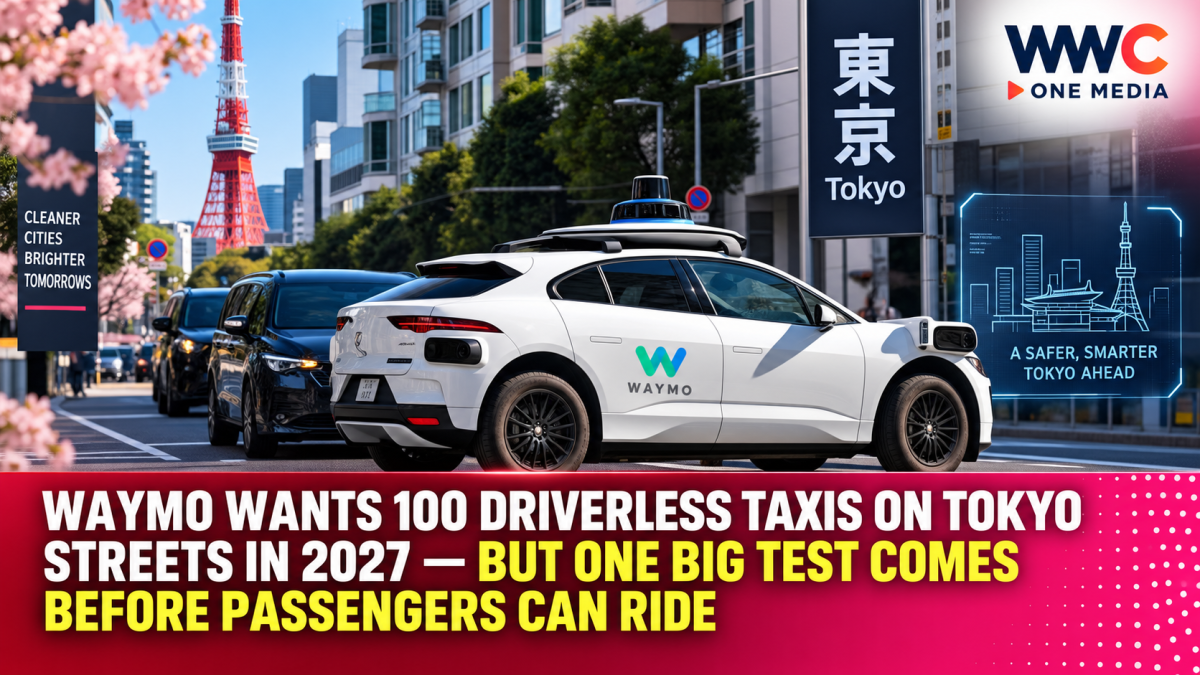
TOKYO — Tokyo’s famously disciplined taxi industry is preparing for a newcomer with one unusual feature:
There may be nobody in the driver’s seat.
Alphabet-owned Waymo has teamed up with Japan’s biggest taxi-app operator GO and major Tokyo taxi company Nihon Kotsu with the goal of launching a fully autonomous commercial taxi service in the Japanese capital during 2027.
And unlike many “robotaxi” trials that still keep a safety driver sitting behind the wheel, the companies say the planned commercial service is intended to be fully unmanned from the start.
The initial fleet would be small, but the partners intend to expand it gradually toward roughly 100 vehicles.
Passengers would eventually be able to summon one through either Japan’s GO app or Waymo’s own ride-hailing application.
If the plan reaches commercial operation as intended, the three companies say it would become Japan’s first fully unmanned Level 4 commercial taxi service.
But the word that matters most is “if.”
The partners have not announced a precise launch date, final operating zone or fare structure.
And the cars cannot begin carrying paying passengers without drivers until authorities are satisfied that the technology is safe and the necessary approvals under Japan’s road-traffic and passenger-transport laws have been secured.
This is no longer just an experiment
Waymo’s Tokyo story began much more cautiously.
In December 2024, the company announced that Japan would become its first international testing destination, describing the project as a “road trip” rather than a commercial launch.
The first all-electric Jaguar I-PACE vehicles arrived in 2025.
Initially, trained Nihon Kotsu drivers manually drove them around central Tokyo so Waymo could gather information about road layouts, traffic behavior and local driving conditions.
Those early drives focused on seven wards:
Minato, Shinjuku, Shibuya, Chiyoda, Chuo, Shinagawa and Koto.
That phase mattered because Tokyo presents a very different driving environment from Phoenix, Los Angeles or San Francisco.
Japanese vehicles travel on the left.
Local roads can be extremely narrow.
Cyclists, pedestrians, taxis, delivery vehicles and buses frequently occupy the same tight spaces.
Lane markings, traffic signs and parking behavior differ from the United States.
Waymo therefore could not simply import a U.S.-trained system and assume it would behave correctly in Tokyo.
The cars are already driving themselves — but humans are still there
The project has since moved beyond manual mapping.
Waymo says its vehicles are now operating autonomously on Tokyo roads while trained Nihon Kotsu personnel remain behind the wheel as the system is validated and refined.
The company said in March that its autonomous-driving system was learning from everything from Tokyo’s large arterial roads to narrow neighborhood streets.
Waymo Chief Product Officer Saswat Panigrahi said the company was adapting technology built through extensive U.S. operations to the “nuances of Tokyo’s streets.”
The September agreement effectively marks the next step:
Move from testing an autonomous vehicle with a human backup driver toward letting paying passengers ride with no driver in the vehicle at all.
That is a much bigger threshold.
Waymo isn’t trying to replace the Japanese taxi industry from the outside
The structure of the partnership is particularly revealing.
Waymo is supplying the autonomous-driving technology and operational know-how.
Nihon Kotsu will manage local taxi operations and facilities.
GO will integrate the service with Japan’s existing taxi ecosystem and allow customers to book vehicles through its app.
That model is very different from a Silicon Valley company simply arriving in Japan and attempting to build an entirely separate taxi network.
GO says it will act as the bridge between Waymo and local taxi operators, while Nihon Kotsu will provide the operational expertise required to run a regulated taxi business in Tokyo.
For Waymo, that local knowledge could be essential.
Japan’s taxi industry is heavily regulated, and a commercial autonomous service must operate within rules governing both vehicles and passenger transport.
The technology may be American.
The taxi operation will still have to work like a Japanese transportation business.
Why Japan actually wants robotaxis
There is another reason government officials and taxi operators are taking autonomous driving seriously:
Japan is running short of drivers.
The country’s transport ministry says the number of taxi drivers fell by roughly 50,000 between fiscal 2019 and fiscal 2022.
Although employment subsequently began recovering, the ministry continues to describe securing enough bus and taxi drivers as an urgent problem for maintaining transportation for residents and tourists.
The long-term demographic pressures are even harder to escape.
Japan’s population is shrinking and aging, while transportation demand is becoming more complicated as the country receives large numbers of foreign tourists and needs mobility services for an increasingly elderly population.
Japan’s Ministry of Finance has specifically identified robotaxis as one potential response to declining and aging taxi-driver numbers.
That is why Nihon Kotsu’s messaging about Waymo has generally emphasized supplementing a future shortage of human drivers, rather than portraying autonomous vehicles as a campaign to eliminate current taxi jobs.
For Japan, the robotaxi debate therefore looks somewhat different from markets where the technology is discussed primarily as a labor-displacement threat.
The argument in Tokyo is increasingly that there may simply not be enough human drivers to meet future demand.
But Japan already has Level 4 vehicles — so what would Waymo actually be first at?
This is an important distinction.
A headline saying Waymo will bring “Japan’s first driverless vehicle” would be wrong.
Japan has already authorized Level 4 autonomous transportation.
In March 2023, the transport ministry approved a vehicle operating in Eiheiji, Fukui Prefecture, as the country’s first Level 4 vehicle that did not require a driver onboard or remotely under its defined operating conditions.
Japan also changed its Road Traffic Act to establish a legal permission framework for specified automated operation, effectively allowing SAE Level 4 driving without a human driver when conditions and permissions are satisfied. Those provisions took effect in April 2023.
What Waymo, GO and Nihon Kotsu are targeting is more specific:
Japan’s first fully unmanned Level 4 commercial taxi operation in a major metropolitan market.
That distinction matters because navigating a limited autonomous shuttle route and operating a taxi through Tokyo traffic are very different technical and commercial challenges.
What does Level 4 actually mean?
Level 4 autonomy does not necessarily mean a vehicle can drive absolutely anywhere, under every road and weather condition, with zero restrictions.
Instead, the system performs the entire driving task itself within a defined operating environment.
Inside those conditions, a human driver is not required to intervene.
That is fundamentally different from many consumer “self-driving” or advanced driver-assistance systems, which still require a licensed person to supervise the road and remain responsible for taking control.
Japan created its driverless-operation regulatory framework specifically to make services without a human driver legally possible when regulators approve their operating conditions.
For Tokyo, the crucial questions will therefore include where the Waymo vehicles may operate, under what weather and road conditions, and what happens if a vehicle encounters a situation it cannot safely resolve.
Those details have not yet been publicly finalized.
Tokyo could become Waymo’s biggest international test yet
The Japanese launch matters strategically for Waymo because Tokyo is not simply another U.S. expansion city.
It is proof of whether Waymo’s autonomous-driving system can be transferred successfully into a fundamentally different transportation culture.
Waymo’s first Tokyo announcement specifically cited the need to adapt to left-hand traffic and one of the world’s densest urban environments.
By March 2026, the company said its systems had accumulated more than 300 million autonomous kilometers on U.S. public roads and that it was already providing roughly half a million autonomous trips a week across its American operations. Those figures are company-reported.
Waymo has since continued a rapid expansion across the United States and announced additional markets.
Reuters reported this week that it is also moving into Las Vegas, part of a broader race involving Waymo, Amazon-owned Zoox, Tesla and other autonomous-driving developers.
Tokyo therefore represents more than a new city.
If a system trained and commercialized largely in the United States can operate safely in the Japanese capital, Waymo gains a much stronger argument that its technology can scale internationally.
But Waymo will not have Tokyo to itself
The race is already getting crowded.
Earlier this year, Nissan, Uber and British autonomous-driving company Wayve announced their own Tokyo robotaxi partnership.
Their plan calls for Nissan Leaf electric vehicles equipped with Wayve’s AI driving system to become available through Uber.
A pilot is targeted for late 2026.
There is one major difference.
The Nissan-Wayve-Uber pilot is initially expected to operate with a trained safety operator inside the vehicle.
Waymo, GO and Nihon Kotsu are targeting a commercial service in which no human driver is present.
That means Nissan’s group could put passengers into AI-driven taxis earlier while Waymo could still claim the more significant milestone if it becomes the first to remove the driver entirely in commercial operation.
The two projects also demonstrate how quickly Tokyo has become a proving ground for competing autonomous-driving philosophies.
Waymo relies heavily on a sophisticated sensor suite and years of experience operating geofenced autonomous fleets.
Wayve has promoted an AI-first approach designed to generalize across different cities without relying on the same level of high-definition mapping.
Tokyo may eventually become one of the first places where those approaches compete in the same market.
The cars may also change
Waymo’s existing Tokyo test fleet uses modified Jaguar I-PACE electric SUVs.
The companies have not yet publicly specified exactly which vehicle platform will make up the eventual 100-car commercial fleet.
That is worth watching because Waymo is transitioning beyond the Jaguar platform as it expands internationally.
What has been announced so far is the service model and fleet target—not the final vehicle specification for every Tokyo robotaxi.
The 100-car number sounds large, but Tokyo is enormous
A fleet of around 100 driverless taxis would be highly visible symbolically.
Operationally, however, it would still be tiny relative to the scale of Tokyo transportation.
That is why the partners describe the expansion as gradual.
The service is expected to begin with a limited number of vehicles, validate operations in real-world commercial conditions and then increase toward the 100-unit level.
Waymo co-CEO Tekedra Mawakana told Reuters that the intention is for the commercial service to begin without drivers and eventually serve a broader part of Tokyo as the operation expands.
The initial commercial geography has not been formally announced.
So it would be premature to assume that a passenger anywhere in metropolitan Tokyo will be able to open GO in 2027 and immediately request a Waymo.
The seven wards currently used for testing provide a clue to where the company has concentrated its learning, but they are not yet an officially announced commercial service map.
Regulation may be a bigger obstacle than building the car
Japan has deliberately created laws to enable Level 4 autonomy.
That does not mean approval is automatic.
Driverless operators must satisfy requirements covering vehicle safety, automated-operation permissions and commercial passenger transport.
Tokyo itself has also established autonomous-driving promotion zones intended to streamline government procedures, coordinate stakeholders and support areas where Level 4 deployment is expected relatively soon.
The environment is therefore broadly supportive.
But Waymo’s partners explicitly say the actual start of service will be determined only after safety is confirmed and all required approvals are completed.
That makes 2027 a target rather than a guaranteed opening date.
A serious test incident, regulatory delay or unresolved operating issue could still change the timetable.
Safety will decide whether Tokyo accepts the idea
Japan’s taxi culture creates another challenge that may be less technical but just as important.
Japanese taxis have long been associated with professional drivers, clean vehicles, automatic doors and highly structured customer service.
A robotaxi must convince riders that removing the professional driver makes the experience at least as safe—not merely more technologically impressive.
Waymo has repeatedly highlighted its U.S. safety record, including company analyses that it says show significantly fewer serious crashes than human benchmarks.
But those results are based largely on U.S. operating environments.
Tokyo regulators and passengers will ultimately care about what happens in Tokyo.
A system that performs well on wide roads in Phoenix must still prove that it can handle bicycles emerging from side streets, pedestrians near stations, narrow lanes, unusual construction zones and the highly localized etiquette of Japanese traffic.
That is precisely why the company has spent more than a year collecting and validating data before committing publicly to a commercial target.
And there is another question: What happens when the taxi needs a human?
Removing the driver does not mean removing humans from the business.
Autonomous fleets still require maintenance, cleaning, charging, dispatch oversight, customer support and systems for responding when a vehicle encounters an unusual situation.
Nihon Kotsu is expected to provide much of the local operational infrastructure, while Waymo will supply its autonomous-driving platform, fleet-management tools and specialist knowledge.
This may ultimately be one of the most consequential features of the Tokyo model.
Instead of autonomous vehicles replacing the taxi operator, the taxi operator becomes the company that manages the autonomous fleet.
That could offer a blueprint for other Japanese operators facing labor shortages:
Technology handles more of the driving.
Existing transportation businesses continue handling the service.
The real test begins after the safety driver gets out
For now, Tokyo residents may spot white Waymo Jaguars navigating the capital with a trained person still sitting behind the wheel.
That phase is deliberately reassuring.
Someone is there.
Someone can intervene.
Someone can explain what is happening.
The commercial model planned for 2027 removes that final psychological safety net.
A passenger will open an app.
A car will arrive.
The door will open.
And the seat traditionally occupied by the person responsible for getting them across Tokyo will be empty.
That is why Waymo’s next milestone is not really putting autonomous cars on Japanese roads.
It has already done that.
The milestone is persuading regulators—and then ordinary passengers—that Tokyo traffic can be handled safely when nobody is sitting behind the wheel at all.
And for one of the world’s most complex, crowded and exacting transportation markets, that may be the most important test Waymo has attempted outside the United States.




Leave a Reply