
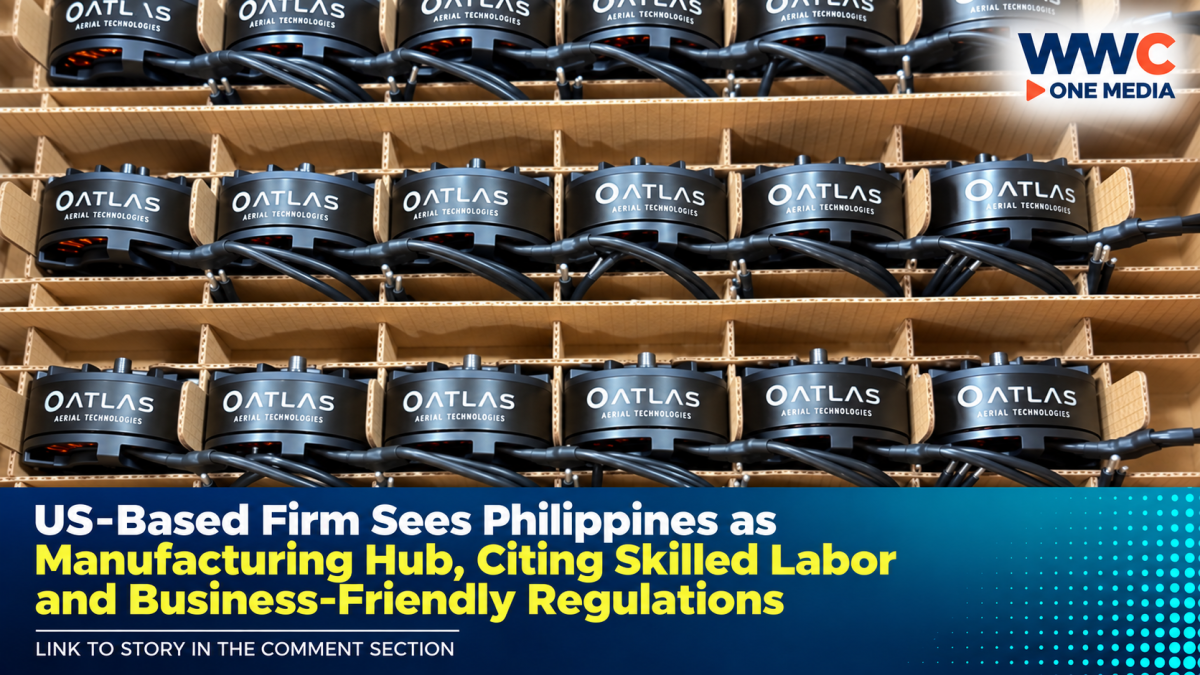
MANILA — The Philippines is drawing renewed attention as a potential manufacturing destination, with a US-based company pointing to the country’s qualified workforce and supportive regulatory environment as key advantages for businesses considering production operations.
The assessment highlights an increasingly important question for investors: can the Philippines turn its large pool of workers and improving investment framework into a stronger position in global manufacturing?
According to the Philippine News Agency, the company cited the availability of qualified labor and supportive government regulations among the factors that make the Philippines attractive for manufacturing.
Skilled Filipino workers remain a major advantage
The Philippines has long been recognized for its large and adaptable workforce. While the country’s international reputation has traditionally been strongest in business-process outsourcing and services, policymakers have increasingly sought to expand its role in advanced manufacturing, electronics, semiconductors and other higher-value industries.
Labor regulations also provide a formal framework covering wages, working hours, overtime, benefits, workplace safety and other employee protections. Companies operating locally therefore have to balance competitiveness with compliance under Philippine labor laws.
For foreign companies, that regulatory framework can provide greater predictability when establishing a local operation — provided they properly comply with Philippine employment requirements.
Regulation is becoming part of the investment conversation
The country’s labor and trade rules have gained additional attention amid international scrutiny of supply chains.
In 2026, the Philippine government defended its record on forced-labor safeguards after the United States raised concerns about the country’s enforcement framework. Manila argued that Philippine exporters have established compliance mechanisms and that local manufacturers exporting to the US have demonstrated the ability to provide documentation showing compliance with American requirements.
The issue is significant because access to major export markets increasingly depends not only on production costs but also on traceability, labor standards and supply-chain compliance.
The Philippines has also moved to strengthen its response. Recent government measures have included tighter rules concerning imports connected to forced labor, reflecting growing pressure on manufacturers to demonstrate responsible sourcing.
Manufacturing faces a bigger regional race
The opportunity comes as Southeast Asian economies compete aggressively for new factories and supply-chain investments.
Countries including Thailand, Vietnam, Malaysia and Indonesia have been attracting major investments in areas such as electronics, electric vehicles, batteries and automotive components. Thailand, for example, reported billions of dollars in commitments across its EV supply chain in 2026, illustrating the scale of competition for manufacturing projects in the region.
That means the Philippines cannot rely on labor availability alone.
Investors are increasingly weighing infrastructure, electricity costs, logistics, regulations, skills, incentives, supply-chain depth and access to export markets when choosing where to locate production.
The Philippines’ next manufacturing test
For the Philippines, the challenge is to transform its workforce advantage into sustained industrial growth.
A strong labor pool can attract companies, but long-term manufacturing competitiveness requires reliable infrastructure, efficient logistics, predictable regulations and a supply network capable of supporting increasingly sophisticated production.
The country’s position is also evolving beyond traditional low-cost manufacturing. Electronics and semiconductor-related activities already form an important part of Philippine exports, while government policy has increasingly emphasized attracting investments that generate higher-value jobs and strengthen domestic supply chains.
The latest assessment from the US-based firm therefore comes at a crucial time.
The Philippines may have the workers and regulatory framework investors are looking for — but whether those advantages are enough to win the next generation of factories will depend on how quickly the country can close its remaining competitiveness gaps.




Leave a Reply