
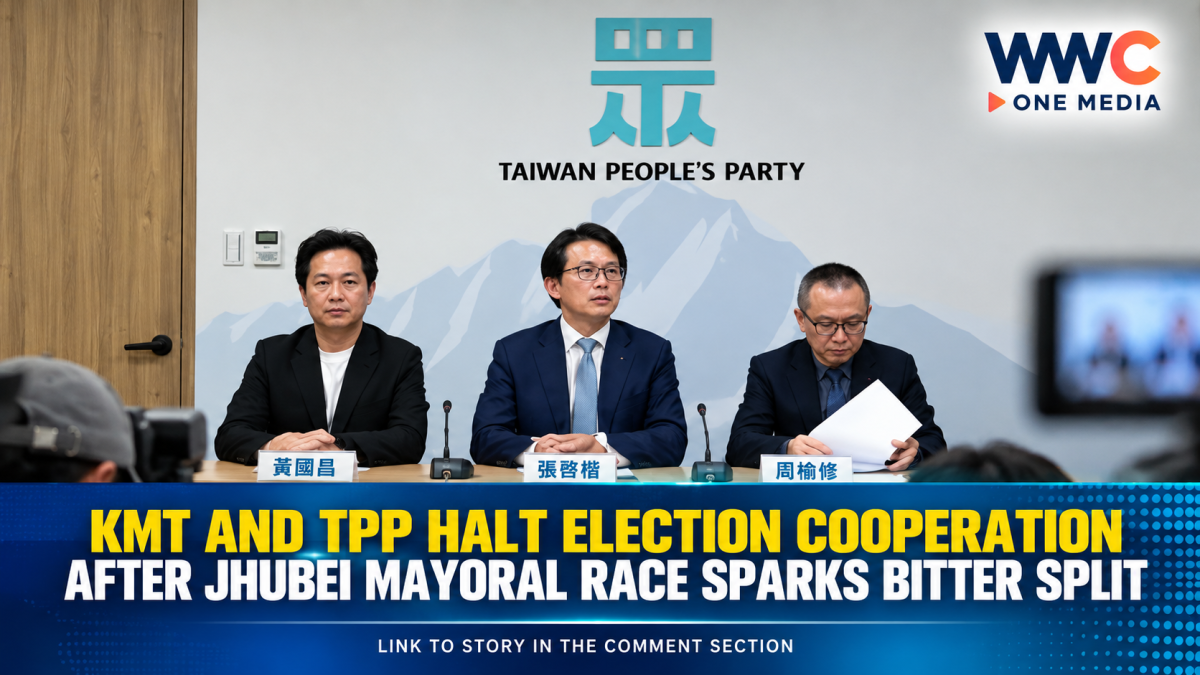
HSINCHU, Taiwan — Taiwan’s opposition alliance has suffered a major setback after the Taiwan People’s Party (TPP) announced it was suspending all electoral cooperation with the Chinese Nationalist Party (KMT) in Hsinchu County, following a bitter dispute over the Jhubei City mayoral race.
The split erupted after both parties refused to step aside for the other’s preferred candidate, raising fresh questions about whether the opposition’s broader electoral alliance can survive ahead of Taiwan’s Nov. 28 local elections.
The TPP announced the decision after the KMT’s Wu Hsu-chih and the TPP’s Chiu Chen-yuan both formally registered as candidates for Jhubei mayor.
The two opposition candidates are set to face Democratic Progressive Party candidate Tseng Sheng-kai, potentially dividing the opposition vote in one of Taiwan’s fastest-growing political battlegrounds.
TPP Suspends All Cooperation With KMT in Hsinchu County
The TPP’s Central Committee passed a resolution to halt electoral cooperation with the KMT across all races in Hsinchu County after party leaders accused their larger opposition partner of breaking promises.
TPP Chairman Huang Kuo-chang publicly accused the KMT and its Hsinchu County magistrate candidate, Hsu Hsin-ying, of going back on their word and then misleading the public about what had been agreed.
TPP Secretary-General Chou Yu-hsiu said the dispute had seriously damaged the foundation of trust built between the two parties over the past two years.
The party also ordered members to unite behind Chiu in the Jhubei race, warning that members who publicly support rival candidates could face disciplinary action, including possible expulsion.
Jhubei Race Exposes Cracks in Opposition Alliance
The conflict centers on a simple but politically explosive question: Who should step aside?
The KMT and TPP had previously discussed coordinating candidates to avoid splitting opposition votes in Taiwan’s 2026 local elections.
However, no agreement was reached over the Jhubei mayoral race.
KMT candidate Wu initially attempted to downplay the dispute, saying cooperation remained possible.
But tensions escalated after Hsu said the parties had never reached an agreement on which candidate should defer to the other and that the TPP had never formally committed to supporting a primary.
Those remarks triggered a fierce response from the TPP leadership.
By the following day, what began as a local candidate dispute had turned into a complete suspension of election cooperation between the two parties in Hsinchu County.
Why Hsinchu Has Become a Major Political Battleground
The dispute is particularly significant because Hsinchu County and Jhubei City have become increasingly important political and economic centers.
Their rapid growth has been fueled by their proximity to the Hsinchu Science Park, one of Taiwan’s most important technology hubs.
The region’s expanding population and economic influence have made local elections increasingly competitive.
That means a split opposition vote could have consequences far beyond Jhubei.
The race is now being closely watched as an early test of whether the KMT and TPP can maintain their broader political cooperation ahead of the Nov. 28 elections.
KMT and TPP Still Have a Broader Election Deal
The Jhubei dispute does not automatically mean the entire KMT-TPP partnership across Taiwan has collapsed.
In March, the two parties reached an agreement to coordinate candidates and cooperate on policy positions for the 2026 local elections.
Under that arrangement, the TPP agreed to support KMT candidates in several key races, including:
- New Taipei City
- Taichung
- Tainan
- Kaohsiung
- Yilan County
Meanwhile, the KMT agreed to support the TPP candidate in Chiayi City.
The parties also reached separate arrangements involving independent candidates in Chiayi County and Hsinchu City.
But the breakdown in Hsinchu County shows just how fragile those agreements can become when both parties believe they have a realistic chance of winning the same race.
A Test for Taiwan’s Opposition Before the 2026 Elections
Taiwan’s local elections are scheduled for Nov. 28, 2026, and will be closely watched as a major political test for the country’s leading parties.
For the KMT, cooperation with the TPP could help consolidate opposition support in competitive races.
For the smaller TPP, however, maintaining its own political identity and securing winnable positions remains equally important.
That creates an unavoidable tension.
The KMT needs unity.
The TPP needs visibility and political growth.
And in Jhubei, those two goals have collided.
What Happens Next?
The immediate question is whether the KMT and TPP can repair their relationship in Hsinchu County before the election campaign intensifies.
The larger question is even more important:
If the two parties cannot agree on who should run in a single city, can they maintain a nationwide strategy across Taiwan’s highly competitive local elections?
For now, the Jhubei dispute has delivered a serious blow to opposition unity.
What was supposed to be a coordinated political partnership has instead produced two candidates, a public war of words and a suspension of cooperation.
And with Taiwan’s Nov. 28 elections approaching, the battle in Jhubei could become an early warning sign of much bigger problems ahead for the KMT-TPP alliance.
WWC ONE MEDIA J.M.D


Leave a Reply