
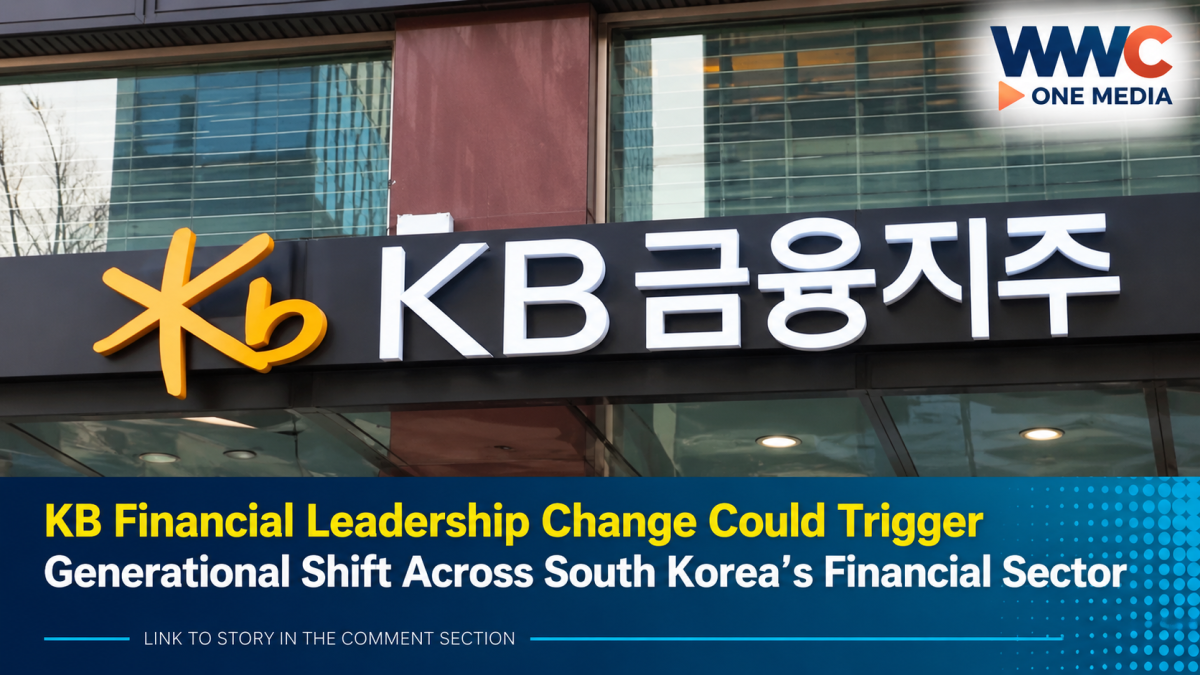
SEOUL — A surprise leadership decision at KB Financial Group could become the first move in a much broader generational shake-up across South Korea’s financial industry.
KB Financial’s chairman recommendation committee selected Lee Jae-keun, the group’s vice chairman and head of its global, wealth-management and small- and medium-sized enterprise businesses, as its candidate for the next chairman. The decision came despite strong expectations that incumbent Chairman Yang Jong-hee would receive another term.
Lee’s appointment is scheduled to be finalized at an extraordinary shareholders meeting on November 20, when Yang’s current three-year term expires.
Why KB’s decision is causing waves
The decision is significant because Yang’s tenure has coincided with exceptionally strong financial performance.
KB Financial became the first South Korean financial holding company to record more than 5 trillion won in annual net profit in 2024, and the group is on track to surpass 6 trillion won this year, according to The Korea Times.
That makes the choice of Lee over the sitting chairman particularly notable.
KB’s succession committee said Lee was chosen to lead a “bold transformation and generational shift”, with the aim of strengthening the group’s competitiveness and finding new sources of growth.
The decision therefore appears to be less about correcting a financial crisis and more about preparing KB for the next phase of competition.
Lee brings more than three decades of KB experience
Lee, 60, is hardly an outsider.
He joined Housing & Commercial Bank, a predecessor of KB Kookmin Bank, in 1993 and has spent more than three decades working across finance, strategy, banking, global operations and wealth management.
He previously served as chief executive of KB Kookmin Bank and became the industry’s youngest bank chief in 2022.
During his time as bank CEO, he helped reshape the bank’s earnings structure and laid the groundwork for its record net income in 2025. He subsequently moved to KB Financial’s holding company, where he took responsibility for global operations, wealth management and SME finance.
His selection therefore represents a change in leadership without abandoning KB’s deep internal experience.
The bigger issue: Will other banks follow?
That is where the KB decision could become much more consequential.
South Korea’s major financial holding companies have been under increasing scrutiny over how their chairmen are selected and how long they remain in office.
Financial authorities have been pushing for greater transparency in succession procedures and measures aimed at discouraging excessively long leadership tenures.
Against that backdrop, KB’s decision not to extend its incumbent chairman could influence how other financial groups approach their own succession planning.
Recent leadership decisions at Hana Financial, Shinhan Financial and Woori Financial have already demonstrated the importance of chairman succession in the country’s banking sector. The Korea Times noted that all three saw their incumbent chairmen reappointed earlier this year.
KB’s move could therefore provide a contrasting model: prioritize a leadership transition even when the incumbent is delivering strong financial results.
A leadership reset could reach subsidiary companies
The potential shake-up may not stop at KB Financial’s top position.
Industry officials cited by The Korea Times expect Lee’s arrival to trigger a broader management overhaul across KB’s subsidiaries.
Several senior executives at the holding company are also approaching the end of their terms, increasing the possibility of significant personnel changes during the year-end executive reshuffle. Seoul Economic Daily reported that 19 holding-company executives have terms expiring at the end of 2026.
That could give Lee an opportunity to reshape the group’s senior management structure as he prepares to take over.
Lee signals a different approach to growth
Lee’s early comments suggest that simply remaining South Korea’s largest financial group will not be enough.
Speaking to reporters on his first day as chairman nominee, Lee questioned what being No. 1 in the domestic financial industry means if the group fails to create new standards and compete globally. He emphasized the need to respond to artificial intelligence, digital transformation and the growing importance of capital markets.
He has also emphasized capability rather than age when discussing organizational change, suggesting that any leadership renewal will not necessarily be based simply on replacing older executives with younger ones.
That distinction matters.
The emerging shift is less about age alone and more about whether financial institutions can adapt quickly enough to technological, regulatory and competitive changes.
Why the timing matters for Korean finance
South Korea’s financial groups are entering a period of intense transformation.
Traditional banking remains central to their businesses, but competition is increasingly extending into wealth management, insurance, brokerage, digital finance, overseas markets and technology.
AI is also beginning to reshape how financial companies approach customer service, risk management and internal operations.
Lee’s background across both banking and nonbanking businesses makes him particularly suited to that environment, according to KB’s recommendation committee.
But expectations will be high.
KB is not entering this transition from a position of weakness. It is changing leadership while reporting record-level earnings.
That means Lee will have to demonstrate that the promised “generational shift” can produce new growth without sacrificing the financial strength that made KB Korea’s leading financial group in the first place.
One chairman change could become an industry signal
Lee’s selection is still subject to shareholder approval, so the leadership transition is not formally complete.
But the message from KB Financial is already clear: strong past performance does not automatically guarantee continuity at the top.
If other Korean financial groups adopt a similar approach, the KB decision could become the opening chapter of a much broader leadership transformation across South Korea’s banking and financial sector.
And that may ultimately prove more important than the change at KB itself.




Leave a Reply