
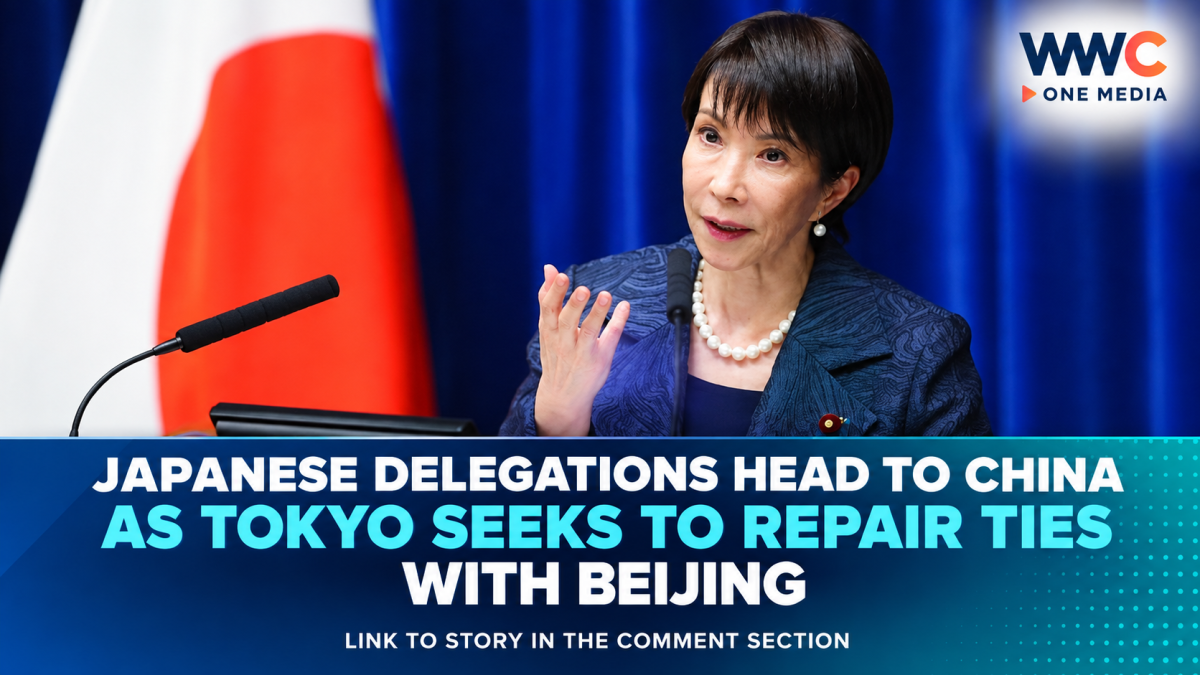
A growing stream of Japanese lawmakers, business leaders and other delegations is heading to China in an effort to reopen dialogue after relations between the two Asian powers deteriorated sharply.
The renewed exchanges suggest that influential groups in Japan are looking for ways to stabilise ties with Beijing even as Prime Minister Sanae Takaichi’s government remains at the centre of a diplomatic dispute over Taiwan.
Several Japanese political and business delegations have already travelled to China or are preparing visits, raising hopes that communication channels can be restored. But any broader thaw is likely to depend heavily on whether Takaichi and Beijing can resolve their fundamental disagreement over Japan’s position on Taiwan.
Lawmakers try to reopen dialogue
Japanese lawmakers travelled to Beijing in August in an effort to ease tensions, marking one of the clearest attempts by political figures in Tokyo to repair the relationship.
The delegation included members of Takaichi’s Liberal Democratic Party as well as opposition parties, reflecting concern across Japan’s political spectrum about the consequences of prolonged confrontation with China.
The visit produced heated exchanges, however, with Chinese officials making clear that Beijing considers Takaichi’s comments about a possible Taiwan conflict to be at the heart of the dispute.
Another delegation led by former Foreign Minister Takeshi Iwaya is expected to visit China later in September, while additional exchanges involving Japanese business groups are also being considered.
Taiwan remains the biggest obstacle
The deterioration in relations stems largely from remarks Takaichi made about a potential conflict over Taiwan.
She suggested that a Chinese military attack on Taiwan could create a situation in which Japan might consider exercising its right to collective self-defence.
Beijing reacted angrily, arguing that the comments crossed a major diplomatic red line and interfered in what China considers an internal matter.
China has repeatedly demanded that Takaichi retract the remarks. Tokyo, however, has maintained that Japan’s fundamental position on Taiwan has not changed.
That disagreement has made it difficult to achieve a full diplomatic reset.
Beijing has not shut the door completely
Despite its anger towards Takaichi’s government, Beijing has continued to receive Japanese visitors and engage with political and business groups.
That distinction is important.
China appears willing to maintain people-to-people and economic exchanges while making clear that it expects Tokyo to address what it considers the root cause of the deterioration.
Chinese officials have indicated that the problem is not contact between the two countries itself but the policies and statements of the current Japanese government.
The continued exchanges therefore offer a possible pathway towards stabilisation without necessarily representing an immediate political breakthrough.
Japanese businesses have strong reasons to restore ties
Japan’s business community has particularly strong incentives to prevent relations with China from deteriorating further.
China remains a major market and manufacturing hub for Japanese companies, while Japanese firms depend on Chinese suppliers and consumers across a wide range of industries.
The recent tensions have already spilled into trade and travel.
Chinese restrictions and warnings affecting Japanese products, tourism and other exchanges have created additional uncertainty for companies operating between the two countries.
Rare-earth supplies have also become a sensitive issue because of China’s dominant position in the global market and the importance of rare-earth materials to Japanese manufacturing and high-technology industries.
Tokyo faces a difficult balancing act
Japan cannot easily separate its economic relationship with China from its growing security partnership with the United States.
Tokyo views China’s military expansion and activities around Taiwan and the East China Sea as major security concerns.
At the same time, Japan does not want its relationship with its largest Asian neighbour to deteriorate into a prolonged confrontation that damages trade and regional stability.
That has produced a two-track approach: strengthening Japan’s security position while keeping diplomatic and economic channels with Beijing open. Analysts have described this as an increasingly important strategy for Tokyo.
China is watching Takaichi closely
The success of the diplomatic outreach may ultimately depend on Takaichi herself.
Beijing has made clear that it wants Tokyo to revise or clarify its position on Taiwan before relations can return to normal.
Takaichi has so far resisted calls to retract her remarks, while continuing to insist that Japan’s established position has not fundamentally changed.
That leaves Japanese delegations trying to accomplish something difficult: rebuilding practical cooperation without resolving the political dispute that caused the crisis in the first place.
Regional tensions add urgency
The dispute comes as military tensions around Taiwan and the wider East China Sea remain high.
Japan has been strengthening its defence capabilities, particularly across its southwestern islands, while China has increased military activity around Taiwan.
Okinawa’s strategic importance has also grown following the recent victory of Takaichi-backed candidate Genta Koja in the prefectural election. His victory is expected to give Tokyo greater freedom to expand its military presence in the region.
For Beijing, these developments reinforce concerns about Japan’s evolving security posture.
For Tokyo, they underline the need to maintain communication with China even while preparing for possible regional crises.
A thaw is possible, but far from guaranteed
The growing number of Japanese delegations travelling to China is an encouraging sign for bilateral relations, but it should not be mistaken for a full diplomatic thaw.
The visits demonstrate that there are still political, economic and social forces in Japan that want to keep engagement with Beijing alive.
But the central disagreement over Taiwan remains unresolved.
As long as Beijing continues to demand changes from Takaichi and Tokyo refuses to retreat from its security position, relations are likely to remain fragile.
The coming months could therefore determine whether the current wave of Japanese visits becomes the beginning of a genuine reset or simply a temporary effort to prevent an already difficult relationship from deteriorating further.
For now, the message from Tokyo’s political and business communities appears clear: Japan and China may disagree sharply on security, but neither side can easily afford to stop talking.




Leave a Reply