
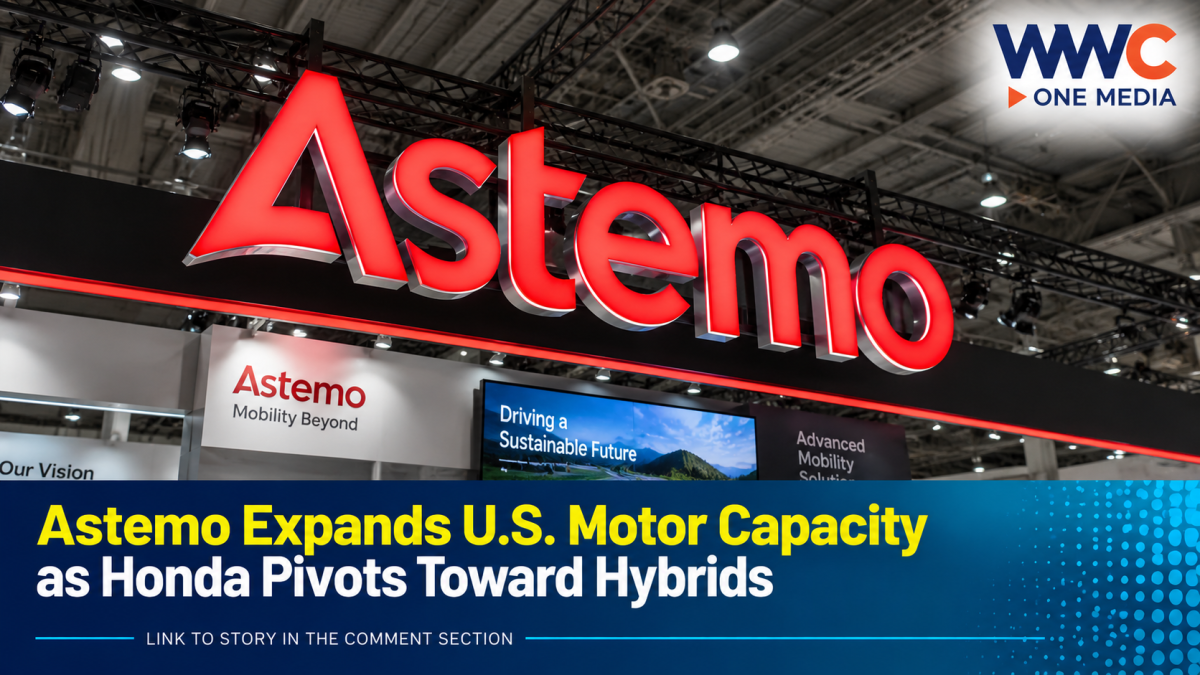
TOKYO — Japanese auto-parts supplier Astemo is preparing to increase its motor-production capacity in the United States as its major customer Honda Motor shifts more aggressively toward hybrid vehicles in the North American market.
The move highlights a broader change in Honda’s electrification strategy. Rather than relying as heavily on battery-electric vehicles in the near term, the automaker is putting greater resources behind hybrids as it responds to market demand, production economics and the slower-than-expected growth of EVs.
Honda has said it plans to introduce 15 new hybrid models globally by 2030, with North America a particularly important market for the next phase of its strategy.
Astemo prepares for stronger U.S. hybrid demand
Astemo, a major Japanese automotive supplier, produces components and systems used by automakers including Honda.
The company’s expected U.S. capacity expansion comes as Honda prepares to manufacture more hybrid vehicles locally. Honda has announced plans to make its North American plants capable of producing hybrid vehicles and to redirect excess capacity at its Ohio factories toward gasoline-powered and hybrid models.
That creates a direct opportunity for suppliers such as Astemo, particularly in components associated with electrified powertrains.
The shift also illustrates how the transition away from conventional gasoline vehicles is not necessarily moving in a straight line toward battery-electric cars. Hybrids—combining an internal-combustion engine with electric propulsion—are increasingly being used by automakers as an intermediate technology while EV adoption develops.
Honda is betting heavily on next-generation hybrids
Honda announced in May that it would invest 4.4 trillion yen (about $27.8 billion) over the next three years in new gasoline and hybrid vehicles, alongside another 1 trillion yen for software technologies, according to industry publication WardsAuto.
The automaker expects its next generation of hybrid vehicles to play a major role in North America.
Honda has said its upcoming hybrid lineup will use a new hybrid system and platform, with the company targeting a reduction of more than 30% in the cost of its next-generation hybrid system compared with its current technology.
Honda is also converting some production capacity at its Ohio battery joint venture with LG Energy Solution to produce batteries for hybrid vehicles.
The strategy signals that Honda does not view hybrids as a temporary detour. Instead, the company sees them as an important part of its long-term electrification pathway.
Why North America matters
The United States is crucial to Honda’s new strategy because it is one of the company’s largest markets and has shown strong demand for hybrid-powered SUVs and other vehicles.
Honda has already expanded hybrid availability across models such as the CR-V, while planning additional hybrid products for the region.
The company says the North American manufacturing network will be reorganized to provide greater flexibility between gasoline and hybrid production, allowing factories to respond more quickly to changing consumer demand.
For suppliers, that flexibility is equally important.
A shift toward hybrids means demand can increase for electric motors, power electronics, batteries and other electrified components even when consumers are not moving directly from gasoline cars to fully electric vehicles.
Astemo is becoming more closely tied to Honda
Astemo’s relationship with Honda is also becoming strategically more significant.
Honda announced in June that it would acquire additional Astemo shares, changing the ownership structure to 61% Honda, 19% Hitachi and 20% JIC Capital, subject to the necessary approvals.
The restructuring is intended to give Honda greater influence over Astemo as the supplier adapts to rapid changes in the automotive industry, including electrification, software-defined vehicles and artificial intelligence-related technologies.
Astemo has said the new ownership structure will accelerate its efforts in electrification and intelligent mobility.
That makes the supplier’s U.S. manufacturing plans more significant than a simple capacity expansion: they are part of a broader realignment of Honda’s supply chain around its evolving vehicle strategy.
The EV slowdown is reshaping the auto industry
Honda’s pivot comes amid a broader global reassessment of the speed of the EV transition.
Automakers have faced challenges including high EV development costs, uneven consumer demand, charging infrastructure concerns and changing government policies.
Honda has therefore been redirecting resources toward hybrids while continuing to develop battery-electric vehicles and other electrification technologies.
The company’s approach is increasingly becoming a multi-path strategy rather than an immediate transition away from internal-combustion engines.
For suppliers, that creates a complicated but potentially lucrative market: companies must support traditional engines while simultaneously expanding their capabilities in electric motors, batteries and software.
A bigger bet on hybrids
Astemo’s planned U.S. capacity increase is ultimately a reflection of where Honda believes the market is heading.
The automaker is not abandoning electrification. Instead, it is betting that hybrids can deliver fuel-efficiency and emissions benefits while giving consumers a more familiar transition away from conventional gasoline vehicles.
As Honda prepares its next generation of hybrid models, Astemo’s ability to supply motors and other electrified components could become increasingly important to the company’s North American production strategy.
The bigger question is whether Honda’s hybrid-heavy approach will give it an advantage while competitors race to balance EV investment with changing consumer demand.
And if Honda’s hybrid bet succeeds, Astemo’s expanded U.S. capacity could be only the beginning of a much larger shift in America’s automotive supply chain.




Leave a Reply